Monday, December 18, 2006

Uncommon Carriers (Copy)

It is 4:45 p.m. on a sunny, 70-degree, Friday afternoon, as I emerge from Uncommon Carriers by John McPhee to find a FedEx deliveryman at my door. Did he know I was just reading about his competitor, UPS? Is he here in my driveway to chastise me for being unfaithful?

What are the odds? I was reading how UPS perfected a sorting technology known only to them, right before he rang the doorbell. I quote, “The technology is not new, but nowhere else in the world is it used on this scale, including Memphis.” Can he see the guilt in my eyes as he hands me a package from relatives?

FedEx experienced their biggest day of the year December 18, 2006, a Monday before Christmas, when 9.8 million packages shipped to satisfy our gift giving needs. That is an alarming amount of L.L. Bean robes, Pottery Barn initialed towels, and Harry & David fruit baskets.

According to author McPhee, the busiest day to ship lobsters by UPS is Christmas Eve. Apparently, the traditional Christmas dinner in France is not turkey, but fresh lobster. In the chapter titled “Out in the Sort,” there are more crustaceans flying in 757s to Paris than humans.

Uncommon Carriers is the story of our nation’s freight transportation system. Short articles include how 18-wheelers transport hazardous material from coast to coast, how tow boats maneuver barges on the Mississippi River, how fuel tankers handle the open sea, how trains with miles of coal cars ascend a grade, and how lobsters fly.

Each article, first written for The New Yorker, provides fascinating information about men and women who navigate uncommon carriers. McPhee shadows major players like Don Ainsworth, a true “road” scholar, who’s shiny, chemical-tanker truck carries “hazmats.”

Unfortunately, the chapter, “Five Days on the Concord and Merrimack Rivers,” isn’t about movement of freight, but about the passage of time as McPhee and his brother recreate Henry David Thoreau and his brother’s canoe trip in 1839. Even a fanatic Thoreau fan will find this article a little slow.

This book is an enjoyable read filled with unique phraseology, slang and manly banter. Now, if I could just swap my FedEx box from Crate & Barrel with a Clearwater Seafoods.

Thursday, December 14, 2006

Giving Inspiration, Fostering Tradition


Carl is at it again! His challenge is an easy one and will not interfere with Christmas "crunch" time. Just promise to do five things, involving Christmas, and blog about them. Read a poem, write a poem, read a book, watch a movie, relate a family story, etc.

One original post from Bookie involves Christmas Cartoons!

I'll be participating as the opportunities arise. Thanks again Carl!

Wednesday, December 13, 2006

Christmas Quiz, Anyone?

GIFT Challenge #1

As you bask in the glow of your finely lit Christmas tree, I thought you might enjoy a holiday quiz. It is real simple and may require help from other family members. So, put down that angel-shaped cookie and back away from the eggnog!

Each paragraph is a quote from a beloved Christmas book, seven in all. You are to guess which book goes with each quote. Easy peasey, right? Well, I’m not going to give you the titles. To find the answers look at the following blog entry titled “Christmas Quiz Answers”. Good luck!

A. “The Kranks are skipping Christmas! No party! No tree! Nothing but money in their pockets so they can blow it on a cruise.”

B. “I will honor Christmas in my heart, and try to keep it all the year. I will live in the Past, the Present, and the Future. The Spirits of all Three shall strive within me. I will not shut out the lessons that they teach.”

C. Chapter title “My Old Man And The Lascivious Special Award That Heralded The Birth Of Pop Art”

D. “Maybe Christmas,” he thought, “doesn't come from a store. Maybe Christmas… perhaps… means a little bit more.”

E. “You may be an undigested bit of beef, a blot of mustard, a crumb of cheese, a fragment of underdone potato. There's more of gravy than of grave about you, whatever you are!”

F. “The Herdmans were absolutely the worst kids in the history of the world. They lied and stole and smoked cigars (even the girls) and talked dirty and hit little kids and cussed their teachers and took the name of the Lord in vain and set fire…”

G. “His eyes-how they twinkled! His dimples how merry! His cheeks were like roses, his nose like a cherry!”

H. “On Christmas Eve, many years ago, I lay quietly in my bed. I did not rustle the sheets. I was listening for a sound—a sound a friend had told me I’d never hear—the ringing bells of Santa’s sleigh.”

I. “…the Man, the Connection, Santa Claus himself”

J. “More rapid than eagles his coursers they came, and he whistled, and shouted, and called them by name!”

K. “God bless us every one!”

Christmas Quiz Answers


(B, E, K) A Christmas Carol by Charles Dickens

(C, I) A Christmas Story by Jean Shepherd

(F) The Best Christmas Pageant Ever by Barbara Robinson

(D) How the Grinch Stole Christmas! by Dr. Seuss

(G, J) The Night Before Christmas by Clement Clarke Moore

(H) The Polar Express by Chris Van Allsburg

(A) Skipping Christmas by John Grisham

Wednesday, December 06, 2006

Gift Books for Men

Need books to entertain the males in your family this Christmas? Here are a few suggestions….

If the movie, Casino Royale, awoke a new James Bond enthusiast in your family, wrap a couple of Ian Fleming’s paperbacks for him. For the older aficionado, try Mondo Cocktail: A Shaken and Stirred History by Christine Sismondo. This book contains the history of twelve popular cocktails, plus specific instructions on their construction.

For that par"d"ner in your life, there is a new collection of modern, short-story Westerns titled Gallatin Canyon. Author Thomas McGuane is, “thought of as a writer of manly-man reticence in the school of Hemingway,” notes the New York Times Book Review. They state the book is, “beautified with dashes of Big Sky coloring” and “masculine themes.”

Does the man in your life crave real stories in espionage? New in paperback, A Look Over My Shoulder: A Life in the Central Intelligence Agency is the story of Richard Helms. This man once had lunch with Hitler, pre-World War II, and later became the CIA director from 1966 to 1973.

For the rocker-boy cousin, U2BYU2, is hot this season. He will be able to follow Bono, The Edge, Adam Clayton and Larry Mullen Jr. through the years as the band goes from Irish pub to Mega-stadium stardom. Tattoo by Dale Rio might appeal to those males who wear their attitudes on their arms rather than their sleeves.

Do you know any men who like hard-boiled mysteries? Robert Parker has a new Spenser out titled Hundred-Dollar Baby. Publisher Weekly says, “Spenser exchanges witty dialogue with the faithful Hawk, sexy dialogue with his beloved Susan and smart-alecky dialogue with cops and villains.”

Michael Connelly is back this season with a new Harry Bosch novel titled Echo Park. This serial-killer thriller has Bosch reflecting on the bad guy who got away. Go get him, Harry.

For the man with the funny bone, Carl Hiaasen’s new title Nature Girl will keep the laughs coming. People magazine explains, “Zapped during dinner by a telemarketer peddling Florida ‘ranchettes,’ Honey Santana doesn’t just go postal, she devises a get-even scheme of demented brilliance.”

Monday, December 04, 2006

Exciting NEW Literary Terms

AP Illustration/Peter Hamlin
Litrosexual anyone?
KEVIN SAMPSELL, comes to the rescue
with his funny and knowing list
of tomorrow's terminology ... today.

Wednesday, November 29, 2006

Sheldon Sheep Soft Book (copy)

It’s the most wonderful time of the year. The carols ring in our ears as we push our carts through endless aisles in search of jaw-droppin’ gifts. We envision this ultimate present, one that causes sweeties to gush and relatives to praise as they unwrap with glee.

Giving books usually doesn’t generate these emotions. The receiver holds the obvious gift, no matter how wonderfully wrapped, as if receiving new underwear or socks. I’ve seen the look, especially from children, which makes me cringe.

Well, not anymore. I have found the perfect little book for infants up to age four. His name is Sheldon, and he is a soft book in the shape of an adorable sheep. His wool is luxuriously fluffy, plus his purple face beams with a pink-stitched nose and smile. As you unlock the velcro, he falls open to expose two material pages for a six-page rhyming story.

I envision Sheldon, or Shelly, becoming the teddy bear of future generations. He is the perfect means to instill a love of books and reading. If my name were Mrs. Jessica Mary Claus, I would gladly give one for each child born in the U.S. No need for a security blanket, just hand them Shelly.

Unfortunately, Shelly isn’t available at Wal-Mart or Target, yet. The only source I found was through Bas Bleu Catalog. If you are interested, you may purchase the Sheldon Sheep Soft Book at http://www.basbleu.com/ for $21.95 plus shipping.

Another way to instill a love of reading in children is the easy act of reading to them. I once had a patron who read to her unborn daughter while still in the womb. She would visit the library on her lunch break and read the picture books and nursery rhymes to her belly. Her eight-year-old daughter loves books and wants to become a teacher. Not bad.

Now, if my name were Mr. Santa Claus, I would give each new parent in the U.S. a copy of The Read-Aloud Handbook by Jim Trelease. I can hear the parent stammering, “Um, thank you,” not realizing they just received gold.

Author Trelease’s sixth edition packs a wallop. The book’s seven chapters contain ideas to encourage reading from infancy to young adult. He explains the techniques of reading aloud, including sad male reading statistics, and why it is so important to read. Over 100 pages are dedicated to book titles, which sex they appeal to, and their themes. A gift equal to a lump of gold, not coal.

Sunday, November 26, 2006

All Over but the Shoutin' (notes)


Rick Bragg discusses his early affection for reading...


I couldn’t hammer a nail without bending it or severely damaging myself or someone standing near, and if you had depended on me to feed the fire or the hog we would have froze to death, huddled with our emaciated pig. I was a dreamer, and while I loved the woods and the creeks and the natural bounty of our world, I also loved to bury myself in books. After all the lights were shut out, I would cover my head, click on the flashlight, and read as long as the batteries lasted from You Were There books about the Alamo, the Creek Indian Wars, the Battle of New Orleans. I solved mysteries with the Hardy Boys, and drifted down the Mississippi with Mark Twain. By the time I was in the eighth grade, I had read every book—except the ones for the little kids—in the tiny library at Roy Webb Junior High School. I am not bragging. I was just hungry. When I was out of books, I just found a quiet place to dream. p91

Saturday, November 25, 2006

Lunch with Books 11/21

This past Tuesday, 11/21, I gave my first club presentation. Yippee! I truly enjoyed the experience and I hope the Senatobia Book Club liked it. The presentation took 35 minutes and was open enough for questions between bullets. There were ten fun book talks within the speech.

The talk was developed specifically for Senatobia’s book club, but it might be valuable for other librarians or book club leaders. The previous blog is my presentation notes for anyone to use in the spirit of, "Steal this Idea." Hope y'all can use it!

Sorry, I don’t have anything for handling the dominating talkers or off-topic discussers. Although, I know these are universal problems, and we could use some tips. Right, Booklogged?

10 Ideas to Revitalize a Successful Book Club

1. Book clubs are meant to be…enjoyable social occasion; conversation with people who like to read

¶ Why not have all the members bring a book they have enjoyed past or present to book talk. (explain book talk)

2. Book clubs develop…according to the personality of its members. (serious vs. hoped for)

¶ Why not read something different by the same author one month. (explain author study) serious bio/hoped for short stories.

3. Book clubs that meet…in the library attract a variety of members with a variety of taste. (library vs. home clubs)

¶ Why not chose a book in which all readers will have something in common…Mississippi (Smile Please and/or One Mississippi)

4. Book clubs cannot survive on books alone…Food is very important! The act of breaking bread provides social interaction before the discussion. (sweets enhance insight)

¶ Why not read a book of fiction containing recipes and then have members bring in some of the dishes. (Being Dead is No Excuse or Jan Karon)

5. Book clubs are great…for sharing outside the initial discussion. (take home discussion)

¶ Why not try a mother-daughter, grandmother-granddaughter, or husband-wife meeting when both read a book and share w/ club. (A Northern Light)

6. Book clubs sometimes… need suggestions for the next best read. (Laurie/Margaret/internet/NoveList)

¶ Why not meet one month at the local bookstore and stroll the lit. aisles pulling your favorites. Cull books and discover tastes…

7. Book clubs sometimes…need visual stimulation. (who will play?)

¶ Why not read a book then attend a showing of the movie at the cinema or local library. (Running with Scissors or The Egg and I)

8. Book clubs have members…who have only experienced one culture, the South. (others may travel)

¶ Why not read a book representative of another culture or country. One can explore differences and humanity. (Things Fall Apart and/or Snow Flower and the Secret Fan)

9. Book clubs may… look for inspiration from outside the immediate community.

¶ Why not let a local author entertain the group with his latest offering. (Memphis Crump Don't Like It and /or Waltzing at the Piggly Wiggly)

10. Book clubs give…the participants a license to read something they would never consider.

¶ Why not try a theme approach w/ a kooky but interesting subject. (The Lobster Chronicles and/or The Secret Life of Lobsters)

Wednesday, November 22, 2006

I am the Turkey (review)

Michele Sobel Spirn. I am the Turkey. Illus. Joy Allen. New York: HarperCollins, 2004. 48pp. Grades 1st-3rd.

You will have the beginnings of a realistic fiction reader after they tackle this, “I Can Read!” book from HarperCollins. The Thanksgiving play is coming closer and Mark has been chosen for the part of the Turkey. All is sunshine and roses until Mark overhears his big brother call him the class turkey. Later, on the way home from school, big brother gives Mark the low-down, “The Pilgrims and the Indians eat you.” Mark suddenly has more to worry about than his lines, “Gobble! Gobble! Gobble!” He will have to try his darnedest not to be a dead duck or turkey in this case. Many new readers will relate to this book on different levels, having to participate in their first class play, being assigned parts that aren’t as cool as first thought, and the ever present older sibling that loves a good tease. Sit back and enjoy the pre-reading child sound out the word “thanksgiving” for the first time and without help. An accomplishment the child will wish to produce by returning to the book even after the holidays.

Someone Bigger (review)

Jonathan Emmett. Someone Bigger. Illus. Adrian Reynolds. New York: Clarion Books, 2003. 32pp. Grades PreK-3rd.

Just like the little Dutch boy that stuck his finger in the dyke and held back a river, so too does this book remind us sometimes bigger isn’t always better. Sam is off to the park to fly his homemade kite with Dad. From the beginning we fall hypnotically into the lyrical prose as it looks like Dad wants to do all the work and have all the fun. Dad’s enjoyment is kept in motion by hushing his son with, “This kite needs someone bigger.” As the blustery illustrations show Dad being swept away, others grab hold of the string and try to pull it down. In seconds there is a long line of helpful citizens and eager zoo animals that try to add their weight. Children will delight in the Macy’s Day Parade style illustrations that add a floating procession of bulbous looking characters holding onto the kite string. As Sam saves the day your amused listeners may be able to recite those involved in descending order. A soon to be storytime favorite with all ages memorizing, “Can I hold it now?’ asked Sam, “I’m old enough- I know I am!”

The Giant and the Beanstalk (review)

Diane Stanley. The Giant and the Beanstalk. New York: HarperCollins, 2004. 32pp. Grades PreK-2nd.

Otto, the Giant, wants his hen back, but he cannot find the right Jack in this tale of mixed-up folktales. Otto isn’t like the other giants in the magical kingdom. For one thing he is too nice and caring. When he could pick any ferocious pet in the kingdom’s pet store he chooses a hen instead. His confused and upset parents allow him to keep it because it lays golden eggs. One morning Otto surprises a human pilfering around his kingly home. When the human gets one look at him he grabs the hen and heads for a new beanstalk in the kingdom fields. In hot pursuit Otto climbs down after him and begins his search for the hen in the human kingdom. Otto starts to feel like he is on a wild goose um hen chase as he goes from Jack to Jack and still hasn’t met the correct one. Will Otto turn into a gruesome fierce Giant after spending time with humans in the search for his beloved pet hen? Author Staley has created another amusing story that children will be sure to love. Children will engage their brains trying to figure out the next Jack from common nursery rhymes as their eyes fill with beautiful illustrations.

Good Night, Copycub (review)

Richard Edwards. Good Night, Copycub. Illus. Susan Winter. New York: HarperCollins, 2004. 32pp. Grades PreK-1st.

An important step in any child’s development is being able to accomplish things on their own. One way to learn things for oneself is to mimic the actions of others. Copycub is having trouble sleeping and has inadvertently awakened Momma bear with his tossing. This loving mother takes him on a midnight amble through the forest of sleeping inhabitants. Copycub encounters a goose, a moose and a hare dozing, “Safe and sound.” When he returns to the cave his mother encourages him to copy the animals. The illustrations set a sleepy mood with a full moon and long shadows of a clear blue sky. Momma is given a drowsy feel with her eyes held at half-mast and the honey color of the animals radiates warmth. This is the perfect bedtime book; for even the repetitive prose has a couple of yawns included, for extra slumber time encouragement. What a clever book to provide a child with the means to fall asleep on their own.

Crepes by Suzette (review)

Tony Monica Wellington. Crepes by Suzette. New York: Dutton Books, 2004. Unpaged, Grades PreK-2nd.

Magnifique! Who wants crepes? Mais Oui! This book takes you on an extraordinary tour of Paris combining art with the sights. As you travel along with Suzette, actual photographs of the city appear in the background. The street pulses with pedestrians and autos on their way to work. The market place hums exotically with a cosmopolitan air as families dicker with peddlers. The park invites one to stop and smell the roses or just people watch. It isn’t until the Luxembourg Gardens scene when one realizes Suzette is serving to famous art paintings. I’m embarrassed to say I passed right by the Postmaster of Arles assuming it was part of Suzette’s illustrated family and not a representation of Van Gogh’s work. This book provides a great chance to explore art from famous artists by introducing the original works that inspired the cartoon versions. A child will delight in the French phrases although you will need to know them prior to reading aloud for they are not pronounced in the text. Notes in the back of the book include a recipe for crepes, glossary of French words, notes on the photographs and paintings. Author Wellington will sate any young child’s appetite for art and architecture along with encouraging their ability to find the same photographed children amongst the crowds.

Let's Eat (review)

Beatrice Hollyer. Let’s Eat: What Children Eat Around the World. New York: Henry Holt, 2003. 41pp. Grades 3rd-5th.

Open this book and explore the eating habits of five different children in five different countries. In South Africa, you will gather firewood and weed the garden with Thembe then join the family for a traditional wedding. In Mexico, you will follow Luis as he tries to lasso a ewe and travel to the big city for Fiesta. Thailand comes alive as AA takes us to the market in the morning and we watch her poach quail eggs. With Jordan we truffle hunt and make chocolate cake without a recipe in France. The final country is India where we follow Yamini to school and the market then celebrate her birthday. The author provides a recipe per country and food glossary for the more exotic items. Unfortunately a pronunciation guide is not provided. This colorful picture book is perfect for geography studies. Just think of the fun you will have trying to make these delicious treats with little cooks.

Buried Fire (review)

Jonathan Stroud. Buried Fire. New York: Hyperion Books, 2004. 332pp. Grades 6th-Up.

Are you ready to lose yourself in a book that will have you reading all day long? This book, by the author of The Amulet of Samarkand, is ready to please. From the very first sentence we are entranced. “Under the old king’s barrow, in a hollow place hidden from the winter mists and the summer sun, a dragon coils.” Directly above this hallowed spot Michael is presently napping. While he naps the local Vicar is directing workers digging outside St. Wyndham church to stabilize its foundation. As workers strike a hard surface, the dragon stirs and a small bubble begins to rise from his lair. This bubble incases Michael on its exit from the hill and bestows magical powers to him as he slumbers. Meanwhile the workers uncover an ancient Celtic like cross from the trench below the church. Are you hooked yet? This fast-paced plot keeps moving by mini cliffhangers at the end of chapters and perilous large ones at the end of days. All the events take four days to occur. A stripped down version was read for this review. One can only hope the final copy will include illustrations and a map of the Wirrim area.

A Couple of April Fools (review)

Gregory Maguire. A Couple of April Fools. Illus. Elaine Clayton. New York: Clarion Books, 2004. 182pp. Grades 6th-Up.

What do you get when you genetically cross a domestic chicken with a Galapagos blue-toe lizard? It isn’t as pretty as it sounds. In this sixth book in Maguire’s count-down series we are again facing the unknown as three eggs hatch and these blue-green thingies emerge. Creatures the locals call “Flameburpers” for they shoot out little puffs of flames. Dangerous conditions considering chickens are normally found around barns full of hay. Rival clubs of children, the Tattletales and the Copycats, find them adorable and have become quite attached. Unfortunately one has run into the woods and another has met an untimely death. The children visit the remaining one after school each day, this one is getting larger, scalier and moodier despite the tender stepchicken raising her at Fingerpie Farms. Between visits the rival clubs have been planning April Fools day tricks. These tricks have the power to prove which faction is smarter, the Tattletale girls or the Copycat boys. I’m rooting for the girls in this fun read-aloud. Would be perfect to read all of Maguire’s series out loud as you travel through the same fourth or fifth grade class in a year.

Earthshake (review)

Lisa Westberg Peters. Earthshake: Poems from the Ground Up. Illus. Cathie Felstead. New York: Greenwillow, 2003. 32pp. Grades 4th-8th.

This poetry book could be the next School House Rock for eager young geologist. Although the format looks easy; these poems are for sophisticated young readers possessing more developed minds. Once the correct audience gets a hold of these poetic earth gems they will have a better understanding and enjoyable way to remember difficult physical concepts. For example, the continental plates sit on the continental shelves of earth’s dishwasher and Peters ask the reader to just let the forks in the river soak. Old faithful becomes a land locked underground whale that shoots water through his blow hole and flicks his tail causing mild tremors. The poems also encourage kids to look around and find geodes by the side of the road or fossilized clams in their sidewalk. The illustrations are mesmerizing in blues, greens, and oranges; plus the cut out maps suggest a day of outdoor exploring. Teachers can use these short surprising poems to begin all types of classroom discussions as students hear about China’s clay hills, Washington State’s sea cliffs and Michigan’s sand dunes. Let Earthshake flow like lava and be prepared for the river of ideas it exposes.

The Truth About Poop (review)

Susan E. Goodman. The Truth About Poop. Illus. Elwood H. Smith. New York: Viking Books, 2004. 40pp. Grades 3rd-6th.

Don’t shy away from this information packed book just because of the title. In our current world of reluctant readers we need all the enticing books for boys we can find. I see young boys between the ages of eight and ten clamoring for this book in hopes of finding their next bathroom joke. Once they delve inside this book their heads will be absorbing all kinds of poop trivia known to present day man. Michelangelo bathed his statues in donkey poop to give them an aged patina. Many cultures have rubbed poop on their face to get rid of freckles. The first public bathrooms in European cities were outhouses located on bridges. The book contains cleverly organized chapters featuring animal droppings, the elimination process, and the uses for poop. An afterword contains further readings for adults and children plus a website called theplumber.com. (Puts a new spin on seeing "the plummer" in Bloglines!) The illustrations enhance the fun. They contain poop that sometimes looks more like chocolate chip cookies than cow patties. Again, you needn’t be afraid of owning this book. You may just inspire the world’s next Nobel scientist who transforms poop into a clean source of alternative fuel.

Thursday, November 16, 2006

An Ordinary Man (notes)

There is no greater gift to an insecure leader that quite matches a vague "enemy" who can be used to whip up fear and hatred among the population. It is a cheap way to consolidate one’s hold on power. p27
Many of us have encountered this despicable human behavior as early as elementary school. Two girls, without anything in common, can strike up a friendship by making fun of someone else. It becomes their shared secret from whence other conversations grow. It can also become a friendship breaker. For example, one in the bond actually talks to the outsider, thus becoming disloyal to the original pair.

A psychologist would agree both these girls are insecure. Without knowing, they use this mean tactic, to ease their uncertain position. I heard it expressed by this phrase, “Nothing bonds friendship like a common enemy.”

Any excuse will serve a tyrant. p96

It doesn’t have to be a sane, rational excuse. If you want someone gone, just catch that person breathing wrong. A trick I learned from a past insecure boss.

Wednesday, November 15, 2006

An Ordinary Man (copy)


In the mid 1800’s, a British explorer’s theory evolved into the 1994 genocide in Rwanda, Africa. The first white man to see Lake Victoria, John Hanning Speke, claimed the two tribes in the Rwanda region were direct descendants from the Bible.

Speke theorized the Tutsis were a lost Christian tribe from the Middle East. The Tutsis were a thin-nosed, tall race, who ate beef and drank milk. They immediately escaladed from poor tribe to royal subjects with this new knowledge.

Their counterparts, the Hutus, were direct descendants of Noah’s son, Ham. As the Genesis story goes, Ham is forced into servitude for his sins against Noah. The Hutus, described as farmers, short and stocky in stature with wide noses, became overnight un-successes. They went from independent providers to dumb animals in need of a master.

In reality, one could not tell a difference in the races, because one didn’t exist. Speke saw an opportunity to pontificate his claims and consequently weighed one group against the other. A person today would merely assume the cattle-owning Tutsis benefited from better nutrition.

As the years progressed, the Tutsis became tyrant leaders. They believed themselves special and entitled to more of Rwanda’s resources. Since they owned the cows, they needed more land to support them. The Tutsis spread their claim; and an economic divide, as well as social, began to form.

On April 6, 1994, a huge explosion rocked the capital city of Kigali, Rwanda. Tatiana called her husband in fear, begging him to return to their home. Her husband, Paul, was manager of the premier Rwandan Hotel Diplomate. Paul was also a Tutsi and his wife Tatiana a Hutu.

As he rushed home he noticed civilians, even his neighbors and their children, sporting uniforms and machetes. The car radio exclaimed, “Do your work. Clean your neighborhood of brush. Cut all the tall trees.”

An Ordinary Man is the autobiography of Paul Rusesabagina and his experience in the 100-day revolt. A horrendous 850,000 Rwandans lost their lives. Paul, living in the very hotel used as Hutu headquarters, kept 1,268 Tutsis in the hotel alive through verbal reasoning. This incredible story is the basis for the 2004 movie, Hotel Rwanda.

Monday, November 13, 2006

Children's Book Week!

My favorite children's picture book,
Where the Wild Things Are!
To help celebrate this week share your favorite
book with me, a friend, or (best of all) a child.
Happy Reading!

Friday, November 10, 2006

Good News!

My article for Veteran's Day books will appear in the North Mississippi Herald in Water Valley. This is the first time for me to appear in their weekly newspaper.

I am also a weekly column in the new start up paper, The Southaven Press out of Olive Branch. They are so new, they don't have a website yet.

So, if you are keeping count, I appear regularly in The Southern Reporter, The Tate Co. Democrat, The DeSoto Tribune, and The Southaven Press. I am filler for The Sun-Sentinel and The Tunica Times. We will just have to wait and see if North MS Herald runs a weekly Booktalk. Yippee!

Wednesday, November 08, 2006

Dying to Win & The Crisis of Islam (copy)

As Veterans’ Day nears, one’s reading list of books could represent other military holidays such as Memorial, Flag and Armed Forces Day. A popular and readable list might include: James Bradley’s Flags of Our Fathers or Flyboys, Stephen E. Ambrose’s Band of Brothers or Citizen Soldiers, and even Tom Brokaw’s The Greatest Generation.

Although these create a great list, they really don’t reflect the true picture of today’s veterans. Today’s veterans can be as young as 18 years old. This younger troop may have served in Iraq last month; older veterans may have seen conflicts in Korea, Vietnam, and the Middle East.

The battlefields of these young veterans may be the same sand, grass and pavement; yet the machinery used to gain this ground is quite technically advanced. The battlefields are now mapped in computer coordinates not dead reckoning. Airplane bombers no longer need fighter pilot escorts, since bombs are dropped from the super stratum. Heck, even the bombs are smarter.

How do we win a War on Terrorism when our enemies are unseen terrorists? I guess naval officers faced this same dilemma in the Pacific theater during World War II. The first Kamikaze must have been seen as a fluke, until five more followed suit.

For this Veterans’ Day, spend some time exploring terrorism and its chilling threat to our current and future servicemen and women. Both, Dying to Win: The Strategic Logic of Suicide Terrorism by Robert Pape and The Crisis of Islam: Holy War and Unholy Terror by Bernard Lewis, bring a historical perspective with future consequences.

Author Pape is a political scientist at the University of Chicago. He claims Dying to Win is, “groundbreaking evidence to explain the strategic, social, and individual factors responsible for [terrorism].” He is also the first author to provide an all-inclusive list of suicide attacks since 1980.

Author Lewis’s award-winning essay in The New Yorker has been expanded into The Crisis of Islam. The book is a comprehensive, historical journey through 13 centuries of Islamic culture. From the Crusades to modern times, Lewis provides religious and political reasoning for resentment and acts of terrorism towards America.

Whatever you read, remember our veterans November 11; they have served us well.

Monday, November 06, 2006

Winter Reading Challenge


Just signed up for another reading challenge at Overdue Books blog. I have from November 1st to January 30th to read 5 books in my TBR stack.

My books TBR are:

  1. Mockingbird by Charles J Shields
  2. One Mississippi by Mark Childress
  3. Provence A-Z by Peter Mayle
  4. Things I didn't know by Robert Hughes
  5. Thunderstruck by Eric Larson

Sunday, November 05, 2006

A Southerner Ascends North

A great book should leave you with many experiences, and slightly exhausted. You should live several lives while reading it.


~ William Styron (1925-2006)

Saturday, November 04, 2006

A Shared Weakness!

"Where is human nature so weak
as in the bookstore?"
(1813 - 1887)

Thursday, November 02, 2006

RIP Challenge Wake!

Thanks goes out to Carl V at Stainless Steel Droppings for sponsoring the first ever RIP Challenge.
I read Everyman by Philip Roth, The Thirteenth Tale by Diane Setterfield, Spook by Mary Roach, Ghost Hunters by Deborah Blum, and upteen million short stories. I tried reading Frankenstein by Mary Shelley, but it wasn't meant to be. Thanks again Carl the Fifth!

Wednesday, November 01, 2006

Frankenstein (copy)

Some books are awe-inspiring; some books are thought provoking; some books are lyrical; and some books are duds. Huh, did I just write dud? What would cause me to say that? I’m normally all about the book. How can I be so negative?

As one can imagine, in order to write a weekly column on books I need to constantly read. I usually start a book on Thursday and finish reading it Saturday. That gives me enough time to read another book if the first is “dudish.” If the second book is also a dud, well, I write to you about dud books.

This is where I stand as of Wednesday morning, 9:30. I had really high hopes for the book Frankenstein by Mary Shelley, but as the days past, this pop cultural icon felt more like a school assignment. I would read a chapter, fall asleep, reread a paragraph, fall asleep, and then reread from the beginning. I think you get my predicament.

I could recommend this book to anyone experiencing trouble falling asleep, but that would be all wrong. This is my situation. Another person may pick up the book and be drawn in for hours. They might even devour it in one sitting. It all depends on the mood one is in when they start a book. I apparently was in a drowsy mood.

This brings up an important question. Do you always finish a book once you start it, even if it drags? I have a feeling most of you are nodding your heads, yes.

My beloved is the same way. He reads a book like he is on a mission. Your mission, if you chose to accept it, is to drag your eyes across every word in this work, even if it may cause loss of time and entertainment in order to succeed. “Yes, sir, and may I have another!”

Not me. I give the book a fifty page limit. If I’m not hooked by the fifty-first page, it goes back to the library. It just doesn’t seem proper to waste time on something you aren’t enjoying. There aren’t any teachers looking over your shoulders telling you it has to be read. Sort of takes all the fun out of reading, if you think of it in this manner.

Mood is everything when it comes to reading. If you aren’t in a certain mood for a certain book, you really are wasting time. The bright side to this mood is it may change. A dud at this time and place may become a gem years later.

So, I give you my permission not to read a book, if by fifty pages it evolves into a dud. The problem with Frankenstein—I never got to page fifty. I found myself snoring by page twenty.

Cartoon by Chris Burke

Tuesday, October 31, 2006

QEP Display!

Moving Mathematical Mountains

How do you like our mountain of math books?
Betty clarified the idea and Dustin and Terry created the final product. Can you believe it stands alone by its own weight? I actually caught a student looking behind it today. So Cool!
Here's another angle.

QEP = Quality Enhancement Plan


Monday, October 30, 2006

Bel Canto Book Discussion

Book discussions are fun!

I enjoyed leading this one; although, I feel I made some mistakes. For example, I may have moved the discussion too fast and not given people the chance to chime in. I was afraid of losing my train of thought, so I bounced on comments with more questions.

One participant remarked that it looked like I was dancing during the talk. I was probably rocking with extra excitement. I also talked too much! Can you imagine!?! Maybe I should limit the coffee intake on RRT days.

Man, I love this book! It took this second reading to realize Ann Patchett's style is very much like her favorite authors: Nabokov, Gabriel Garcia-Marquez, Chekov, Raymond Chandler and Joan Didion.

I look forward to her next book!

Wednesday, October 25, 2006

Spook/Ghost Hunters (copy)

When I was little, around nine, my Sunday school teacher told me God never sleeps. He is omni-something. My mother later cleared up my baffled head by explaining omnipresence.

I just thought this was awful. God must get pretty tired. I know how I drag around when I lack sleep. Surely He is allowed a little shut eye or cat nap.

That night, after I thanked God for my Mom, Dad, Sweetheart, Papa, Pa, Granny Smith and ratty brother, Ferrell, I invited Him to lie down. I had just upgraded to a double bed from a twin and had plenty of room for Him.

At the time, I had a cat named Puff. I guess you can tell I learned to read with Dick and Jane. Puff had the habit of sleeping with me at the foot of my bed. It was her nature to stay up with the parents and amble back to my room once the lights were turned off. She would jump on the bed, knead the covers, circle twice, and then lie down. After her rigamarole, I would bend down and pet her goodnight.

Each night I would add a little assurance to God during my prayer. God, you can take a little nap, and I’ll stand guard for you. God, there is plenty of room, and I promise not to knock you off. God, I’ll wake you up if you over sleep. God, I won’t tell anyone if you don’t tell.

After a week of prayer, I was about to give up. I decided to approach Him with a different request. God, I understand you have a duty and must keep your eyes open, but what if you just have a seat? Next thing, my bed compressed down at my foot, like the cat claiming her space for the night. I reached down to pet her goodnight, but she wasn’t there. I patted the empty space and smiled, knowing God had finally taken my advice.

Throughout history man has pondered the afterlife; two new books address this subject. Spook by Mary Roach and Ghost Hunters by Deborah Blum both search for proof through scientific measurements.

Spook considers all the world’s religions. Author Roach travels to research arenas like India to learn from the experts. In her first chapter she meets with Dr. Rawat at the International Centre for Survival and Reincarnation Research to discuss the phenomenon.

Author Blum explores renowned philosopher William James and his endless search for proof of life after death in Ghost Hunters. The first chapter opens with an honest, ghost story. How fun is that? It makes my “God taking a load off” story sound trivial.

Friday, October 20, 2006

Look, I don't cook...

Okay, this is the story I’m telling sweetie.

My friend Jane’s birthday is today and she is a chocoholic, so I decided I was going to make her a special treat, chocolate chip muffins. I love Jiffy cornbread because of its sweetness and I though putting some chocolate chips in them would be excellent. (Jane thinks this alone is funny!)

Now, I’ve never done this, but mixing corn mix, one egg, and some milk isn’t hard. I can also handle throwing in chips and pouring the mixture into a sprayed muffin pan. Pretty easy peasey, right?


Here comes one of the difficult parts…what do I do with the oven? We have an old, state-of-the-art, 1940s double oven built into the cabinetry. The last time I tried to heat a pizza, let’s say the year was 2004, the bottom element actually blew-up. We got that fixed and then the upper element did the same thing to Pete last year.

The second difficulty lies in the correct oven. Do I use the bottom or top? I’m thinking the upper oven is correct, and I turn the preheat on. It is heating no problem, and then I think no, it is the bottom one. I turn it off, turn the bottom on, and call my sweetie, who does all the cooking in our home. He tells me that the bottom is correct, and not to use the upper one.

As we are chatting, I notice that the bottom oven isn’t warming at all. I clarify the bottom is right, and then I tell him it isn’t getting hot. This is when he spouts out his infamous line, “Do not use the upper oven.”

He knows nothing. He is confused. I’m standing here and he is 600 miles away. I can tell which one is working. Doesn’t take a rocket scientist to figure top hot, bottom not. “Okay, Pete I’ll just throw the muffin mixture in the trash.”

If you know me at all, you will realize the most difficult part of this story just happened.

I hang up the phone and flip the upper oven back on, setting preheat to 400 degrees. I then skip down the bowling alley hall and plop down in my rocker for some quality TV time.

Time elapses...

Ah, the smells of burnt cheese being reborn as I stroll down the hall. You know the smell. It is universal and just means spilt food from the last usage is currently burning off the elements. I reach the kitchen, the oven is slightly smoking, and my detector begins to buzz.

No problem, I constantly use the smoke detector as a timer for my frozen pizzas. I even have an efficient way to stop the buzzing. Pull the fan cord, which blows the smoke down, and give a couple of waves with my dishtowel until it hushes.

Man, the elements are red hot. It has to be more than 500 degrees. I’ll just turn the bake on and it will cool down with one less element burning.

Hop on one foot. Pet the cat. Feed the cat. Pet the cat again. Okay, it should be cool now. Open oven and place muffins on top rack. Turn around to replace mitten, look back at my soon to be delicious dessert, and see the pan on fire. Um, I must have used too much spraying oil. It will burn off.

Next thing the oven interior is on fire!

“What the Hell!” Billowing smoke and my mind is thinking “how” as I dial 911 after turning off the oven. Must move paper products out of the upper cabinets...Burning eyes…Must move liqueur, too…Getting dizzy from all the up-down chaos of moving stuff…Starting to cough…

Two trucks and five firefighters later, the joke is on me…Pete must have put your Christmas present in there. The one place you would never think to look!” Ha-ha.

Wednesday, October 18, 2006

Oceans of Patience

Sarah Stewart has the incredible ability to remember events past and turn them into modern classics for today’s young children. Her gift for nostalgia has produced two books I love, The Library and The Gardener.

I commend her for writing The Friend and the possible conversations from reading it. This is a story that is long overdue and extremely needed. Although, I wish it was available 20/30 years ago, allowing more time for the civil rights generation to share.

In the South, things were separate and unequal to keep the races from mingling. One of the few acceptable interactions would be between employer and employee. This interaction was not equal; however, it did allow opposite races a means to acceptable conversation. Many laborers that worked indoors with the family became part of the family. If you truly accepted the house cleaner as part of the family, wouldn’t you want to stop the oppression of unequal treatment?

House cleaner Bea isn’t accepted as a family member from the parent’s point of view, but from the child’s she hangs the moon. It is obvious that Belle loves Bea and Bea loves Belle.

When racism is the topic in book clubs, a scenario loops like a stuck record needle. The older women proclaim they had a “Mammy” or “Auntie” that they loved; yet, “No, we can’t put benches outside the library. Certain people will lay about discouraging visitors.” My understanding, yes they truly loved their caregivers, but never considered them equal.

I believe that as Belle looks back on the wonderful gift that was Bea her thoughts aren’t of race, injustice, or equality. She is purely thankful that Bea was there to watch over her when no one else cared. Belle’s thoughts concentrated more on the ocean of patience Bea had just for her.

Maggiereads Note: I learned from judging books, that this title appeals more to adults than to children.

Short Eerie Reads...

Did last week’s book talk inspire you to pick up an eerie book for the month of October? “No,” you say. “Who has the time to read? Maggie, not all of us work in a library and have unlimited hours to peruse books.”

Well, don’t fret. I thought of the perfect solution. Read a short story!

Short stories are perfect because they are, um, short. That’s right; I just stated the obvious, but stay with me. They are akin to compact, story bombs: any well-written tale will leave a lasting impact. I remember “The Legend of Sleepy Hollow” by Washington Irving as read by my teacher Mrs. Margaret Hamilton.

Short stories are perfect for retelling at later events. Read a short story during the day then personalize it for a chilling fireside ghost story. Retell “An Occurrence at Owl Creek Bridge” by Ambrose Bierce using a local train trestle and creek as the setting. Main character, Peyton Farquhar, could be your great-great-great grand uncle unable to serve in the Civil War for medical reasons. These personal touches give the story a real feel.

Short stories are perfect because they appeal to all generations. Edgar Allan Poe is fresh to today’s youth and is an old friend to the retiring. Reading aloud these gems to either group can be rewarding. (Short story reading is perfect for senior care centers because the listener doesn’t have to juggle too many characters or plots.)

If this sounds more appealing to your time than reading a whole book, here are a few author suggestions: Ambrose Bierce, Nathaniel Hawthorne, Washington Irving, W. W. Jacobs, Henry James, Sinclair Lewis, Jack London, Edgar Allan Poe, Saki, and H. G. Wells.

Two of my favorite twisted tales are “The Yellow Wall-Paper” by Charlotte Perkins Gilman and “The Law of Life” by Jack London.

Classic short stories are now accessible to internet users through www.shortstory.byethost6.com. Browse the index for title/author then print for later reading. At most, an hour is required to read the tales, promising a ghoulish quick fix.

If you still think reading one of these short stories is impossible because of time, might I suggest a poem by Edgar Allan Poe titled “The Raven”? “Once upon a midnight dreary, while I pondered, weak and weary….”

Wednesday, October 11, 2006

What's this Dribble...


RE: The Thirteenth Tale #2 RIP Challenge

That's right. I've been telling everyone about how great this book is, but when it comes to writing it down--nothing but boring dribble. I had big plans too! I mean I finished it Saturday and had upteen hours to think and write, yet I wait until the very last "deadline in sight" and write crap. What about the ghost? What about the incest? What about the twin connection? Man, I'm worthless...
Sometimes you hit homers and sometimes you just foul out!

The Thirteenth Tale (copy)

Don’t you just love the fall season? The weather with its cool crisp winds, clear blue skies, and large harvest moon makes one want to don a sweater and drink spice tea. It also presents the perfect setting for eerie fireside ghost stories.

For the month of October, I plan to book talk some new, classic, and truly ghoulish tales. I chose to read The Thirteenth Tale by Diane Setterfield as a compliment to this month’s Friday thirteenth—another day in our psyche that also conjures up eerie happenings and bad luck.

Author Setterfield is new to the book world. The Thirteenth Tale is her first book, yet it sits number one on the New York Times bestsellers list. This is an unprecedented accomplishment. For one thing, she is an unknown English author—unheard of even in England. Another thing, she hasn’t sold that many copies in her own native land.

The only English author to land number one on the American list had Robert Redford’s help. In 1996, Nicolas Evans’ book, The Horse Whisper, had a movie deal prior to its publication. So you can see the shock on American publishers’ faces at this moment.

It took Mrs. Setterfield six years to write this gothic tale. She carried ideas around in a box while working as a French teacher. Her husband agreed to live hand-to-mouth until it was written. That was a good choice, since they are bona fide millionaires now.

Main character, Vida Winter, is on her death bed and needs a capable writer to author her biography. Ms. Winter is a writer more popular than John Grisham, Danielle Steel, and James Paterson combined.

The reading public has enjoyed all of Vida Winter’s work but is reminded of her one mistake. She published her first book titled The Thirteen Tales but only included twelve. The scandal forced the recall of all her books. Fifty years later her fans still want to know what the thirteenth tale is.

Margaret Lea has grown up in her father’s antiquarian bookstore which specializes in rare and expensive books. She prefers books to people and even enjoys writing biographies in her spare time. One particular biography about twin brothers catches the eye of Ms. Winter, who request Margaret personally to be her biographer.

Margaret is wary of taking on the request. Ms. Winter has a reputation for making up events rather than telling the truth. In the past 22 interviews alone, she has told unbelievable tales, more elaborate than her books. This leads Margaret and readers to wonder if this gothic story is true.

Sunday, October 08, 2006

The Thirteenth Tale (notes)

"All morning I struggled with the sensation of stray wisps of one world seeping through the cracks of another. Do you know the feeling when you start reading a new book before the membrane of the last one has had time to close behind you? You leave the previous book with ideas and themes--characters even--caught in the fibers of your clothes, and when you open the new book, they are still with you. Well, it was like that." p289-90

This same feeling happened after I finished Love in the Time of Cholera. The next four books I picked up to read were pure fluff compared to LitToC.

"What better place to kill time than in a library? And for me, what better way to get to know someone than through her choice and treatment of books?" p41

Saturday, October 07, 2006

Yippee! Review Published!


The new Mississippi Libraries contains a review I wrote for Victorian Houses of Mississippi by photographer Sherry Pace. Pace was lovely to interview, we did it via e-mail, and I hope she enjoys the review. As always, I want to thank Jane for all the help.

Friday, October 06, 2006

Memphis is Burning...

Downtown Memphis firefighters are currently fighting a fire which has spread to a third building. The fire started at the historic First United Methodist Church built in 1893. The Lowenstein (Jolly Royal) building, a beautiful brownstone, is lost and now the Lincoln American Tower is on fire. All of these buildings are landmarks to the downtown skyline. My strength goes out to those currently fighting the fire.

Wednesday, October 04, 2006

Move Over Gayle...

Oprah, poor soul, had her dreams for a smarter reading public shattered last summer. By all accounts, her 2005 book club featuring Faulkner didn’t sizzle; it fizzled.

What was she thinking? Any teacher could have told her people don’t willingly submit to Faulkner or Tolstoy. Book clubs are meant to be fun, uplifting, inspiring, and reflective, not seen as a mandatory trip to the dentist.

Her vision started to erode in 2003 after Jonathan Franzen, the author of The Corrections, refused to appear on her show. He was a bit embarrassed to have been picked by the talk show diva. “She’s picked some good books,” Franzen said, “but she’s picked enough schmaltzy, one-dimensional ones that I cringe….”

The Million Little Pieces fiasco in 2005, when author James Frey admitted his non-fiction blockbuster was slightly invented, sent Oprah on a tirade. How dare he lie to the person who made him famous?

From that moment, Oprah declared her club would read only the classics—no more making millionaires out of contemporary authors. Well, it’s hard pushing “dead” authors on a very much “alive” audience.

Now, I’m afraid Oprah is too gun-shy to continue with the book club. She did switch back to living authors. Her choice for this 2006 season was Night by Elie Wiesel; unfortunately, that was a January read, and she hasn’t announced another selection since.

To Oprah’s credit, she stretched a short, one-night read into three full episodes. We accompanied her and Wiesel on a trip to Auschwitz; we listened to first-hand accounts of survivors, and enjoyed a question and answer session with Wiesel.

Maybe Oprah just needs some help picking another book. If anyone knows her cell number, please pass it along to me. I’m willing to push Gayle out of the way so we can really talk books. She has done so much for the reading public; it would be a shame to let this club come to an end.

Saturday, September 30, 2006

Harleys & Reading (A cool mix)

The motorcycles in this case
are made from copper wires and pecan shells.

Make Vroom for Reading!
(Library Displays)

In honor of R.I.P. ...

...I gave blood today.

I'm also reading The Thirteenth Tale by Diane Setterfield!

I never read without making sure I am in a secure position. I have been like this ever since the age of seven when, sitting on a high wall and reading The Water Babies, I was so seduced by the descriptions of underwater life that I unconsciously relaxed my muscles. Instead of being held buoyant by the water that so vividly surrounded me in my mind, I plummeted to the ground and knocked myself out. I can still feel the scar under my fringe now. Reading can be dangerous. (pg 4)

I Won! I Won! I Won!

I won a book
from my favorite Brit blog,
Reading Matters!
A copy of
A Wild Ride up the Cupboards by Ann Bauer,
will be skipping across the pond just for me.
Yippee!
Thanks Kim

Thursday, September 28, 2006

LA Times ~ Delta Librarian

For Delta Librarian, The End

After decades of doing
battle with illiteracy,
poverty, racism and the
elements in Mississippi,
Ronnie Wise is walking away.
By J.R. Moehringer,
LA Times Staff Writer
September 23, 2006


Francine Orr, LA Times Staff Photographer

CLEVELAND, Miss. — It's not easy to escape the Delta. People have been writing songs for 100 years about how hard it is to escape, especially this part of the Delta, where the crushing poverty and the heat storms and the ghost towns get hold of you and won't let go.

Some used to hop a train out, but the trains don't stop here anymore. Some worked their way out, but jobs have gotten scarce. Few dreamed of escaping through books. Then Ronnie Wise came along.

How many have learned to read because of Wise? He lost count long ago. Hundreds, maybe thousands. He doesn't care. As director of libraries for Bolivar County, one of America's least literate places, where 41% of 40,000 residents can't read, Wise keeps his mind on what needs doing, not what's been done, which might be why he looks so cranky.

He glances out his office and spots someone headed toward Fiction, meaning another reader will soon discover the picklock words of Flannery O'Connor or Joseph Conrad, another person will soon escape the Delta, using one of Wise's libraries as the point of departure. Such is the hope, anyway, that's given shape to Wise's last 30 years.

It's a long time for anybody at one job, 30 years. For Wise it feels like 130, because he's spent most of it fighting arsonists, bureaucrats, censors, racists, tornadoes, apathy, poverty, thieves — and mold, that insidious green carpetbagger. He used to enjoy a good, clean fight, but less so lately. Lately, the hours have felt like days, the days like compressed eternities.

But eternity ends today. Come 5 o'clock, Wise is taking early retirement. For once it's his turn to escape.

No one knows just why Wise is retiring, or what happens next, to this part of the Delta or to him, and that might be another reason he looks so cranky. Every escape, after all, is an anxious and secretive undertaking.

Then again, Wise always looks cranky.

People just don't realize the stress of a Mississippi librarian's life, he says. People don't understand what it takes to keep those front doors open — or what's at stake if you don't. Reading, Wise believes, is life. Illiteracy, therefore, is death. He witnesses its stranglehold every day. Shopping at the grocery store, standing in line at the bank or post office, he's constantly accosted by strangers trying to conceal their secret behind the same lie. "Excuse me," they say. "Forgot my glasses — could you tell me what this says?"

People call him a librarian, and he surely looks like a librarian, with his sedentary frame, thick eyeglasses, fastidiously trimmed hair and goatee. But, deep down, he feels like something else, something more. He feels like the Sisyphus of Mississippi. He feels like a superhero in one of his beloved comic books, even though he fights the forces of darkness with little more than night classes and meager grants, and he loses more than he wins; 30 years of that would make even Spiderman cranky.

So thoroughly has Wise devoted himself to crusading for literacy, to creating a book-lined fortress in the middle of the book-starved Delta, that everyone around here figured he'd die among his books. "Just felt like it was time to close this chapter of my life," he tells them all with a tight smile.

A nonexplanation, which keeps questioners at bay. Precisely as it's meant to do.

Wise doesn't like to talk about his reasons, or his feelings, especially when it comes to his 10 libraries, which he loves like the children he never had. Some things go beyond words, even for a divorced 55-year-old librarian who's dedicated his life to the furtherance and cherishment of words.

He'll admit this much: He's done with the Delta. Born in Memphis, Tenn., raised in Webb, Miss., he's never lived anywhere else and he's ready for a change. He hates change, clings to his 1986 computer and keeps phone numbers in his checkbook because he refuses to figure out his cellphone, but today he's making the biggest change of all. Leaving the Delta. He's proud of his home, and desperate to escape it, and the contradictions about him only start there. Kind and rude, eloquent and reticent, he's an altruistic loner, a misanthropic do-gooder, a study in inscrutability straight out of Eudora Welty or William Faulkner.

He's a literacy crusader who's hard to read.

But there's a strange look in his eye today, a faint gleam that suggests this day could be different. Maybe, before 5 o'clock, with nothing to lose and no consequence if he offends anyone, Wise will stop concealing his secret. Or at least drop a hint as to why he's leaving.

Such is the hope, anyway, that gives shape to his Last Day.

Wednesday, September 27, 2006

Can I Get A Witness?

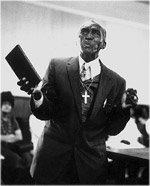
The Reverend James Louis Cole
(1900-1981)
Photograph by James Perry Walker

The Reverend (copy)

The year was 1967, when a young man from Red Banks, Miss., James Perry Walker, decided to make a difference. Right out of college, he began work as a Head Start teacher at Gatewood Baptist Church in Slayden, Miss. Picture a group of awestruck children surrounding him as he read Where the Wild Things Are by Maurice Sendak.

At the time, Gatewood Baptist Church was

a ragged, tumbling wood frame structure with tilted steeple, sinking foundations, and loose planks bowing from the ceiling
or in real estate jargon, a bona fide “fixer upper.” It was here, while attending a fall-morning revival service, Walker met the focus of his six-year photographic quest.

In this unlikely place, less than twenty miles from Walker’s home, existed a preacher unlike any other. He was a man who,
seemed to fill the shoes of Maritain’s ideal philosopher, who shared with Martin Luther his bluntness of speech and love of dogs, with Erasmus his reverence for learning and proverbs and his rigorous suspension of judgment, with Paracelsus his vision of the world as capable, at any moment, of epiphany and revelation.

The Reverend Louis Cole was an old-fashion circuit preacher who spent each weekend ministering to four different churches in Marshall Co., Miss., and Fayette Co., Tenn. Between ministering to his flock of seven or eight families per church, he tilled and sowed the soil of his own homestead. Reverend Cole believed,
A preacher whose livelihood depends on the favor of his congregation faces a constant temptation to temper the Word to suit his worldly benefactors.

From 1976 to 1981, Walker spent many hours in the company of Reverend Cole and his flock, taking photographs of religious ceremonies and the everyday life of his congregation. The collection of his work, which displayed in New York City, is now available in book format.

The Reverend contains 79 black and white photos filling the pages with atmosphere and passion. Children on their way to school, well-worn church buildings, teen boys in their best Sears pose, black choir robes drying in a morning fog, mourners at a funeral, an innocence of a virginal baptism, and the strong images of Reverend Cole preaching are just a few of the scenes in this book.

As an added bonus, the book includes two of Reverend Cole’s sermons and his biography. After reading his sermon, “Strange Fire,” get ready to witness. I had trouble focusing on the book once I felt the fire in my feet and hands.

Wednesday, September 20, 2006

NoveList (copy)


Have you ever finished a book and thought, “Boy that was great! Can I read something else just like it?” Maybe you just finished all the Stephanie Plum mysteries by Janet Evanovich and want another author who writes like her.

I have had patrons describe a book they read years ago, and all they can remember is a character’s name or plot. Their question to me, “Do you know the title or author?” Um, some days I’m lucky if I remember my name much less a title of a book.

This week I gave a brief talk to the faculty at Northwest about a versatile database available to all Mississippians called NoveList. Through the Mississippi Alliance for Gaining New Opportunities through Library Information Access (MAGNOLIA), anyone in the state of Mississippi can access this database through an internet connection.

The database states, “NoveList is a fiction database that provides subject heading access, reviews, annotations, and much more for over 135,000 fiction titles. It also includes other content of interest to fiction readers, such as Author Read-alikes, What We're Reading, Book Discussion Guides, BookTalks, and Annotated Book Lists. For school media specialists and teachers there are Picture Book Extenders and articles on Teaching with Fiction.”

NoveList is wonderful for those teachers struggling to find books on certain reading levels for their students. Not only can you search a book by subject, for example, Civil War, but you will be able to see the lexile, or grade level, of the results. You may even search the database by lexile numbers combined with a title or author.

In order to use NoveList, one will have to call their local library for the website and password. All librarians in the state are trained on this database and will be eager to assist.

In the library world we call this service Reader’s Advisory. Most of us enjoy providing this service because it allows us to introduce readers to new authors. We may also hear of new authors from the patrons.

If you finish a fabulous book and want to talk about it, come see us. We realize this happens, because we face it every time we read something equally fabulous. So, when you approach us, we may smile and nod our heads in shared enthusiasm, but be fair; if you share, please let us share back.