Thursday, April 09, 2009

Reflections of a Mississippi Magnolia


April is National Poetry Month and in celebration I have joined the Celebrate the South Blog Tour. Y'all know I'm all about the South, but did you know I have a secret affinity for poetry? That’s right! I’m poetry in motion. Bah! How can I even say that with a straight face!

Celebrate the South Blog Tour features poet Patricia Neely-Dorsey’s new book Reflections of a Mississippi Magnolia: A Life in Poems. Her's is a good life! The poems are upbeat, bouncy at times, and make me proud to be a Mississippian. They are positive to the core, even the “Right to Vote” which is her parents struggle to check the ballot in Tupelo, Mississippi. It might easily lean to the bitter, but the last stanza of the poem affirms the positive:

It seems almost incredulous
That this was how it was;
But, believe you me, no matter what,
I vote, now, just because.

At times I hear past U.S. Poet Laureate, Billy Collins, in her voice. It is amongst her shorter poems, he stands out such as “Turning 40.”

When I turn 40,
I felt so brand new;
I bought a bikini,
And got a tattoo;
For some unknown reason,
I felt more alive;
I can’t imagine what’ll happen,
When I turn 45.

In the section title “Getting Personal” Patricia wrote a poem based on the many different takes on her name. For example, it begins:

Patty, Patty Cake, Patsy,
Tisha, Trisha, Trish;
I've got more names that I am called,
I can't even begin to list.

In this poem titled, “Name Calling,” I want to add two more deserved monikers. She should be called Magnolia after the title of her book; although, I shorten it gladly to Maggie.

Y'all may visit Pat at her blog or purchase her book through Amazon. For more information on her book, Reflections of a Mississippi Magnolia, visit other blogs on the tour.

BLOG TOUR

April 5 - Preaching Sunday

April 6 - Southern Life

April 7 - Mississippi Morning

April 8 - Southern Man

April 9 - Soul Food Restaurant
April 10 - Shelling Peas

April 11 - Reflections of a Mississippi Magnolia

Wednesday, April 08, 2009

Eudora Welty: Some Notes on River Country (copy)

Eudora Welty was born April 13, 1909, in Jackson. To help celebrate her centennial, I am reading her works all during the year. This week I picked up Eudora Welty: Some Notes on River Country.

The book is a reprint of her 1944 essay that first appeared in Harper's Bazaar. This rambling essay starts with the history of River Country—land south of Vicksburg to and including Natchez and the Natchez Trace—then ends with the flora covered landscape of the area. After the essay, readers thumb through a set of 32 photos, most snapped by Welty. These include the ruins of Windsor, the mighty Mississippi River, the ghost town of Rodney, cemeteries, and other River Country landscapes.

The afterword by Hunter Cole gives insight into Welty’s writing through these notes. For example, Cole takes a quote from Welty as told to Dr. Peggy Prenshaw in Conversations with Eudora Welty. Welty said, “Why, just to write about what might happen along some little road like the Natchez Trace—which reaches so far into the past and has been the trail for so many kinds of people—is enough to keep you busy for life.”

Welty kept busy alright. According to Cole, she set her book The Robber Bridegroom and six short stories: A Worn Path, Asphodel, First Love, A Still Moment, Livvie, and At the Landing, in River Country.

Cole continues, “It is known that she read Audubon’s diaries, J.F.H Claiborne’s Mississippi narratives, and Robert M. Coates’s The Outlaw Years: The Land Pirates of the Natchez Trace and wished to verify the history these told.”

It was apparent while reading Welty’s essay that I lack basic Mississippi history. She nonchalantly wrote, “Deep under them both is solid blue clay, embalming the fossil horse and fossil ox and the great mastodon, the same preserving blue clay that was dug up to wrap the head of the Big Harp in bandit days, no less a monstrous thing when carried in for reward.”

What! Yuck! Is this really true and why haven’t I heard of said Harp, Big or Little?

Now I want to know more about the Harps, Mike Fink, Lorenzo Dow, John Murrell, John Law, Aaron Burr, Harmon Blennerhassett, and John James Audubon’s search for the ivory-billed woodpecker in Mississippi thanks to this essay. Maybe I should get busy and add the books Eudora read to my reading list this year, too.

Wednesday, April 01, 2009

Going Down South (copy)

Olivia Jean liked New York City. She didn’t wanna have to live in a backwater place like Cold Water Springs, Alabama. What would she do with her time? How would she meet kids her age while living far away from town? If it wasn’t for the baby she carried, maybe the prospects of going down south might interests her.

Things had definitely changed in the Stone household. Daisy, her mother, had taken to smoking twice as many Pall Malls than usually, and her father Turk would not speak to her. When entering the kitchen for supper he avoided her eyes. Their once close bond was completely severed as her normal teasing was now met with a scowl.

If it wasn’t for her pregnancy, she might have gone farther in school. Her straight A’s were impressive on a report card. How come she was so stupid when it came to boys? She should have known kissing in the school closet would lead to something, but Preston Douglass was so dreamy. He was like a triple-dark color, almost blue, and his penny loafers carried shiny new pennies instead of old ugly ones.

It didn’t take long for Preston to move on once he got what he got. He avoided Olivia Jean in school, and when they did meet it was Dora he spoke with so friendly like. That was okay. Dora liked him and Olivia Jean had lost his shine. Especially, after she told him she was going to have the baby, but he needn’t apply for a marriage certificate.

Now, she sat in the back of Sally, Turk’s new Chrysler, with her head on the cool glass as they made their way south. It was a cool morning and she was stunned as Daisy leaned back and handed her a small gold ring.

“Here, put this on your ring finger Hon. It will keeps those nosy-bees quiet for a little while. Just long enough for you to have that baby and us get back to normal.” Daisy turned back around, but Olivia Jean knew it would take a lot more than a ring to be normal again.

Set in the 1960s, Going Down South by Bonnie J. Glover focuses on three generations of women as they navigate through debilitating secrets. The book is broken into four distinct parts; Olivia Jean, Daisy, Birdie, and Of One Accord. Readers will marvel at the characters as the story unfolds.

Visit with author Bonnie J. Glover at her active blog.

Friday, March 27, 2009

Happy Spring Everyone!


Wednesday, March 25, 2009

Jellicoe Road (copy)

I remember the first birthday party attended as a child. It was my friend Ellen’s party held outside Castalian Springs, Tenn., in an old Victorian complete with picket fence. The tall ceilings and huge rooms were so different from our cookie cutter ranch houses in town; consequently, it was like entering a magic kingdom.

Once inside, we stood grouped in the large dogtrot hall waiting for the party to begin. Ellen’s mother gave a nice welcome, took our presents to the kitchen and returned to instruct us on a little game. Each child was to look for his/her name on a piece of paper with yarn attached. Once located, we were to roll the yarn around the paper as we worked our way through the maze creating a ball of yarn in the process.

She turned her back and pushed open the enormous pocket doors. In awe we stood as we faced a web of multi-colored yarn from floor to ceiling. She then hollered, “Go!”

Once finding my name, I weaved in and out of the other children, between spindles on a rocking chair, around a couch leg, up through a book on the library shelf, across to a ceiling fan blade, and finally to a little present for me!

It was during the reading of Jellicoe Road by Melina Marchetta that I thought of this day. Somewhere in chapter six, I began to realize the many different characters and separate storylines were tangled much like the web in my friend Ellen’s house.

Main character Taylor Markam attends the Jellicoe boarding school, outside of Sydney, Australia, ever since her mother dumped her at a 7-Eleven on Jellicoe Road nearby. She has spent the last 11 years learning the layout of the school, its dormitories, the woods, and the significance of the prayer tree. It is because of her extensive knowledge and the fact holidays are spent on school property that the year 12 students have elected her president.

This unofficial title is known only amongst the student body. The faculty remains blissfully in the dark. Along with official duties as house leader, Taylor must memorize the purple Rule Book of Engagement. With this book she will lead the Jellicoe students through war with two factions: the town kids called Townies and the encroaching campers named Cadets. Within the sacred purple book are the boundaries and possibly the answer to her missing mother’s whereabouts.

Wind the yarn of this mystery and be rewarded with a perfect present from this year’s Printz Award winner, Jellicoe Road.

Friday, March 20, 2009

The Making of Common Craft!

I watch Common Craft videos to help me explain all this web 2.0 stuff. On my feed, I let this one sit because I thought it fun to actually watch them make a video. Enjoy!

Wednesday, March 11, 2009

American Masters of the MS Gulf Coast (copy)


The librarian called and I put on my running shoes! She was holding a new book for me and I could not wait to flip through the pages. Yes, I work at a library but this particular book was still on order. My book lust was too strong to let the copy sit one more minute on the public library’s shelf.

I am speaking of American Masters of the Mississippi Gulf Coast: George Ohr, Dusti Bongé, Walter Anderson, Richmond Barthé by Patti Carr Black. In book form, it is the catalog for the current exhibit traveling the state of Mississippi until 2010. The closest venue for the exhibit is Oxford at University of Mississippi Museum during the month of August 2009. Can you say road trip!

The Mississippi Gulf Coast is a magical, mystical place that feeds its artists’ passions. From a mad potter to an exclusive purveyor of African souls, Mississippians, whether art enthusiasts or not, will delight in the examples provided in this book. It is our coast’s natural beauty which flames the fires of imagination in our state’s inhabitants.

“’The Coast’ is abundantly gifted in arts and culture, has produced world-class visual artists, and boasts of a unique agua- and agri- culture that melds the rural simplicities of Mississippi lore with the rich eccentricities of New Orleans,” states the Director of Mississippi Arts Commission, Malcolm White, in the introduction.

The format of the book includes a brief history of the area by Patti Carr Black and then breaks into four parts for each artist. The four parts are separated further by a biography of the artist, the artist’s approach to his art and a brief sampling of works in the exhibit. Unfortunately, Richmond Barthé’s sampling of work is too brief. The artist has only four sculptures depicted on full pages where the others have over ten.

Flip through these pages and reacquaint yourself with fellow Mississippians: George Ohr, the mad potter of Biloxi who may have the honor of being the first American performance artist, Dusti Bongé, a woman of privilege who singlehandedly brought modernism to Mississippi, Walter Anderson, a recluse who rode his bike 200 miles for art supplies, and Richmond Barthé with his rags to riches then back to rags story who may be the first African-American to receive $100,000 for a single piece of art.

American Masters is well worth the run to the library, but I wish it included more art.

Wednesday, March 04, 2009

The Art of Racing in the Rain (copy)

My name is Enzo and my master’s name is Denny. He named me after the famous race car driver Enzo "the Commendatore" Ferrari. Have you heard of the Italian sports car Ferrari? Well, he is one in the same, and one day my master will have a car named after him.

Denny is a great race car driver. He has a unique skill that makes him a desirable team member. He can race in the rain. Wet conditions on the track do not scare him; actually, he perfected a maneuver which allows him to accelerate through the turns. Denny is a natural at finding the curve’s apex and shooting for the exit.

For the first year of my life it was Denny and I alone. Life was quieter with daily walks in the park and plenty of fetch then we stumbled upon Eve. Her hairlessness didn’t appeal to me, but they soon married and Zoe entered our family a year later.

Life was good. I spent my time watching over the fascinating Zoe. She filled my nose with all kinds of baby scents; plus, it was rather fun watching someone else teethe for a while. I kept company with Eve while she cooked in the kitchen and every so often she gave me little tastes; although, I never begged—that was for lower class dogs. And Denny didn’t treat me differently now that there were more people vying for his attention. He was a true gentleman master.

Unfortunately, there was down time when I was left alone for long periods such as when they had to work. I would amble from room to room looking for entertainment but none was to be found. I was literally bored to death then Denny noticed me watching television. Oh, I thank the day he decided to leave it on while he went to work. My vocabulary really blossomed during these periods. Too bad my tongue wasn’t designed for speech.

If I could talk, I would be able to warn Eve. I would explain my heightened sense of smell and the unmistakable scent of death coming from her ears and nose. I would tell Denny something bad was eating her brain. I would scream, “See an oncologist!” Man, if I had thumbs, I would drive her to the hospital myself. Why was I only a dog?

These are my words as Enzo the narrator of Garth Stein’s new book titled “The Art of Racing in the Rain.” I highly recommend this read. I was awake into the wee hours crying while reading the last two chapters. Not yet spring and I may have read the best book of the year; although, I did have one slight problem. Enzo’s vocabulary will rival that of a scholar. Scary to think my dog may be smarter than me.

Sunday, March 01, 2009

Library Loot ~ Overdue!

I rushed to the library after the librarian called to tell me my hold was available! Yes, I'm a sucker for art and am having a grand time discovering Mississippi artists!

American Masters of the Mississippi Gulf Coast: George Ohr, Dusti Bonge, Walter Anderson, Richmond Barthe by Patti Carr Black is a catalog for the current exhibit traveling the state of Mississippi until 2010. Just my luck, the closest venue will be Oxford. Why didn't we get this for Northwest?

Check out other Library Loot at A Stripped Armchair.

Wednesday, February 25, 2009

Little Heathens (copy)

Yesterday was an exercise in fun as participants buzzed over our latest read, Little Heathens: Hard Times and High Spirits on an Iowa Farm during the Great Depression by Mildred “Millie” Armstrong Kalish for February’s Reading Round Table.

The majority of the group enjoyed the book, but one was deterred by the language. She read the whole book and the offending words appeared in only one chapter, but it was enough to turn her off. That was until we began to talk about the book.

As one can guess by the title, Little Heathens is a memoir written around Millie’s childhood during the Great Depression. She was five-years-old when the trouble started. Her dad had done some bad things. The whispers included, “bankruptcy, bootlegging, and jail time,” and there was an abrupt divorce.

Does she lament over lost quality time with her daddy? Does Millie write about her troubled youth without male guidance? No! This is pre-Oprah and her story is far from depressing. If his name is mentioned, she says he is dead and moves on; matter of fact, the whole family “moves on” and into the grandparents Urmy’s house.

The Urmys are a somber retired couple. They live in the town of Garrison, but through frugal living have bought and paid for four different farms complete with houses and barns that the offspring live and work on. Unfortunately, during the harshest winter months, Millie along with mother, John, Jack, and Avis, live in Garrison to attend school.

The terms of the Urmy household includes rising from sleep at a designated time every day, coming down to breakfast fully clothed and ready for work, eating what Grandpa decides will be the meal, only eating at meal times where the table will be set before anyone can take a seat, and retiring to bed at the same time.

June through Christmas, the family lives on the farm and life is a little more relaxed. That is, if you can call milking the cows, cleaning the separator, cooking three meals, working in the garden, and doing homework daily a relaxing pastime.

This book was a pure joy to read; although, every chapter was filled with four-letter words that offend me such as dust, chop, cook, wash, and iron. Oh, and yes the W-word was thrown a lot. You know W O R K!

Check out Nan's Book Report for Little Heathens at Letters from a Hill Farm!

Wednesday, February 18, 2009

How to Tell when You're Tired (copy)

In these sad economic times emphasis is being placed on work or more importantly the lack of work in our society. Looking for a history of work, I found Reg Theriault’s How to Tell When You’re Tired: A Brief Examination of Work. It is less of a history and more of Theriault own experiences having entered the work force during the depression as a crate maker for fruit. The book chronicles his life among fruit tramps then eventually becoming a longshoreman.

Theriault has a work ethic I admire and found my head nodding in agreement to most of his statements such as, “Poverty and hard work are twin plagues; education is the vaccination against them,” or “I work with an acceptance that it is easier to do the job than to fight it.”

Growing up my Dad had a mantra, “If you want a job done right, you have to do it yourself.” As one can guess, I probably made a lot of mistakes but I was always eager to please. My father also had an aversion to child labor laws; thus, I worked. From the time I was tall enough to stand behind a lawnmower, I earned my own income. The funny thing, I liked work and although I grumbled stacking wood or vacuuming offices I found it satisfying.

Now, I have one of those cushy white-collar jobs where cushy describes my physique. Theriault might have a problem with me. He writes of many disputes between blue-collar and white-collar workers where he favors the laborers, but oddly disagrees with unions. He cites many examples but my favorite has to be the worker’s study.

College students decided to study a group of workers and separated them into two groups. Production was monitored as the different groups were subjected to a variety of music and variations in lighting. One group was given a 5-minute break every hour and the other a 15 minute break after three hours. This study continued for three years and during that time production remained within normal parameters. After a year into the study, one student stayed late to gather his numbers when he noticed the factory empty. He could hear voices and followed the noise down the corridor to a back break room. Upon opening the door he saw all the workers either playing cards, knitting or socializing.

The college students were left in charge of the factory and they clocked out at 3:15 p.m. leaving the factory unmonitored. At 3:30 the workers relaxed until the five o’clock shift ended. One could argue the blue-collar workers out smarted the thought-to-be smarter college students.

Written in 1995, this book offers wisdom for many who still do back-breaking work and for those who manage them.

Sunday, February 15, 2009

Thank Yew, Thank Yew All!

Thank Yew California Girl at a Women of a Certain Age! It was nice to be thought of on Valentine's Day!

These blogs are exceedingly charming. These kind bloggers aim to find and be friends. They are not interested in self-aggrandizement. Our hope is that when the ribbon of these prizes are cut, even more friendships are propagated. Please give attention to these writers. Deliver this award to eight more and include this cleverly written text in the body of your awards.

Thank Yew Violette at The Mystery Bookshelf! I'm happy all the time so I just had to think of things that stood out!

The rules are to link to the person who has tagged you. Then write down six things that make you happy. Post the rules, tag six others and let them know you did it. Then tell the person when your entry is complete. Here are my answers: 1.) Hubby 2.) Cows 3.) Walking 4.) Interacting w/ Patrons 5.) Reading 6.) Coffee!

Thank Yew Mo at Inside Mo's Mind. I'm in a writing funk where articles are rather dull and drinking a little lemonade sounds good!

To play there are two requirements: 1.) You should link back to the person who is giving you the award, done, and 2.) You must pass the award along to ten deserving bloggers. Here is where I stumble. Everyone deserves an award! If it will make you happy steal it from me! :D


I'll add more later...

Wednesday, February 11, 2009

Reluctant Readers (copy)

This week I am reading the plays of Tennessee Williams as part of a group of educators who travel to Jackson, MS once a month to discuss Mississippi authors. The program is titled “four Ws” which relates to the authors we are studying: Richard Wright, Eudora Welty, Tennessee Williams, and Margaret Walker Alexander. Sponsored by the Mississippi Humanities Council, we sit for eight hours listening and discussing works with the respective author’s scholars.

As one can guess, this is heaven for me. I have an affinity for Southern literature (as do most Southerners) and relish the chance to learn more through intellectual bantering. Who knew Eudora Welty had an erotic side?!? Next time I read Moon Lake I will be sure to blush. Do today’s kids realize the right to check out library books would be denied if they were a certain color?!? Richard Wright knew all too well.

The play I am reading currently, Cat on a Hot Tin Roof, is so well known I hesitate mentioning it; instead, I wish to discuss luring reluctant readers through the use of plays.

Reluctant readers are reluctant for a reason. The major reason being they lack confidence in the classroom. They are afraid of getting the wrong answer, being forced to vocalize weak skills while reading aloud, or lack basic comprehension skills. By introducing plays in the classroom, teachers give the reluctant reader a relaxed activity in which to make mistakes.

Wrong answers become less worrisome because the teacher asks the questions while the group reads together. The students will blurt out answers and the reluctant reader will find his answers being vocalized by others. Teachers may find him joining in for the first time.

Reading aloud becomes less stressful because all students make mistakes. It is the stumbling through pronunciation we all do when we are unfamiliar with a word that makes a reluctant reader cringe. Another trick for readers who do not recognize a word, is to place another word there that has the same meaning or contains the same prefix. This assuming can lead to rather funny sentences. It is a bright day when the reluctant reader realizes better readers than him do the same vocal dance.

Have any hams in class? By acting out the scenes, students connect the story with the words. Comprehension happens naturally. The small act of assigning the boys girl parts and vice-versa will have the whole class paying attention. Add a little emotion, and one may find memories being made.

Teachers, demonstrate you’re a class act by introducing plays, and win those reluctant readers over.

Thursday, February 05, 2009

Outstanding Books for the College Bound

Three years pass in a blink of an eye when one is having fun. It was three years ago that I accepted an appointment to serve on the Outstanding Books for the College Bound and Lifelong Learners committee. A 15 member committee assigned the daunting task of finding engaging books for students wanting to attend college or those wanting to keep abreast of readings in a particular field of study.

Within our group the fields of study were divided into five with three members assigned to a particular area. I served on the Science and Technology. The other areas include Social Sciences, History and Cultures, Arts and Humanities, and Literature and Language Arts.

As a member of this committee, we promised to attend all meetings with the possibility of one missed session. Meetings were scheduled twice during annual and midwinter conferences of the American Library Association on Saturday and Sunday afternoons. In the early stages we canceled the Sunday meetings for lack of work.

This is the story of how we rolled. At the first meeting, we did introductions and divided into groups. At the second meeting, we read the previous mission statement for the Science and Technology sub-committee and developed our own. At the third meeting, we discussed all the past books on the S&T list and decided on those that needed to be reconsidered. At the fourth meeting, we began the process of nominating books and reading nominees. At the fifth meeting we talked about the books nominated and possible books in the same category that might be better. During our sixth and last meeting, we decided on the books for the list and wrote annotations for those books.

I heard other groups did a little less looking back at the old lists and began nominating books and reading new stuff from the point after writing the individual mission statements at the second meeting. I see how this would be essential for those whose lists of books were enormous like Literature and Language Arts and History and Cultures.

I found it amazing how we all seemed to be done at the same time that last Sunday afternoon meeting. Our group wrote the annotations over night at our separate hotels then edited them at that last meeting. We were packing up to leave when our fierce leader, Sarajo Wentling, suggested we all read our different lists to expose dupes.

As a nicety to my readers here is the Science and Technology list.

1.) God’s Debris: A Thought Experiment by Scott Adams
2.) Feed by M.T. Anderson
3.) Super Crunchers: Why Thinking-By-Numbers is the New Way to Be Smart by Ian Ayres
4.) Damned Lies and Statistics: Untangling Numbers from the Media, Politicians, and Activists by Joel Best
5.) A Short History of Nearly Everything by Bill Bryson
6.) The Devil’s Teeth: A True Story of Obsession and Survival among America’s Great White Sharks by Susan Casey
7.) The Taste of Sweet: Our Complicated Love Affair with Our Favorite Treats by Joanne Chen
8.) Little Brother by Cory Doctorow
9.) Another Day in the Frontal Lobe: A Brain Surgeon Exposes Life on the Inside by Katrina Firlik
10.) Weather Makers: How Man Is Changing the Climate and What It Means for Life on Earth by Tim Flannery
11.) The Big Necessity: The Unmentionable World of Human Waste and Why it Matters by Rose George
12.) The Race to Save the Lord God Bird by Phillip M. Hoose
13.) Out of Orbit: The Incredible True Story of Three Astronauts Who Were Hundreds of Miles Above Earth When They Lost Their Ride Home by Chris Jones
14.) A Sand County Almanac by Aldo Leopold
15.) Mosque by David Macaulay
16.) Way We Work: Getting to Know the Amazing Human Body by David Macaulay
17.) American Earth: Environmental Writing since Thoreau edited by Bill McKibben
18.) Greasy Rider: Two Dudes, One Fry-Oil-Powered Car, and a Cross-Country Search for a Greener Future by Greg Melville
19.) The Botany of Desire: a Plant’s Eye View of the World by Michael Pollan
20.) The Wild Trees: A Story of Passion and Daring by Richard Preston
21.) Stiff: The Curious Lives of Human Cadavers by Mary Roach
22.) Hidden Face of God: How Science Reveals the Ultimate Truth by Gerald Schroeder
23.) The Radioactive Boy Scout: The True Story of a Boy and His Backyard Nuclear Reactor by Ken Silverstein
24.) The Genomics Age: How DNA Technology is Transforming the Way We Live and Who We Are by Gina Smith
25.) Lost Discoveries: The Ancient Roots of Modern Science--From the Babylonians to the Maya by Dick Teresi

Wednesday, February 04, 2009

Same Kind of Different as Me (copy)

Denver Moore had many experiences in his life. He worked in the cotton fields as a child. His payment being a token he could spend only at “da man’s” store. He watched his grandparents’ shack burn to the ground with his beloved Big Mama inside after attempts to wake her failed. He was pulled behind a galloping horse with a noose around his neck until the skin peeled off, “like a rabbit ready for the skillet.” Amazingly, in his 44 years of life, Miss Debbie was his first real conversation with a white woman.

Ron Hall grew up a sharecropper’s son in the mean sun of Texas. He worked the cotton fields, studied, went to college, and met the girl of his dreams, Deborah—then the draft letter arrived in the mail.

After returning from Vietnam, Ron took a salesman job with Campbell’s Soup. Arranging cans and dusting off green-pea soup tops at area grocery stores, he soon became bored. He quit and moved into the banking business. To earn extra money, for his new wife Debbie, he began to sell art work. He quit the bank the day he sold a Charles Russell for a commission larger than his salary.

As Ron’s material wealth bloomed, Denver sank deeper into poverty. Ron opened a gallery and Denver slept two blocks away in an alley. The two were destined to meet as Denver committed a smash and grab on Ron’s gallery.

Same Kind of Different as Me: a Modern-day Slave, an International Art Dealer, and the Unlikely Woman who Bound them Together by Ron Hall and Denver Moore is the perfect read for Black History Month and Valentine’s Day. Denver felt he was different as his loved ones died or moved away and his opportunities dwindled. Even amongst the homeless, he could not shake his feeling of being apart. Ron felt he was different, too.

It was an earth shattering day when the two realized everyone is different. We all bump around thinking we are, but this true story points out there is common ground. It was Debbie who made the connection in this book. She was the one who held a budding friendship together even after she died, as Ron leaned heavily on the unschooled Denver’s poignant words and belief in God.

Be inspired by this story of commonality through God’s love.

Friday, January 30, 2009

This is so KEWL!


Order ASAP!
Have the kewlest kids on the block!
Send them to school with these traditional one-sided Valentines
by modern-day children's book illustrators!
Read these clockwise from left to right: Mo Willems' "Flowers for you...Yay!", Rosemary Wells, Ian Falconer's "Be Mine or Else!", Kevin Henkes, LeUyen Pham, Brian Selznick, and Marla Frazee's "Hope Your Valentine's Day is Full of Pepperoni!"
All funds "will help us provide programs that focus on early childhood education, literacy, physical activity and nutrition for children in need who live in remote, rural regions of the U.S."
Thanks, Mo Willems, for the lead!

Friday, January 23, 2009

Denverific!


Hello All!


Reporting live from the flaky snow regions of the Denver Convention Center. More to come...

Wednesday, January 21, 2009

When Crickets Cry (copy)

It was a sunny day and she was a sunny little girl. Not any older than six, possibly seven, but she had a slender frame and looked like a four-year-old. In her yellow dress, yellow socks, and white Mary Janes, she looked like the walking sun which spit out flames at intervals. One could hear her two blocks away as she hawked her wares, “Lemonaaaade! Lemonaaaade, fifty cents!”

I watched her before approaching. I wanted to see how Miss Sunshine handled herself amongst customers. The first was a neighborly lady using a lace umbrella to hide from the bright day. She took her time drinking the sweet concoction then placed her 50 cents in the Styrofoam cup sitting precariously on the stand. With a point towards the aunt working in the convenience store, she slipped a twenty into the cup before the girl could turn back around.

As another man tried to glide by on the sidewalk unnoticed, the little girl craned her head around the older woman and yelled, “Lemonaaaade! Lemonaaaade, fifty cents!” He stopped in his tracks and said, “Not now, Annie. I’m in a little bit of a hurry. I’ll come back in an hour.” He took four paces past the stand then turned around and jogged back slowing down to drop some coins in the cup, and then he was off.

I figured it was my turn to meet little Annie as the older woman hobbled down the road. She saw me crossing the street, and before I could reach her the unmistakable Southern twang, “Lemonaaaade! Lemonaaaade, fifty cents!” filled the air. Good thing I faced her head-on. A sideways approach might have set my ear throbbing.

She was a pleasant little thing by the name of Annie. As she plied me with drink, she asked question after question. How old are you? How tall are you? What size shoes do you wear? I could tell she had many repeat customers by her easy manner. It was as she stood up to show me her height that I noticed the fresh scar on her chest. Then she says, “If I get a new heart, my doctor says I might grow some more.” I too gave her the initial 50 cents, but left 20 dollars and 50 cents lighter.

I turned around to wave at her when I reached the other side of the street. She didn’t notice. As I walked away a rogue wind graced her stand and sent the Styrofoam cup soaring. Paper money swirled loose in the street. The backfire from a bread truck coming around the corner was too close for comfort when I realized what was happening.

You will love Christian author, Charles Martin’s, very first book, When Crickets Cry.

Note: These are my words written as the character Mr. Reese.

Monday, January 19, 2009

Happy Martin Luther King, Jr. Day!

Sunday, January 18, 2009

I Love John Green!

Friday, January 16, 2009

Andrew Wyeth (1917 - 2009)

Christina's World
(1948)

"I prefer winter and fall, when you feel the bone structure of the landscape - the loneliness of it, the dead feeling of winter.
Something waits beneath it, the whole story doesn't show."
~Andrew Wyeth

Wednesday, January 14, 2009

Looking for Alaska (copy)

I have a new favorite author, John Green. I haven’t even finished the book and am in love with him. The book is Looking for Alaska and in 2006 it won the edgy Printz Award.

Oh, you have not heard of this award? Do not worry. It is new. As part of the American Library Association’s plethora of awards the website states, “The Michael L. Printz Award is an award for a book that exemplifies literary excellence in young adult literature. It is named for a Topeka, Kansas school librarian who was a long-time active member of the Young Adult Library Services Association.”

Most Printz award books are written in a style called realistic fiction. This genre of fiction exposes readers to adult situations such as drinking, drugs, and sex allowing them to live vicariously through the main young-adult characters. Not as a cautionary tale per se, for these characters can make really bad decisions and get away with them, but as a rich telling of today’s society mirrored in books.

In Looking for Alaska, Miles Halter, quickly nicknamed Pudge by his new roommate because he is so skinny, is attending the Culver Creek Preparatory School in Fair Hope, Alabama. This is his first year and roommate, Chip “Colonel” Martin, is filling him in on the goings and comings of his new school. Pudge learns quickly the kids are broken into two groups: the Weekday Warriors who have money and spend their weekends at home and “the wrong crowd.” As a middle class student who will be spending all his semesters on campus, he correctly deducts he will be a member of the wrong crowd.

Entering “The Creek” is all Pudge’s idea. His father and his father’s father and his grandfather’s father all attended, but that isn’t his reason. He is going to this school—miles away from his Florida home—in order to seek the “Great Perhaps.”

See, Pudge has a quirky talent. He memorizes the dying words of famous people. His favorite, Francois Rabelais, gasped, “I go to seek a Great Perhaps.” He figures he will seek while alive.

Looking for Alaska is broken into two parts: before and after. In the before section the chapters are titled in countdown fashion like “one hundred one days before.” I hate to be vague, but there is a huge possibility I will give away the ending if not. I will tell you that Alaska is a knock-out female character who causes the before and after.

Another point of view from Tricia at Library Queue.

Sunday, January 11, 2009

Library Loot: Due Date 1/13/09


As you can imagine, I use the libraries in my life often. When I found Eva over at A Striped Chair was hosting Library Loot days, I smacked my head! Why didn't I think of that!

Two of the books belong to NWCC and two belong to First Regional Library. All are collections of Eudora Welty's photographs. Miss Welty worked as a copy writer for the Works Progress Administration (WPA) during the depression. When out scouting for stories she took a little free time to take pictures of her home state of Mississippi. These photos which she referred to as snapshots were taken on a Kodak model "one step more advance than the Brownie." A company in Jackson developed the pics and Miss Welty enlarged the prints at her home. All paid out of her pocket, the WPA did not hire her as a photographer as some books and internet sources falsely report.

Left to Right: Photographs, One Time, One Place, Welty (catalog), Country Churchyards.

Wednesday, January 07, 2009

Eudora Welty (copy)

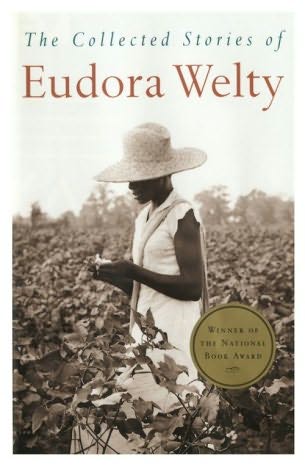
As readers blow out Richard Wright’s centennial candles, another cake awaits decorating. Eudora Welty lovers are planning celebrations statewide since she was born April 13, 1909 in Jackson, Mississippi. Of course, Welty’s home for 76 years will be the centerpiece for activities with staff offering free tours on her birthday.

If one cannot attend the festivities in Jackson, the “Mississippi Reads” program encourages citizens to read her Collected Stories. As the title infers, the book is a collection of Welty’s short stories and essays which provide an easy avenue for studying her works by digesting a little at a time.

Since Thanksgiving, I have read numerous titles in the collection. My favorite is A Worn Path. First published in The Atlantic Monthly in 1941, it received second place honors during the O. Henry Awards that year. I deem it first place.

A Worn Path describes an elderly woman’s journey to town in order to obtain medicine for her grandson. It is early morning and the frost covers the earth as she begins her walk somewhere on the Natchez Trail into Natchez.

Her name is Phoenix Jackson, and she is ill prepared for the journey. Although the sun shines bright, it is bitterly cold, and for warmth she wears a long dress, a red rag on her head, a thin sack apron, and unlaced shoes. Her cane, made from a tatter umbrella, rights her slender body as best it can, but still she stumbles on the uneven path.

Along the way she encounters hurdles. A ghost in the field becomes a scarecrow as her eyes and mind slowly focus. A black dog comes at her, and she backs it off with her cane only to tumble into a ravine from which she cannot get out. A hunter extracts her from the gully and tries to talk her into returning home.

Phoenix is a metaphor for life as she encounters obstacles on her journey but must press on. This rich story took shape after Welty, looking outside her train window, saw a black woman crossing an open field. Why was she crossing the field? Where was she going? It is amazing when one realizes a character as diverse as Phoenix was developed solely from a passing glance.

Consider this the year you take up the Eudora Welty banner. Read her stories, read her books, and grab another Mississippian for discussion.

Errata: This article takes on a whole new spin now that I have an interview with Miss Welty indicating she was out with artist friends when she saw the woman cross on the horizon. I am so sorry. I thought I read somewhere that it was while she was on a train!

Thursday, January 01, 2009

Walking in Dewey's Steps

As most of you know Dewey passed away at the end of November. In honor of her memory, I joined the Dewey's Books Reading Challenge. There are two separate blogs: one for news and one for reviews. The deal is to read and review books that Dewey did in her bloggie lifetime. I'll be reading as many YA books from my local library, and donating ones they do not own. Dewey will live on in these books for others.

Tuesday, December 30, 2008

I See Myself on the Porch!


Here's an idea for promoting Mississippi Writers in Residence!

Picture Faulkner's spread in Oxford:
a writer in the attic, horse barn, cook house, parlor, back pasture, etc.

I see myself assigned the porch
where I can do double duty as booktalker and greeter!

Wednesday, December 24, 2008

Have a Warm Southern Christmas!

From the Moran's Home to Yours!

Sunday, December 21, 2008

I Found this Funny!

Saturday, December 20, 2008

Christmas Movie Extravaganza

Yes, I love me some It's a Wonderful Life, but my favorite Christmas movie of all times is A Christmas Carol with Alastair Sims as Scrooge. Shelf Life had this lovely You Tube and I just had to borrow it for the Extravaganza from My Friend Amy.

Why does this 1951 movie appeal to me more than say the one with modern actors such as George C. Scott or Albert Finney? One thing, the dialog remains true to Charles Dickens' written work. Slang starts to creep into the later films to feed new audiences Dickens' meanings. I like the fact that the movie is in black and white - an old story needs an old look. There are more shadows in the bNw that places a viewer on instant alert. Too much lighting for the cameras takes away from the ghosts. They become comical in nature. Although, Bill Murray's Scrooged spooked me a little. I also like the fact that Mr. Sim's acting ability is above par. One can tell he was an accomplished stage actor before accepting this role. This is a long clip, but look at him jumping into bed and throwing the curtains to hide from the experience he just had. Priceless!

Trivia note: Shelf Life reported that yesterday was the anniversary of Dickens' writing of A Christmas Carol in 1843.

Friday, December 19, 2008

Random Acts Meme


I had fun going over this list with hubby. Together we had more than half BOLD experiences! Thank you, Matthew, at A Guy’s Moleskine Notebook. There are a lot of international chances I look forward to doing sometime later in life. The things I have done are in bold.

1. Started my own blog (Dec 2005)
2. Slept under the stars (More than 20X)
3. Played in a band (I have sung backup)
4. Visited Hawaii
5. Watched a meteor shower (My favorite is the Leonid)
6. Given more than I can afford to charity (Hubby says – Oh Yeah!)
7. Been to Disneyland/world (Summer 2008)
8. Climbed a mountain (Again…)
9. Held a praying mantis
10. Sung a solo (A hymn in Como Methodist)
11. Bungee jumped (Florida 1992)
12. Visited Paris
13. Watched lightening at sea (Cruise/Also saw water spouts)
14. Taught myself an art from scratch (cross stitching)
15. Adopted a child (Oops! Crystal calls me her white Momma!)
16. Had food poisoning (Bad chicken from Wendy’s Winter 2006)
17. Walked to the top of the Statue of Liberty (Mulled around the bottom)
18. Grown my own vegetables (Tomatoes are so easy!)
19. Seen the Mona Lisa in France
20. Slept on an overnight train
21. Had a pillow fight (Again…)
22. Hitchhiked (I’ve taken rides w/ people I know)
23. Taken a sick day when you’re not ill
24. Built a snow fort
25. Held a lamb (Nashville Petting Zoo)
26. Gone skinny dipping (Florida – Bahamas- Saint Thomas – Mediterranean)
27. Run a Marathon (I’ve done two half-marathons and one 15-miler)
28. Ridden in a gondola in Venice (We did the cheaper vaporetto over to the fish market)
29. Seen a total eclipse
30. Watched a sunrise or sunset
31. Hit a home run
32. Been on a cruise (Gulf of Mexico 1996)
33. Seen Niagara Falls in person
34. Visited the birthplace of my ancestors (Been to Ireland but not Scotland)
35. Seen an Amish community
36. Taught myself a new language (Pig Latin)
37. Had enough money to be truly satisfied
38. Seen the Leaning Tower of Pisa in person (Summer 2004)
39. Gone rock climbing
40. Seen Michelangelo’s David (Summer 2004)
41. Sung karaoke (Like a Virgin…)
42. Seen Old Faithful geyser erupt
43. Bought a stranger a meal at a restaurant (I also tip Taco Bell employees)
44. Visited Africa
45. Walked on a beach by moonlight (Saw my first shooting star in St. Thomas)
46. Been transported in an ambulance
47. Had my portrait painted (I was asked to pose nude, but felt too uncomfortable. I did have a friend who rendered me in pencil for an art class which when turned upside-down looked like his wife.)
48. Gone deep sea fishing (Alaskan Flounder)
49. Seen the Sistine Chapel in person
50. Been to the top of the Eiffel Tower in Paris
51. Gone scuba diving or snorkeling (I love snorkeling!)
52. Kissed in the rain
53. Played in the mud
54. Gone to a drive-in theater (Saw American Graffiti!)
55. Been in a movie
56. Visited the Great Wall of China
57. Started a business
58. Taken a martial arts class
59. Visited Russia
60. Served at a soup kitchen
61. Sold Girl Scout Cookies (Bought Girl Scout cookies)
62. Gone whale watching (Beautiful on our Tug Cruise in British Columbia)
63. Got flowers for no reason
64. Donated blood, platelets or plasma
65. Gone sky diving (Not yet…)
66. Visited a Nazi Concentration Camp
67. Bounced a check (When I was in college and I was so embarrassed!)
68. Flown in a helicopter (I prefer planes)
69. Saved a favorite childhood toy (stuffed Teddy)
70. Visited the Lincoln Memorial
71. Eaten Caviar
72. Pieced a quilt
73. Stood in Times Square
74. Toured the Everglades
75. Been fired from a job
76. Seen the Changing of the Guards in London
77. Broken a bone
78. Been on a speeding motorcycle
79. Seen the Grand Canyon in person
80. Published a book
81. Visited the Vatican
82. Bought a brand new car (Winter 2008)
83. Walked in Jerusalem
84. Had my picture in the newspaper (Weekly!)
85. Read the entire Bible (Begot the begotten…)
86. Visited the White House
87. Killed and prepared an animal for eating (fish)
88. Had chickenpox
89. Saved someone’s life (I thought I had to do this to become an adult!)
90. Sat on a jury (drugs)
91. Met someone famous
92. Joined a book club
93. Lost a loved one
94. Had a baby
95. Seen the Alamo in person
96. Swam in the Great Salt Lake
97. Been involved in a law suit
98. Owned a cell phone (No, I don’t own one!)
99. Been stung by a bee
100. Rode an elephant
Total 54!

Wednesday, December 17, 2008

In Praise of Pecans (copy)


“He said we had Valdeemers.” My husband came inside the house to tell me. “The tree stump guy called them Val-Deem-Ers.”

What the man meant to say—or possibly said but was somehow lost in a tobacco juiced translation—was Van Deman, a variety of pecan. Whatever the case, he is right. On the northern border of our property, we have five of these cultivars amongst over 20 pecan trees. A favorite in our household because of the large size and taste, we concentrate our picking efforts biannually on these trees when blessed with a crop.

Pecans have become a staple in our diet since our move to Mississippi. When a recipe calls for nuts we use pecans; although, biscotti can only be made with almonds. Instead of a bag of chips for a snack, we now open a zip-locked bag of pecans. For a sweet low-carbohydrate break, we sauté some pecans in a little butter and drizzle over a tortilla adding splenda and cinnamon for taste. We eat salads with pecans, place pecans in our pancake batter, and top fish or chicken with the crunchy delight. The Moran family runs on pecans.

It is with mouth savoring delight I write about June Jackson’s new book In Praise of Pecans: Recipes & Recollections. Mrs. Jackson was feeling a little homesick for her state of Georgia in 2006. In her Maryland home she hosted a fall luncheon for the ladies, and in each dish she included pecans. One attendee, Colleen Nunn, told her husband Sam and the next day June got a call. The then-Senator Sam Nunn asked her, “Do you think you could write a book that would promote pecan use around the world?”

In Praise of Pecans definitely has an international flavor. The recipes include Thai Chicken, Pecan & Mango Salad, Butternut Squash Risotto, Jalapeno Cranberry Compote, and Pan Sautéed Sole a la Beurre Pecane. Closer to home, she includes Marilyn Monroe Brownies, Lula Mae’s Brown Sugar Pecan Pie, and Grits Good Enough for Mardi Gras.

The best recipe in the book is her mother’s Perfect Pecan Pralines. Her mother was a mere 12-year-old in 1928 when she cut out the recipe from a newspaper. A recipe that had Mrs. Stuckey, second generation to the gas and candy chain, call out, “June, this is the best candy I’ve ever eaten in my entire life! How can I get more?”

Now that I have your mouth watering, it is a good time to resolve to eat more low-in-sodium, high-in-fiber pecans in the coming year.

Tuesday, December 16, 2008

Threshing Pecans


I finished reading In Praise of Pecans by June Jackson tonight, and I wanted to share a piece of art mentioned in the Afterword. Jackson writes, "Known for representing daily life as she saw it firsthand, [Clementine] Hunter painted scenes of picking cotton, washing clothes, getting married and getting buried. Fortunately for us, she painted a charming picture entitled Threshing Pecans (above on tin cover), portraying an earlier, preindustrial method of coaxing the nuts from the trees to the ground--adults would use long poles to shake the pecans while children climbed up into the trees to help in the process."

I love the little girl hanging upside down in the first tree, and I have to question Ms. Hunter's leaf and pecan full trees. Pecan trees are harvested in the fall/winter after the leaves leave. Sorry about the quality of the photo. I was unable to locate the artwork as a lone piece. One may purchase this pecan filled tin from the Cane River Pecan Company of Louisiana.

Monday, December 15, 2008

Robert Sabuda (copy)

My Christmas dreams have been crushed. My beloved better-half ordered the electronic book Kindle too late to be placed under the tree. I will be opening my present 11 to 13 weeks later just in time for my February birthday.

Who knew it was going to sell out? Well, I had a feeling way back in August. Remember that little book talk where I asked Santa to bring me a shiny new Kindle. Everyone I know who owns one loves it. Amazon should have known it would be a big seller. Too bad the man of my dreams paid little attention to my subtle hints such as asking him to proof the article and reading it aloud when we got the newspaper. Sigh.

Are you thinking I am easy to please? One little electronic book and my Christmas dream is met? Giving a book is the equivalent to watching someone tear into a box of socks or underwear. There isn’t much excitement after the initial rip, but within the pages is the real gift.

Would you like to give a book to a young child but are afraid of the underwear factor? There is nothing like the look on a child’s face when they open a pop-up book for the first time. I remember mine well; although, I am at a loss for the author and title. It was a collection of nursery rhymes where the reader turned a wheel to watch the “mice run up the clock” and the “four and twenty blackbirds” flew from a pie.

There is a new star in the pop-up business. Robert Sabuda is a rare artist who has taken an ancient art and improved on the technique. A Pratt Institute graduate, Sabuda entered the book business as a children’s illustrator for other authors. In 1994, he talked his publisher into a small series of pop-ups involving a little white mouse exploring The Mummy’s Tomb and The Knight’s Castle.

Today he is credited with illustrating over 50 children’s books of which 40 are pop-ups. For the holiday season he offers Winter’s Tale, The Night before Christmas, The 12 Days of Christmas, The Christmas Alphabet, A Kwanzaa Celebration, Winter, and Christmas.

Other standout books include The Ark which depicts Moses' outstretched palms awaiting the returning dove with olive branch, The Movable Mother Goose with mini pop-up books within the cover, and Sharks and Other Sea Monsters where Jaws lurks as the cautious young reader turns the page.


Purchase one of these and watch your little ones pop-up with joy.


Note: The first photo is Robert Sabuda holding his Wizard of Oz book. Second photo is from the book America the Beautiful. The third photo is from the book Christmas.

Friday, December 12, 2008

Twisted 12 Days of Christmas


For more information about Janet Evanovich, Plum Spooky and the Stephanie Plum Behind-The-Numbers Series, visit: here and here.

Wednesday, December 10, 2008

Good Masters! Sweet Ladies! (copy)

When I was in sixth grade, we studied medieval times with vigor unlike any other subject. I remember we filled notebooks with drawings of castles, coat of arms, lords, ladies, and knights in armor. We pretended we were ladies in distress while the boys jousted on the playground. We sat mesmerized as our teacher explained the devices of war and torture.

It was a particularly fun time. Margaret Hamilton, my teacher not the Wicked Witch of the West although, it was sometimes questionable, took an extra day to teach us medieval manners disguised as chivalry after the “devices of war” day, but I believe she enjoyed the fun, too.

A librarian first then author, playwright, and professional storyteller, Laura Amy Schlitz, faced a group of excited middle school kids at the Park School in Baltimore. She explains, “They were studying the Middle Ages and were going at it hammer and tongs. I wanted them to have something to perform, but no one wanted a small part. So I decided to write monologues instead of one long play, so that for three minutes at least, every child could be a star.”

The opportunity Schlitz seized is now the 2008, Newbery Medal winner, Good Master! Sweet Ladies! Voices from a Medieval Village. The children’s book illustrated by Robert Byrd contains 19 monologues and two plays for two actors. That is a total of 23 parts. If a teacher has a class of 25, and the bashful students help with costumes and scenery, everyone can take part.

The story revolves around a fictional medieval manor in 1255 England. The characters are the ages of the students performing and have names such as Hugo the lord’s nephew, Taggot the blacksmith’s daughter, Mogg the villein’s daughter, Thomas the doctor’s son, Nelly the sniggler, and Giles the beggar.

The story progresses as one monologue leads into the next. Some are light-hearted with sing-song quality such as Otho the miller’s son recites,

Father is the miller
As his father was of old,
And I shall be the miller,
When my father’s flesh is cold.
Jack the half-wit sings,
Lack-a-wit
Numskull
Mooncalf
Fool.
That’s what they call me.
That’s what they yell in the village when I walk through.
Other stories are brooding and cold such as Will the plowboy who works two fields and must secretly hunt in the night to feed his family a rabbit. His story is told to the audience without verse.

This is the perfect book for those teachers who want to extend the gallantry of medieval times.

Thursday, December 04, 2008

Ah, Twas the Day before Christmas Break!

Today, I read The Night before Christmas by Clement C. Moore
and illustrated by Will Moses to the NWCC daycare kids!
Will is the grandson of Grandma Moses!
The kids were talkative and expressive.
What a joy and I feel like I am on cloud nine!
Thank you Miss Penny for this opportunity!

Wednesday, December 03, 2008

My Eyes are Dewey

It is with heavy heart I write you.

Fellow blogger Dewey at The Hidden Side of a Leaf has died. Leaving us with no hint to her physical troubles, her husband said she was in a lot of pain in the last hours. I am glad she is now in a place where there is no pain.

This is the third blogger on my bloglist who has died.

How do we know the condition of the person on the other end of our internet connection? Blogging is a God send for those who are ill or immobile. We make friends without judging which is how life should be, but we all have prejudices. Did Dewey have cancer? Was she suffering from MS? Was she in a car accident? Her energy blogging put most of us weekly writers to shame. Did blogging add days to her life or shorten them. I like to think it added days as she added thoughts to my reading with her Weekly Geeks program.

I leave you with her namesake: Birth, life, and death -- each took place on the hidden side of a leaf. ~ Toni Morrison

Thanks Cassandra!

Thank yew Style Expert!

I am so honored!

How does this work?

Every new Superior Scribbler will name 5 other Super Scribblers. If you are so honored, link to the author and the name of the blog that gave you the award. Then you display the graphic above and link to this post, which explains the award. Finally you must visit this post and tell your name to Mr. Linky list. Then they will have a record of all the people who are super scribblers!

I hate to do this, you know, point out people that write way better than I, but here it goes! (1) Sage at Musings (2) SFP at Pages Turned (3) Jenclair at A Garden Carried in the Pocket (4) Bookfool at Bookfoolery and Babble (5) Eva at A Striped Airchair.

The Wall (copy)

This week I read an excellent juvenile picture-book. Most teachers and parents of middle grade students can tell you this is not possible. A picture book is for toddlers through eight-year-olds because the format is oversized with illustrations and usually minimum words. They are meant to be read-aloud to an audience or one-on-one such as father and son, and the vocabulary is easy.

Children who grow up with this format remember these books with fond memories. When asked to move to the next level in reading your child may balk. Chapter books can look boring in comparison to a picture book. This is why the “Frog and Toad” series is so popular. Author Arnold Lobel fills his chapter books with illustrations that help the new reader gather clues from the pictures.

What if your child returns over-and-over to picture books even though he can read chapter books? This might be an indication that he is bored with his chapter books, or a little uncomfortable in his reading. It is time to head to the library or bookstore for some more chapter books and juvenile level picture-books.

There is such a thing as a harder picture book. Peter Sis, author and illustrator, has a collection of biographies that demand the reader expand her vocabulary. The Tree of Life: Charles Darwin and Starry Messenger: Galileo Galilei are two I wrote about in 2005.

Sis now challenges young readers with his autobiography The Wall: Growing Up Behind the Iron Curtain. This picture book contains words like Soviets, Czechoslovakia, militia, indoctrination, defecting, nuclear, Vietnam, realism, revolution, etc. all appearing in the margins.

If a teacher or parent wants to read it as a picture book alone, each page contains one sentence about the author. For instance, the story begins, “As long as he could remember, he had loved to draw.” Next page continues, “At first he drew shapes.” Within the margins of the first page are definitions that frame a self—cartoon—portrait of Sis. The words are Iron Curtain, Cold War, and Communism. Not baby definitions either, “Cold War – The geopolitical, ideological, and economic struggle that emerged between capitalism and communism from 1945-1991.”

This inside look into the Cold War is a Caldecott (2008) Honor book and a Robert F. Sibert (2008) Information Medal winner. It is perfect for that reluctant—to move up to the next level—reader. Many will delight as they learn The Beatles became a huge crack in Sis’s The Wall.

Monday, December 01, 2008

Monday Morning Cartoons!