Sunday, March 30, 2008

What Cruel Parenting!

Between the ages of nine and fourteen, I was reading up to three or four books per week. This was mainly because my parents finally broke down and bought a television, and the rule was that I had to read a full book for every half hour that I watched it. The second rule was that I had to mute all the commercials so I would not be brainwashed into wanting products that I didn’t need.

When I started reading nothing but Sweet Valley High and The Baby-sitters Club, my parents decided that sugary teenage books didn’t count and that I had to read a literary “classic” for every half hour of television. My mom created elaborate (and oddly draconian) charts for my brother and me to keep track of all this. All I know is that suddenly I was plowing through Jane Austen and Charlotte Bronte as fast as I could—just so I could watch a measly hour of Saturday morning cartoons.”

~Jerramy Fine
from her memoir
Someday My Prince will Come

Wednesday, March 26, 2008

Garden Spells (copy)

Clair is at home in her garden and kitchen. From the time she rises in the morning until she lays her head in bed, she can be found tending to the Waverley garden and creating delicious recipes from its flowers, fruits, and herbs.

These culinary creations, known all over the county, have flourished into a profitable catering business. Wines, jams, jellies, soups, sauces, and breads producing heady smells in the kitchen and having a heady effect on consumers, are her specialties. This past week she whipped up a batch of Rose Geranium wine for her friend and neighbor Fred Walker. He is having a little love trouble with his partner of 16 years, and the mixture promises to bring back sweet memories.

The town folks rave over her concoctions and use her catering ecstatically, but they keep a distance from Clair personally. See, the Waverley family is a little different. Each member has a special gift such as Clair’s way with food. Her aunt, Evanelle, can predict other people’s needs. Out of the blue, she will walk up to you and hand you a knit hat in summer, but oddly enough it will come in handy before the end of the week. No, they are not witches; they are Waverleys, and long-lost baby sister is coming home.

At 28, Sydney is running away from an abusive boyfriend before he kills her or does damage to her 6-year-old daughter Bay. It has been 10 years since she has seen Bascom, NC, and her sister, Clair. While away she has been under an assumed name and believes they will be safe and untraceable back in her hometown. As you can guess, they are not.

Garden Spells is an enchanting read by new, Southern author Sarah Addison Allen. The book contains a mixture of mysticism, mystery, romance, and relationships. By mysticism, I mean a magical apple tree in the backyard which likes to throw apples at unsuspecting passer-bys.

I decided to give this book a try after going to the Lunch with Books at Senatobia Public Library. Lighty Durley and Jane Billingsley gave an informative program on culinary books which included yummy dessert. Culinary books contain plots with cooking and recipes as either vital character or scenery element to a story. Garden Spells is the latest one on the market; although it does not contain recipes. One will need to visit the author’s website for those.

Sunday, March 23, 2008

Nabokov's Art as Story

Landscape with the Voyage of Jacob
Claude Lorrain (1677)

After Lolita’s mother is hit by a car, HH and Lolita begin a yearlong driving tour of North America. They have been on the road now for months and their views of the countryside are understandably different. HH takes an artsy approach (as in the below paragraph) where Lolita reads road signs to pass the time. She is fascinated by the different bathrooms signage such as Guys/Dolls, Jack/Jill, John/Jane and ignores his pleas to be transformed by the scenery. A mark of their different ages, sure, but also their futures; HH foresees a tempest coming and Lolita is merely biding time until her rescue.

View of Toledo
El Greco c1597-9

“By a paradox of pictorial thought, the average lowland North-American countryside had at first seemed to me something I accepted with a shock of amused recognition because of those painted oilcloths which were imported from America in the old days to be hung above washstands in Central European nurseries, and which fascinated a drowsy child at bedtime with the rustic green view they depicted—opaque curly trees, a barn, cattle, a brook, the dull white of vague orchards in bloom, and perhaps a stone fence or hills of greenish gouache. But gradually the models of those elementary rusticities became stranger and stranger to the eye, the nearer I came to know them. Beyond the tilled plain, beyond the toy roofs, there would be a slow suffusion of inutile loveliness, a low sun in a platinum haze with a warm, peeled-peach tinge pervading the upper edge of a two-dimensional dove-grey cloud fusing with the distant amorous mist. There might be a line of spaced trees silhouetted against the horizon, and hot still noons above a wilderness of clover, and Claude Lorrain clouds inscribed remotely into misty azure with only their cumulus part conspicuous against the neutral swoon of the background. Or again, it might be a stern El Greco horizon, pregnant with inky rain, and a passing glimpse of some mummy-necked farmer, and all around alternating stripe of quicksilverish water and harsh green corn, the whole arrangement opening like a fan, somewhere in Kansas.” (Lolita p150 Peguin edition)

Wednesday, March 19, 2008

Lolita (copy)

He is a pervert, this E. Humbert Humbert from mysterious places in Europe. The deviant lurks in a handsome face capable of playing the leading man. The voice charms unassuming Americans within listening distance of his romantic French phrases. What knowledge can be gleaned from his façade? How can anyone close enough to smell his cologne realize it masks his spoil?

As the narrator, Humbert Humbert realizes his behavior is unacceptable. See, HH likes his mates on the young side, preferring prepubescent females between the ages of nine and fourteen. These beauties, these flickers of light, these exquisite nymphets swarm his mind and control his every action.

The obsession starts as all innocent encounters during youth when one becomes attracted to the opposite sex. Normal preadolescent HH spends a summer at the coast with his aunt. His father, away on business, leaves the youth without a consultant for his growing admiration of friendly neighbor, Annabel. The faunlet, two months HH’s junior, seems to enjoy her new pet, too.

Left to their own devices, the two embark on a summer of discovery. The journey, thwart at every apex, leaves HH fragmented; this sultry summer of ‘23 becomes the foundation of his madness.

Oh, but in the summer of 1947, after being in and out of sanatoriums, Double H meets Lolita. Fresh, young, 12-year-old Lolita, who seems as independent as Bathsheba Everdene, is the ideal faunlet. HH sings, “My sin, my soul. Lo—lee—ta: the tip of the tongue taking a trip of three steps down the palate to tap, at three, on the teeth. Lo. Lee. Ta.”

Vladimir Nabokov asks the reader to suspend judgment until the end of his favorite book titled Lolita. It has been over 50 years since its American publication, and I am still unable to remain indifferent. I loathe the character HH and his equally sinister shadow Clare Quilty. I deplore the sexual contact and feel icky for participating in the act of voyeurism through reading.

Not only do I have trouble suspending judgment on the characters, but the author as well. What kind of man writes about pedophilia without realizing his readers will be left with a bitter taste? Does he want the reader to be repelled or titillated? I would love to hear another reader’s view.

Here is Nymeth's thoughts at Things Mean a Lot.

Friday, March 14, 2008

Irish Movie Meme!

Number 9 is Far and Away! Thanks to everyone for playing! :D

Here's a fun meme I saw on Lynne's Little Corner of the World.

The Rules!

1. Pick 10 of your favorite movies. (I picked 10 of my favorite Irish movies.) 2. Go to IMDb (Internet Movie Database) and find a quote from each movie. 3. Post them here for everyone to guess (if you know them all, please don't guess every one). 4. Strike it out when someone guesses correctly, and put who guessed it and the movie. 5. No Googling or IMDb-ing. (That would be cheating, and no fun!)

Here are my quotes and hints: All these movies are set in Ireland! Don't think Irish mobs in America, Think Dublin, Limerick, etc!

1.) Sir!... Sir!... Here's a good stick, to beat the lovely lady.
(The Quiet Man, one of my all time favorites! Miriam has written a lovely post about this, her favorite movie, too!)

2.) Is there a greater twist of fate Annie? To win half a million and the next minute die from the shock of it.
(Waking Ned Divine! Great job Mary!)

3.) How do you know he was Spanish? Or a sailor? He could've been a Pakistani postman if you were that drunk!
(The Snapper! Mary's gettin' giggie wid it!)

4.) Do heavy metalers eat chips?
(The Van and Mary Rocks!)

5.) Do you not get it, lads? The Irish are the blacks of Europe. And Dubliners are the blacks of Ireland. And the Northside Dubliners are the blacks of Dublin. So say it once, say it loud: I'm black and I'm proud.
(The Commitments! Way to go, Diane!)

6.) All is nothing, therefore nothing must end.
(My Left Foot! Give that Mary a shillelagh!)

7.) Have you ever seen the seagulls a-flyin' o'er the heather, or the crimson sails on Galway Bay the fishermen unfurl? Oh, the Earth is full of beauty, and it's gathered all together in the form and face and dainty grace of a pretty Irish girl. Oh, she is my dear, my darling one, her eyes so sparklin' full of fun, no other, no other can match the likes of her! She is my dear, my darling one, my smilin' and beguilin' one; I love the ground she walks upon, my darling Irish girl!
(Darby O'Gill and the Little People! W2G Tiffany!)

8.) Fairy land was never like this!
(Finian's Rainbow! Mary Donley got this jewel by contacting me through e-mail! You Go Gal!)

9.) I recognize these hedges by their dullness.

10.) Forgive me, Father, for I have sinned. It's been a minute since my last confession.
(Angela's Ashes! Faith and Begorrah Deana!)

Saturday, March 08, 2008

Memory Troubles (copy)

Note: I need to thank Sam Houston at Book Chase for this article idea. It was sometime last fall when Sam (I think) reported on Beah's timeline troubles in A Long Way Gone. Seems an Australian reporter did not believe his story because one year did not match Beah's uncle's recollection. We are talking 1994 vs 1996, and I totally see how time can be a problem in memoirs. Beah is forgiven in my eyes. But these others, bah!

I am currently between books, but deadline looms. For this reason, I decided to report a book controversy sweeping the globe. Remember James Frey’s A Million Little Pieces lie? Well, folks, it happened again. I am talking about authors who pass off false stories as truth in the form of memoirs.

Motoko Rich, a journalist for International Herald Tribune, reported, “In Love and Consequences, a critically acclaimed memoir published last week, Margaret B. Jones wrote about her life as a half-white, half-Native American girl growing up in South-Central Los Angeles as a foster child among gang-bangers, running drugs for the Bloods.”

Here is the truth: “Margaret B. Jones is a pseudonym for Margaret Seltzer, who is all white and grew up in the well-to-do Sherman Oaks section of Los Angeles, in the San Fernando Valley, with her biological family. She graduated from the Campbell Hall School, a private Episcopal day school in the North Hollywood neighborhood. She has never lived with a foster family, nor did she run drugs for any gang members. Nor did she graduate from the University of Oregon, as she had claimed.”

A week before this news broke, Misha Defonseca admitted her 1997 memoir, Misha: A Memoir of the Holocaust Years, is fake.

According to Blake Eskin of Slate, “Misha is about a Jewish girl from Brussels who walked across Europe by herself during World War II and spent months living in the forest…Even if you forget for a moment that Defonseca has two prolonged encounters with wolves in war-torn Europe, her story strains credulity: She walks from Belgium to Ukraine, sneaks into and out of the Warsaw Ghetto, and stabs to death a Nazi rapist who attacks her—all between ages 7 and 11.”

Two decades after the European bestseller was translated into 18 different languages, a fact finder tried to research Misha’s family tree. The results exposed Misha, whose real name is Monique De Wael, is Catholic by birth and spent the war safe in Brussels.

This is a troublesome trend to read as a lover of memoirs. Memoirs, autobiographies, and biographies have a natural tendency for inaccuracies, but to fabricate a whole book is disgraceful.

Wednesday, March 05, 2008

The Canon (copy)

My father-in-law was a reader. Before his demise, bless his soul, I used to love talking to him about books. One of his favorite authors, Patrick O'Brian, wrote 23 books in the Aubrey/Maturin series with Master and Commander as the anchor. Mr. Moran was in a happy seafaring knot as he would read all 23 then turn around and start again.


A very curious thing was pointed out to me during a visit in the summer of 2003. On Mr. Moran’s nightstand was a textbook titled Ionic and Non-Ionic Surfactants. When asked about the book, he said he read it when unable to sleep.

This is the first thing I thought when picking up The Canon: A Whirligig Tour of the Beautiful Basics of Science by Natalie Angier. The premise is promising, but sleep is certain.

I am happy to report this is one of the most engaging science books read. Angier won a Pulitzer Prize Beat Reporting award in 1991 for her compelling science writing at The New York Times. It was well deserved as she tackles topics in this book such as physics, chemistry, molecular biology, and astronomy with intelligence and humor.

The book begins with discussions on critical thinking, probability, and calibration before delving into major topics. In the probability chapter she demonstrates how one can predict whether a class of students, broken into two groups, tosses a coin 50 times or pretends. Both groups must record the number of heads and tails in sequential occurrence. Within seconds of looking at the two results, she has an answer. How?

The first topic, physics, is the foundation on which other sciences are built. Angier explains, “Physics is the science of starter parts and basic forces, and thus it holds the answers to many basic questions. Why is the sky blue? Why do you get a shock when you trudge across a carpeted room and touch a metal doorknob? Why does a white T-shirt keep you cooler in the sun than a black one, even though the black one is so much more slimming?”

Angier advocates teaching physics before all other topics. She likens beginning with chemistry and biology as to building walls and a roof before pouring the slab. I like the idea but wonder if students have enough math skills to accomplish physics first.

This is the perfect book to prop up on your chest while in bed. No need to worry about the effects of gravity.

Wednesday, February 27, 2008

No Country for Old Men (copy)

I am so psyched! One of my favorite books, No Country for Old Men by Cormac McCarthy, did very well at the Academy Awards by winning four Oscars. One Oscar in particular, Best Adapted Screenplay, was well earned. We went to see the movie this past fall, and it followed the book word for word. I actually mouthed dialog as the movie proceeded, and once, aloud I said, “It’ll do till a mess gets here.”

I find it odd that a book I read in the summer of 2005 can be so recent in my memory. I hate to admit this, but sometimes I cannot remember the last book read; usually, because I am already deep into another. McCarthy’s book made quite an impression since I remembered the plot and dialog two years after reading it. Unfortunately, something did not stick.

There was an inconsistency in our memory and the movie’s ending. I’ll not tell you the ending, but let’s just say we had a totally different one in mind. So, too, did the audience in attendance that night. There were plenty of confused faces with discussions from different groups as we made our way to the exit. Most of the people we mulled through had not read the book, yet remained perplexed by the ending.

We rushed home to consult the book which had precisely the same ending. Why the discrepancy in our minds? I say “our” because hubby also read the book and could not remember the ending. Well, after four months of ruminating, I have the answer.

In our reading, we both choose to accept the book as a work of literature and not a genre piece. By this I mean, we were reading a critically acclaimed author where one expects thought provoking prose, instead of a pure western genre such as Louis L’Amour or Zane Grey. In addition, we focused on the main character Sheriff Ed Tom Bell, who narrates the book, instead of the bad guy Chigurh. I think this is where the movie and book differ.

I want to reiterate the movie followed the book exactly; unfortunately, the emphasis was placed on the bad guy. This misplaced emphasis led the movie into a genre piece and away from an artsy work. The problem lies in the literary (artsy) ending where the audience is waiting for the genre’s trademark, happy ending. A finale complete with hero on horse in the sunset’s silhouette.

The movie might have enjoyed one more Oscar for Best Leading Actor had the emphasis been placed on Sheriff Ed Tom Bell. But, hey, four Oscars are nothing to sneeze at.

Sunday, February 24, 2008

Arbor Day Anyone?

We planted two pecan trees this past Arbor Day, February 15, 2008. It is our habit to plant at least two trees during the February month. We moved in Oct 31, 1995 and since have lost 13 pecans, 1 holly, 1 black walnut, and 4 dogwoods.

It's not our fault, I promise. Trees have a natural life span just as people. A pecan tree has an average life of 125 years. Our home was built in 1873 and we guess the pecans followed soon after.
We are thankful the trees fell one or two a year. It is expensive to have trees removed and as misers we keep a high deductible.

The tree we miss the most has to be our holly tree. It was beautiful, majestic, and the perfect bird heaven. Mockingbirds would call from the tight limbs and do their little dances, flicking color which contrasted vividly with the deep green leaves. The redbirds were a winter treat. Imagine a holly tree covered in snow and then place a couple of them on the branches and it becomes postcard perfect.

As you may have guessed, the display case holds a Shel Silverstein biography and two of his poetry books for children. The man was quite a character and I hope y'all try his work.

The tree shape is from his children's book, The Giving Tree. A young boy discovers a tree is perfect to play in, on, under, and around. He eats fruit from it and takes naps under it, then the book becomes menacing. The boy grows older and keeps taking from the tree until there is only a stump. I just want to slap the selfish man, but the tree keeps forgiving him. It makes me cry, every time. Um, excuse me...

Wednesday, February 20, 2008

Born Standing Up (copy)

I was born at the perfect time. While reading Steve Martin’s new book, Born Standing Up, I was reminded of this. The timing of my birth made it possible to see the first episodes of Saturday Night Live uninterrupted. See, I was much too young to go out on dates. My only privilege at the time was a late Saturday night spent in front of the television. Popcorn between crossed legs, I giggled, slapped my sides, and constantly cracked up without so much as a squeak. I didn’t want to wake my parents.

I remember seeing Steve Martin’s act while sitting on the floor of our red-shagged den. Practically hugging the Buck stove for heat, I was unsure what I was seeing. Wearing a suit and sporting salt-n-pepper hair, a man was in place ready to perform stand-up. This was an odd sort—unlike my favorites, Bill Cosby and George Carlin. Where was the laid back 70’s manner? Where was the t-shirt and jeans?

In my young eyes I saw an old nerdy man. He would really have to be funny to break down my natural ageism. And, well, his first joke was a dud. It wasn’t funny but then he put a fake arrow through his head and told it again. I was rolling on the floor! He was silly, and I was giggly, the perfect combination.

By the time of Martin’s first appearance on Saturday Night Live, he had been in stand-up for 13 years. He tells in the book he actually appeared on the Tonight Show with Johnny Carson 16 times before he hit it big. These were his salad years, and boy he was skinny. Ba-da-dum... crash!

The book begins with Martin’s confession: “I did stand-up comedy for eighteen years. Ten of those years were spent learning, four years were spent refining, and four were spent in wild success.”

He goes on to explain those years were a blur, and he is no longer that young man. “In a sense, this book is not an autobiography but a biography, because I am writing about someone I used to know.”

After reading half the book, I thought I would stop and start another book. I was unsure it deemed entertaining enough to recommend. My expectations, just like that 1978 night in front of the television, were searching for funny.

Just as his comedy act begins to improve, so too, does the book. One must wade through some name dropping, but I am sure Steve Martin would say, “Well, Excuuuuse Me!”

Sunday, February 17, 2008

Wanna Play? Nonfiction Meme!

I’ve been tagged, that means I’m IT! Na-Na-Day-Boo-Boo! Iliana tagged me for a non-fiction meme created by Gautami.

A) What issues/topic interests you most in non-fiction, i.e, cooking, knitting, stitching, there are infinite topics that has nothing to do with novels? I read a variety of nonfiction for fun such as history, memoirs, travelogues, biographies, true adventure and crime. Right now I am really enjoying micro-histories on topics such as pigeons, rats, oysters, cotton, etc. where one learns the origins of a subject through to modern times. I pick up how-to books only when I exhaust my neighbors’/friends’/family’s knowledge.

B) Would you like to review books concerning those? Yes, I do it all the time! Since I publish weekly in local newspapers, I do mostly nonfiction to encourage male readers. Studies show newspaper readers are mostly male and males mostly read nonfiction. When I write about a fiction book it is usually aimed at book club readers or monthly themes such as Christmas and Valentine’s Day.

C) Would you like to be paid or do it as interest or hobby? Tell reasons for whatever you choose. No, I will not accept money for reviews! My writing is totally on a volunteer level and although I may type the articles at work I read the books on my own time. If I was a reviewer, yes, but I’m only a librarian.

D) Would you recommend those to your friends and how? I recommend all types of books through my articles and face-to-face. I see no difference in recommending fiction and nonfiction. To me, I’m suggesting good reads no matter the story.

E) If you have already done something like this, link it to your post. I’ll go back to my latest...How Starbucks Saved My Life, The Diving Bell and the Butterfly, and Fame Junkies.

F) Please don’t forget to link back here or whoever tags you. Iliana at Book Girl Thanks!

Now, time to break the rules…I’m supposed to tag 10 people. If you read to this point, consider yourself tagged. *running away so you can’t get me*

Saturday, February 16, 2008

I'm American Typewriter, Baby!

Typecast Yourself!

Wednesday, February 13, 2008

Our Man in Havana (copy)

He is just a man, an ordinary man, one who keeps to himself. He sells vacuum cleaners during the day and spends teatime at the Wonder Bar with his friend Dr. Hasselbacher. Raising a teenage daughter, he seems never to be alone, but he is. He carries with him a slight ache for the ex-wife who left him for another.

As a salesman for the Phastkleaners Vacuum Company, his money is tight. His salary lacks the elasticity to indulge his beautiful, young daughter’s requests. This month she wishes for a horse. Next month it will be new outfits for her seventeenth birthday. Mr. Wormold is in need of a raise.

Who knew London had their eyes on him and during his most vulnerable time?

It is a normal, everyday day when the stranger enters his shop. The stranger asks some odd questions such as, “You are British, aren’t you?” with a “British passport and all that?” Yes, Mr. Wormold is from England and currently working in Havana, Cuba. The stranger explains that he likes to do business with British firms.

At this announcement, Wormold feels comfortable and begins to show his new friend the showroom models. They proceed to the Turbo, run along the wall to the Turbo Jet, suggest a Midget-Make Easy for the office, and then round the room, ending at the top-of-the-line Atomic Pile. Here Wormold stops to display the snap-action coupling.

Later that day, Wormold, by happenstance, meets the stranger again at the Wonder Bar. The stranger offers him a job as London’s newest secret agent 59200/5. His new side job comes with perks, too. Agent 59200/5 can hire his own secret agents which will be paid through London.

Ah, here is an answer to his financial woes. With a few drinks, pen, and paper, five new sub-agents are born. They may live and reside in Cuba, but it is by Wormold’s own imagination they participate in espionage. Unbeknownst to these phantom operates, a horse, stable, and new membership to the Havana Country Club has been made in their names.

This is not your typical 007 spy, and I love it! Graham Greene’s Our Man in Havana is extremely entertaining even though it was written in 1958; uncannily, prior to Fidel Castro’s rebel forces overtook Batista’s dictatorial government.

Thursday, February 07, 2008

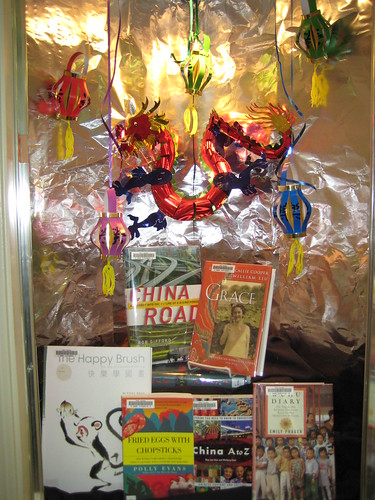
Happy Chinese New Year!

Chinese New Year 2008

If you gave up on those New Year's resolutions,

here is your chance to start all over!

Wednesday, February 06, 2008

Annoying Intro (copy)

It was a dark and stormy night, literally, as I opened my copy of Graham Greene’s Our Man in Havana. I began the book weeks ago, but just could not get past the introduction by Christopher Hitchens. Who is this character, and why should I care about what he thinks of the book?


Ah, after Googling him, and reading the passage in Wikipedia—where I recognized his photo—I learn he is a British author, journalist, and critic. His latest book, God is not Great: How Religion Poisons Everything, was number one on the “New York Times” bestseller’s list in 2006. Hum?

Okay, so he’s a big man in Britain, but boy he is boring. I promise, I tried for a week to read the introduction—16 pages—but fell asleep around page nine. Instead of leading into the book, which a person of sound dictionary knowledge would think meant by introduction, he talks about the book in a critical manner. He quotes different parts of the book and what they mean to him.

I understand the reasoning behind asking a noted author and critic to write an introduction for a classic. Publishers believe the sheer act of having a modern writer’s name attached to a classic will encourage sales. Unfortunately, if the author is as pretentious as our Mr. Hitchens, the reader may not benefit from reading the actual book. The words give up come to mind.

Well, back to the dark and stormy night, I was scared. The initial line of thunderstorms, wind shears, and tornados had missed our town, but another line was to pass through after bedtime. It had started to rain, so I hunkered down in bed and began Our Man in Havana in earnest, enough of Hitchens.

The fire-department radio siren was signaling a severe weather alert and I was giggling at the book. Seems our hero, Mr. Wormold, is a vacuum cleaner salesman, and his new line of vacuums includes the Atomic Pile. One astute customer wants to know if it will absorb all radio activity including Strontium 90. As the car alarm sounds under the carport, I am miles away on a Cuban street. I happened to be reading about the wolf whistles which Wormold hears as his 16-year-old daughter, Milly, makes her way through the streets.

Seems I can be lost in Havana with Greene—so much so, I ignore a raging storm—or I can be bored to tears with Hitchens. In a storm I’ll take Greene any day.

Wednesday, January 30, 2008

The Wednesday Letters (copy)

Jack and Laurel Cooper were living their dream. They had moved from the city after Jack’s retirement to run a Bed & Breakfast in Virginia’s picturesque Shenandoah Valley. Domus Jefferson or The House of Jefferson sat in the middle of heaven, nestled in the shadows of both the Blue Ridge and Allegheny Mountains.

Success wasn’t overnight, through trial and error the B&B began to make money to the relief of eldest son, Matthew, who envisioned his inheritance fueling fires in the quaint fireplaces.

One of the Cooper’s favorite regulars was an eccentric widow woman named Anna Belle Prestwich. Her home, a Southern mansion reportedly worth half a million, was five miles down the road and easily seen through barren trees in the winter. Described as cavernous, the mansion paled in comparison to the goings and comings of the Cooper’s warm Domus Jefferson.

Over the years Anna Belle developed quite a routine at the inn. With a stack of romances and her favorite cat, Castro, she whiled away the day in her $190 room—insisting on paying $300—stirring only for bathroom breaks or tea. The Coopers were weary of waiting on her for one reason, she over tipped. It was nice at first, but really unnecessary. Unbeknownst to Anna Belle, they began to donate the money to a children’s charity in Washington, D.C. which now sported a new basketball court among other niceties.

Over the years, health became an issue for both Jack and Laurel. Jack had cancer and Laurel had a heart murmur, but on the night of April 13, 1988, Jack was in trouble. It could be seen in his sunken eyes and papery skin; He was tired.

Laurel tried not to wake Jack as she eased beside him in their bed. Through her tears, Jack’s voice interrupted with, “Hi.” She quietly asked how he felt, was he dizzy, and he quietly answered, “Nope, peachy.”

It was this moment, as he turned towards his wife, she had a stroke. He shook her. He crawled out of the bed for the phone. He fell on top of the lamp and passed out. He came to and struggling to get back in the bed. Finally, he lay next to her still warm body and began to cry. Ten minutes passed until he made a move for the nightstand and Domus Jefferson stationery. Tonight he would write the last Wednesday love letter to his wife.

Celebrate Valentine’s Day with a love story in Jason F. Wright’s The Wednesday Letter.

Wednesday, January 23, 2008

Let the Cornbread Wars Begin!

Please, this is all in fun, but I nevah! I diminutive(ly) dropped the gauntlet, as any Southern lass, and would love to hear if you're wid me or agin me. I said, "What proper Southerner eats sweet cornbread such as Jiffy?"

This all started at Musings by Sage with his Cornbread story. (Not the food, but the nickname.) Well, I got to wondering if someone slipped something sweet in my buttermilk cornbread. As any good librarian, I went to check my reference sources and found two recipes. I couldn't find a straight recipe, sorry, but it makes sense. Why waste space in a cookbook with the boring everyday chore of making cornbread? Kind of like looking for a recipe for buttermilk biscuits.

UPDATE! Lori at Smokey Mountain Family History has graciously provided her mother's recipe for cornbread. Check out her post on this issue...

The first recipe came from Como Concoctions (1991), a Como, MS cookbook. Where's the sugah?!? The "note" was part of the recipe, I promise I didn't add it. Oh, and don't you know, Grace adds a bag of grated cheddar cheese instead of doing the extra work, now. Does anyone own a grater anymore?

The second recipe came from Magnolia Mixin' (1988), a Kosciusko, MS cookbook. I guess Miss Billie added buttermilk so as not to scare away potential Southern makers.

Mexican Corn Bread

1 cup yellow corn meal
½ teaspoon salt
½ teaspoon soda
2 eggs
1 cup cooking oil
1 chopped onion
4 hot peppers, pickled OR fresh, finely chopped
1 cup cream style corn
¼ pound cheddar cheese, grated

Mix all ingredients together, stirring in grated cheese last. Pour into hot, greased skillet and bake 45 minutes at 350 degrees.

NOTE: A black iron skillet is ideal for this recipe.

Grace Shoaf ~ Como

Yankee Corn Bread

Serves 8 – 10
*2 cups self-rising cornmeal
*1 cup self-rising flour
½ cup sugar
2 cups buttermilk

Mix together and put in buttered loaf pan. Bake 1 hr. at 300 degrees. Cool, remove from pan. Slice and butter.

*Add ½ t. soda and 1 t. salt if using plain flour or meal.

Mrs. Billie Baker ~ Kosciusko

Monday, January 21, 2008

How Starbucks Saved My Life (copy)

He used to work at the best ad agency in New York City. He used to have a six-figure salary. He used to have final say over accounts such as the United States Marines, Burger King, IBM, and Ford. He used to wear Brooks Brothers and commute to work via a car service. He used to live in a home with 25 rooms and a two-story library. He used to have a loving wife.

In a companywide clean sweep, Michael was swept out with the old. It happened at a breakfast meeting with a bright young woman he had hired years earlier. After 25 years of dedicated service Michael was let go. He walked from the meeting realizing he had nowhere to go and nothing to do.

The firing came at a critical time in Michael’s life. He had some major problems. Months earlier he had been diagnosed with a brain tumor. The operation could wait, but eventually had to be done. He also met and courted a woman who became his lover. The affair produced an offspring his wife could not ignore. At 53 years-of-age and without a job, he needed money for medical bills, a divorce lawyer, and a bouncing baby boy.

This was Michael’s messed up life. He needed income and his attempts at consulting were, dare I say, rather insulting. He couldn’t blame his contacts. What did he have unique to offer his former clients other than cheaper rates? The meager returned phone calls slowly dried up.

One thing, through the whole degrading process, Michael could not give up was his daily Starbucks lattes. He had taken to using the famous chain as his headquarters for consulting. What did it matter he hadn’t a corner office? He had done quite a bit of work for the agency during coffee breaks at Starbucks anyway.


With latte in hand, Michael sat daydreaming when a woman spoke, “Would you like a job?"

The first chapter begins, “This is a true, surprising story of an old white man who was kicked out of the top of the American Establishment, by chance met a young African-American woman from a completely different background, and came to learn what is important in life.”

From hubris to humility, from being served into the service of others, Michael Gates Gill has written a quirky memoir in How Starbucks Saved My Life: A Son of Privilege Learns to Live like Everyone Else.

Note: What kind of life is Gill living now? Tom Hanks has bought the rights to the book and Gill is enjoying success on his book tour. Hmm, has he changed?

Saturday, January 19, 2008

NWCC Student Book Club!

A brave new instructor will be leading the college's first student book club starting this January. I'm very excited for him. He has eight students signed up, and just look at the list! I'm taking part as an older member and look forward to reading and discussing all these books. Let's Read!

January 30th
Graham Greene
Our Man in Havana(1958)

February 13th
Kingsley Amis
Lucky Jim(1954)

February 27th
Vladimir Nabokov
Lolita(1955)

March 5th
Larry Brown
Big Bad Love(1990)

March 26th
Barry Hannah
Bats Out of Hell(1993)

April 9th
Louise Erdrich
The Antelope Wife(1999)

April 23rd
Cormac McCarthy
All the Pretty Horses(1992)

May 7th
Edwidge Danticat
The Dew Breaker(2005)

Note: The image is from Planet Book Club

Wednesday, January 16, 2008

The Diving Bell and the Butterfly (copy)

I was thrilled to hear The Diving Bell and the Butterfly movie won two Golden Globe awards: Best Director and Best Foreign Film. I had just finished the book and was in awe of the author’s determination and style.

Jean-Dominique Bauby, Editor in Chief of French Elle magazine, had a massive stroke December 8, 1995. After three weeks in a coma and another month spent in a drug haze, he slowly began to realize he could not escape his hospital bed. He felt pain, but wasn’t sure whether it was “burning hot or ice cold.” To ward off the feeling he instinctively stretched, but his movement was less than an inch. Bauby was experiencing locked-in syndrome.

Bauby equated his post-stroke situation as being locked in a case, or as the title suggest, in a diving bell. He was breathing air and could move his neck a little, but the rest of his body was weighted down by the water.

The word butterfly in Bauby’s title is a symbol representing his imagination. He used his mind to escape the diving bell at every opportunity. “There is so much to do. You can wander off in space or in time, set out for Tierra del Fuego or for King Midas’s court. You can visit the woman you love, slide down beside her and stroke her still-sleeping face. You can build castles in Spain, steal the Golden Fleece, discover Atlantis, realize your childhood dreams and ambitions.”

Most victims of stroke are functional after months of rehabilitation; unfortunately, locked-in syndrome patients take years to learn the art of breathing over their vocal cords for speech. Bauby had the capability to grunt, but being a stylish well-educated man, he desired a form of communication more appropriate with his demeanor.

Easy enough, a blink pattern of once for yes and twice for no, was established during Bauby’s second month of recovery. His left eyelid, the only voluntary movement from his face, began to become the portal for all communication. Next, an alphabet system with the most common letters at the beginning was recited to Bauby, and he blinked at the correct letter.

Now, here is the most incredible part; Bauby wrote The Diving Bell and the Butterfly with his left eyelid! He would compose paragraphs during the morning, memorizing three or four, and then blink them back to his amanuensis. This memoir is a reminder; lives do change in a blink of an eye.