
The peeps at PEN/Faulkner really like ole Philip Roth! He has won this year's award with Everyman. That makes 3 PEN/Faulkners under his modestly sized belt.
Congratulations!
May I borrow $15,000? ;)
Weather this spring has been quite unseasonably warm and dry. Memphis news station, WREG, reported temperatures to be 12 degrees above normal for this time of year. I am beginning to think Punxsutawney Phil, the official weather groundhog, has a gift. Not only did he predict the early spring for 2007, but also busied himself setting out the lounge and pouring iced tea. The last two weeks of March and the first two weeks of April are prime times to begin a thru hike of the Appalachian Trail according to Bill Bryson’s book, A Walk in the Woods.
Just what is a thru hike you ask? A thru hike means walking from Springer Mountain, Georgia to Mount Katahdin, Maine or visa versa in one season; which is over 2,174 miles from start to finish. Most thru hikers prefer to begin their odyssey in Georgia during early spring then arrive in Maine just as fall begins. In theory, they avoid extreme weather such as freezing sleet and snow.
This is how expatriate and author Bill Bryson begins his journey. The book jacket claims he took on this daunting task, “For reasons even he didn’t understand.” Some of us in Reading Round Table suspect his purpose was solely to write the book. Not an unfounded thought, since he wrote Neither Here Nor There after a 1991 back packing trip in Europe.
A Walk in the Woods was written in 1998 after Bryson “sort of” finished the trail in 1996. The book is laugh-out-loud funny. First off, Bryson sends out Christmas cards inviting any and all to join him. Out of all the possibilities, he has one taker, Stephen Katz; a man who exercises by watching T.V. and considers dinner a twice nightly event.
The first night of camp, Bryson realizes his new mate isn’t ideal, as Katz admits to tossing all their food down a ravine before falling instantly to sleep. For penitence Katz rises early and makes coffee. Unfortunately, the brew is contaminated with pink floating specks (toilet paper), as Katz explains tossing the filters, too.
As if going off trail for a bit, Bryson fills the book with “aside” information. Along with the running narrative, readers will learn much about our state parks and woodsy forests.
Art is inspiration on canvas board. That said, I think Edward Hopper’s work can inspire stories. In Hopper’s Nighthawk below, all kinds of plots, conversations, and characterizations come to mind.
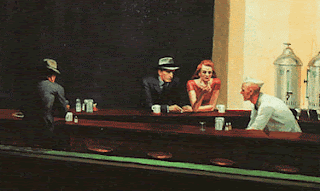

Note: Thanks to RickLibrarian for the idea!
 Jimmy Carter, our 39th President, was a little-known, democratic hopeful when he released his first book Why Not the Best? in 1975. According to Book TV’s “In Depth,” Carter used the book as an introduction to the American people when he began his presidential campaign.
 president Carter, Barack Obama. A junior United States Senator since 2006, little was known of him before his bestseller, Dreams from My Father: A Story of Race and Inheritance. Now, Americans can read his stirring autobiography and have a sense of his character.
 "Rudy" Giuliani’s name. (David Letterman has a nasty habit of using the current city’s mayors as nightly fodder.) Prior to the terrorist attack on the twin towers, outsiders to the city may have seen him as bumbling. He disproved the notion, as we saw a calm demeanor during 9/11. No autobiography, his book Leadership explains his 9/11 manner as a management skill learned during his mayoral stint.
 Hillary Clinton was ready with her book Living History prior to filing for the Exploratory Committee. One can now read her take on world issues without Bill’s point of view. As with most political books, it is a safe read, void of Washington gossip. Darn it.
 turn off the talk radio and listen to more music.
Note: A Special Report from Forbes.com on Books edited by Michael Maiello and Michael Noer.
People still burn books. But that only means that books are still dangerous enough to destroy. And if people want to destroy them, they are valuable enough that they will endure.
Window-shopping is best during springtime. The time when new formals, placed in strategic, teenage-alluring displays, set the trend for the season. In one glimpse, prom goers can register whether Easter egg colors, halters, or ruffles will be the hottest look.
Just last week, I drove by my favorite corner shop, when a yellow-sequence number blinded me. Like the brass pendulum of a hypnotist, I was transported to 1982 and my first prom. What joy! I was going to the senior prom with a senior.
So what you say? Well, I was a freshman at the time; making me the first in the group to dance with other seniors as the infamous “Stairway to Heaven” played in the dimly lit high school cafeteria.
Why was I special? My hair was “Ripley’s Believe It or Not” straight; one could take the point of a pencil and drag it from top to bottom without one tangle. My braces seemed to shine like rhinestones and my freckles brought to mind the infinite stars. Mother Nature served as the cruelest jokester, for the Milky Way crossed just above my upper lip.
I know what you are thinking, “Somebody asked me out?” My date was a friend and not a romantic Fabio. At 5’8” and 265 pounds, he more than doubled my weight. Are you getting the picture? I was going to the prom with someone equivalent to a big-boned cousin. What if you feel some altruistic need to supply your friends with dates before yourself? That is Laura’s dilemma in Blake Nelson’s Prom Anonymous. The obsessive and compulsive prom organizer, Laura, schedules luncheons to go over colors to wear, suitable shoes, and “gaudiless” accessories—including dates. Being caught-up into organizing the perfect prom; she forgets to find a date.

In Top Ten Uses for an Unworn Prom Dress by Tina Ferraro, Nicki finds herself jilted two days before the big event. What is she to do? She loves her “perfectly magical pink vintage dress,” and even though she will get a nice cash back sum, she just cannot part with it. Get a new date or beg and plead with the ex-boyfriend to take her back, Nicki is feeling the heat.
Both books are set to tickle any young adults’ spine, as they contemplate the biggest night of their high school life with humor. By the way, my 1982 prom date turned out to be super fun. After we made our appearance, we headed out to an all-you-can-eat crab legs shack. We both rolled out of the restaurant laughing.
 I love this weather. Our South produces surprisingly short and sporadic warm days in the middle of winter, which can revitalize a wilting soul. In this unseasonable spring, I start to envision the ultimate lawn and garden. My dreams of English roses and hedge mazes may be too grand, as our grounds never become the rosy, green vision.
Nevertheless, that does not stop me from dreaming or looking through new gardening books, to fuel my delusions. I recently thumbed through Publishers Weekly’s “Books and Garden” article, which featured 19 new selections.
The first book speaks volumes to my guilt-ridden, water-withholding, ashamed conscience. I must purchase, 37 Houseplants Even You Can’t Kill, by Mary Kate Hogan. (The title emphasizes the “You” by changing its color) Author Hogan claims she can rid readers of their “black” thumb. The opposite of green thumb, my black thumb is a genetic fault handed down through the maternal side. Imagine my shock when last week, despite my obvious indifference, a geranium bloomed in the house.
What if your guilt surpasses the house and extends into the yard? It is not hard considering; perfect photos bombard us from “home and garden” magazines and television. Author Janice Wells promises to break us free from the “tyranny” with her book, Gin & Tonic Gardener. The book jacket exclaims, “Spirited, funny, and filled to the brim with amusing gardening anecdotes and wisdom.” I imagine Wells’ wisdom as, “Have another G&T and watch as the garden grows,” albeit a little crooked. She may continue, “Pour leftovers on offending weeds.” What leftovers? I will need all the concoction to make my weeds less offensive.
A nice gift for your “lawn ranger” is Lawnscapes: Mowing Patterns to Make Your Yard a Work of Art by David Parfitt. The book promises to teach the art of mowing designs into one’s lawn. Parfitt demonstrates the proper technique to produce checkerboards, hearts, bull’s eyes, Celtic knotwork, etc. Wonder if he discusses the artistic hills one may create when releasing dead houseplants back to the wild?
On a serious note, I would like to tell you about the new reference book, The Plant Finder: The Right Plants for Every Garden by Tony Rodd. This tome, the biggest of the season weighing slightly less than five pounds, offers the owner over 5,000 of the best plants for any zone. In my case it makes a great coaster for the G&Ts and a perfect anvil to pitch at moles.
... as in I didn't read all five books, BUT I read one!
I read Billy Budd by Herman Melville! It's about time, too. I bought the collection of Melville stories when we got back from our honeymoon, over 16 years ago. The book is horribly yellow and crisp. I'm lucky it didn't disintegrate as I turned the pages.
I got this meme from Amy at The Sleepy Reader. Wow, I realize now I haven't read the girly classic stuff. I'm such a bad librarian, I haven't read Wurthering Heights or Emma. :-) Also, where are the Southern (3) authors?
Look at the list of books below:
* Color green the ones you’ve read.
* Italicize the ones you want to read.
* Color red the ones you won’t touch with a 10 foot pole.
* Put a cross (+) in front of the ones on your book shelf.
* Place an asterisk (*) in front of the ones you’ve never heard of.
1. The Da Vinci Code (Dan Brown)
2. Pride and Prejudice (Jane Austen)
3. +To Kill A Mockingbird (Harper Lee)
4. +Gone With The Wind (Margaret Mitchell)
5. The Lord of the Rings: Return of the King (Tolkien)
6. The Lord of the Rings: Fellowship of the Ring (Tolkien)
7. The Lord of the Rings: Two Towers (Tolkien)
8. +Anne of Green Gables (L.M. Montgomery)
9. Outlander (Diana Gabaldon)
10. +A Fine Balance (Rohinton Mistry)
11. +Harry Potter and the Goblet of Fire (Rowling)
12. Angels and Demons (Dan Brown)
13. +Harry Potter and the Order of the Phoenix (Rowling)
14. A Prayer for Owen Meany (John Irving)
15. Memoirs of a Geisha (Arthur Golden)
16. +Harry Potter and the Philosopher’s Stone (Rowling)
17. Fall on Your Knees (Ann-Marie MacDonald)
18. The Stand (Stephen King)
19. +Harry Potter and the Prisoner of Azkaban (Rowling)
20. Jane Eyre (Charlotte Bronte)
21. The Hobbit (Tolkien)
22. The Catcher in the Rye (J.D. Salinger)
23. Little Women (Louisa May Alcott)
24. The Lovely Bones (Alice Sebold)
25. +Life of Pi (Yann Martel)
26. The Hitchhiker’s Guide to the Galaxy (Douglas Adams)
27. Wuthering Heights (Emily Bronte)
28. The Lion, The Witch and the Wardrobe (C. S. Lewis)
29. East of Eden (John Steinbeck)
30. Tuesdays with Morrie (Mitch Albom)
31. Dune (Frank Herbert)
32. The Notebook (Nicholas Sparks)
33. Atlas Shrugged (Ayn Rand)
34. 1984 (Orwell)
35. The Mists of Avalon (Marion Zimmer Bradley)
36. The Pillars of the Earth (Ken Follett)
37. *The Power of One (Bryce Courtenay)
38. I Know This Much is True (Wally Lamb)
39. The Red Tent (Anita Diamant)
40. The Alchemist (Paulo Coelho)
41. The Clan of the Cave Bear (Jean M. Auel)
42. The Kite Runner (Khaled Hosseini)
43. Confessions of a Shopaholic (Sophie Kinsella)
44. The Five People You Meet In Heaven (Mitch Albom)
45. +Bible (I dip in for inspiration but I will never read it cover to cover.)
46. Anna Karenina (Tolstoy)
47. The Count of Monte Cristo (Alexandre Dumas)
48. Angela’s Ashes (Frank McCourt)
49. The Grapes of Wrath (John Steinbeck)
50. She’s Come Undone (Wally Lamb)
51. The Poisonwood Bible (Barbara Kingsolver)
52. A Tale of Two Cities (Dickens)
53. Ender’s Game (Orson Scott Card)
54. Great Expectations (Dickens)
55. The Great Gatsby (Fitzgerald)
56. *The Stone Angel (Margaret Laurence)
57. +Harry Potter and the Chamber of Secrets (Rowling)
58. The Thorn Birds (Colleen McCullough)
59. The Handmaid’s Tale (Margaret Atwood)
60. The Time Traveler’s Wife (Audrew Niffenegger)
61. Crime and Punishment (Fyodor Dostoyevsky)
62. The Fountainhead (Ayn Rand)
63. War and Peace (Tolstoy)
64. Interview with the Vampire (Anne Rice)
65. *Fifth Business (Robertson Davis)
66. One Hundred Years Of Solitude (Gabriel Garcia Marquez)
67. The Sisterhood of the Traveling Pants (Ann Brashares)
68. Catch-22 (Joseph Heller)
69. Les Miserables (Hugo)
70. The Little Prince (Antoine de Saint-Exupery)
71. Bridget Jones’ Diary (Fielding)
72. +Love in the Time of Cholera (Marquez)
73. Shogun (James Clavell)
74. +The English Patient (Michael Ondaatje)
75. The Secret Garden (Frances Hodgson Burnett)
76. *The Summer Tree (Guy Gavriel Kay)
77. +A Tree Grows in Brooklyn (Betty Smith)
78. The World According To Garp (John Irving)
79. *The Diviners (Margaret Laurence)
80. Charlotte’s Web (E.B. White)
81. *Not Wanted On the Voyage (Timothy Findley)
82. Of Mice And Men (Steinbeck)
83. Rebecca (Daphne DuMaurier)
84. *Wizard’s First Rule (Terry Goodkind)
85. Emma (Jane Austen)
86. Watership Down (Richard Adams)
87. Brave New World (Aldous Huxley)
88. The Stone Diaries (Carol Shields)
89. Blindness (Jose Saramago)
90. Kane and Abel (Jeffrey Archer)
91. *In The Skin Of A Lion (Ondaatje)
92. Lord of the Flies (Golding)
93. The Good Earth (Pearl S. Buck)
94. The Secret Life of Bees (Sue Monk Kidd)
95. The Bourne Identity (Robert Ludlum)
96. The Outsiders (S.E. Hinton)
97. White Oleander (Janet Fitch)
98. A Woman of Substance (Barbara Taylor Bradford)
99. The Celestine Prophecy (James Redfield)
100. +Ulysses (James Joyce)
I have been tagged by Paul at Shadow of Diogenes!
(1) Name a book that you just have to read. Mockingbird: A Portrait of Harper Lee by Charles J. Shelds! I have been saving this book for the summer. This way I can take my time and read it while away from work.
(2) When was the last time you met a famous author? Well, last month we had Robert Dalby speak at the library promoting his new book, Waltzing at the Piggly Wiggly. He's not big yet, but his book is rather enjoyable, and he has signed with Putnam publishing. His style is similar to the Dollar Daze series. I like to think he will be the next Clyde Edgerton. (One of my favorite Southern authors.) Dalby's second title in the Piggly Wiggly series will be out this fall.
(3) Who is your favorite Southern writer? Paul, that's like picking a favorite tooth; I need them all! I would love to say Harper Lee and be done with it, but Eudora Welty is my number one Southern writer. Her writing is filled with symbols and humor, and she is right on when it comes to characters. I am always delighted with her. I love Richard Wright, John M. Barry's non-fiction, and Mildred Taylor's YA fiction. Carl Hiassen isn't bad, either.
Any other takers? ;D
Chunkster Challenge #1
I would like to introduce you to my newest friend. Her name is Liesel Meminger, and she is nine-years-old. Liesel lives in a little town called Molching outside of Munich, Germany. She stays at 33 Himmel Street, which is the home of Hans and Rosa Hubermann. Himmel is German for heaven, but her conditions are anything but.
When I first meet Liesel she is traveling with her mother and little brother. It is very sad. The little family is forced to leave their home because the missing father is known to be Kommunist. The whole trip is to ensure the children’s safety by placing them with foster parents until trouble dies down.
The only thing, trouble is just beginning, and it will be years before safety is felt. I didn’t tell you my new friend lives in Hitler’s 1930s Germany.
Tragedy strikes the family early in the story. Liesel’s little brother doesn’t make the trip. He actually dies during the night and has to be buried in Munich.
It is at this point in Liesel's life that she obtains a nickname. During the funeral she discovers a little book on the ground. It’s a silly little book, not necessarily a page turner, describing a 12 step program to dig graves. It obviously belongs to the gravedigger, but all Liesel sees is shiny gold lettering. She cannot read. So, the title means nothing to her; it is just an object that symbolizes her brother’s last day. She becomes the book thief. The book thief, like many a thief, strikes at the most opportune time. Her second opportunity arrives when the town gathers for a book burning event. As a Hitler Youth she sticks around to clean up after the fire. To her amazement five books don’t burn, and she procures one when no one is looking. Unfortunately, in Nazi Germany someone is always looking.
I met the book thief during a recent bout with a nasty virus. She is the main character of Markus Zusak’s book, The Book Thief. It was nice to have such an engaging book during an awful sickness. Books mean so much more when a person is ill.
Listen to the Prologue as told to us by the narrator, Death: “It’s just a small story really, about, among other things: a girl, some words, an accordionist, some fanatical Germans, a Jewish fist fighter, and quite a lot of thievery.” This “small story,” written for young adults, will move anyone with a pulse.
Last week’s Daytona 500 was the most exciting in years. The two leads took themselves out of the race after 130 laps. Harvick’s photo-finish win against Martin was an incredible 0.02 difference. To top off the excitement, we watched agog as eighteenth place Bowyer crossed the finish line—upside down and on fire.
Can you believe stock car racing heralds back to straight-aways on a Daytona Beach? That is right; before we southerners had an oval, we had a hard packed beach at low tide. Someone had the brilliant idea to connect the parallel A1A Highway by cutting slanted curves through the dunes. This new course promised obstacles such as rogue waves and mud at the bottom of the curves.
The official stock car track, roots itself in a forlorn horseracing track at Lakewood, Georgia, not in Indianapolis. Indianapolis might have had the honor if they had not been so haughty. Indianapolis racing began in 1903 with cars made especially for the track. The officials frowned on the new V-8s and outlawed “whiskey trippers” from the track.
Most racers came from the foothills in northeast Georgia, Dawsonville to be exact. Daytona was too far to drive. These bootleggers lined up every weekend at Lakewood to show off police avoiding skills on the red-dirt track with a lake in the middle. For a mere fifty cents, one could lace their fingers in the chicken wire and feel the throaty Ford V-8s as they fought it out for a hundred dollar purse. Neal Thompson, author of Driving with the Devil, has written about an exciting time in our southern history. He says most of the accolades go to Bill France, but that would be an injustice to the first promoter and original racer, Raymond Parks. In 2003, Thompson traveled to Parks’ home and interviewed the ninety-one-year-old legend.
In this book, the “real” story is told through first-hand accounts. The reader meets Parks’ superstar, bootleg-team, Roy Hall and Lloyd Seay, as they achieve certain notoriety for their two-wheel passes in the Daytona curves; and crusty mechanic, Red Vogt explains, “Money equals speed.”
Do not miss this book if you care anything about NASCAR. Each chapter packs interesting information and history. I found the race coverage to be like another notorious book, Seabiscuit. Ew, I can’t wait to try the 180 degree maneuver bootleggers used to evade the police.
 Thanks Tiffany!
One of the perks of being a librarian is the simple act of helping others. I help patrons find tax forms. I help them research the side effects of certain medications, and I provide books for learning and pleasure. I even help them connect the limbs on their family trees.
As a public librarian, I just loved helping a patron from Texas or Colorado research their lineage. We pulled out all the marriage license and census documents and then looked alphabetically for last names. They became excited as they discovered new, unknown to them, uncles and aunts.
Unfortunately, I didn’t have the same positive experience when working with African American patrons. I was eager to help them, but I lacked essential information to move further back than 1870. Our best bet was to use the last name and see if any white families had other than family members listed. If their race was marked black, they might, and might is a big word here, be kin.
Mississippi records, like many southern states, had a lackadaisical attitude toward black race record keeping prior to the 1900s. When African Americans were included in the list of others, they were recorded with nicknames. Amazingly, these nicknames were white generated, and they may or may not have been the name a person actually went by.
What happens when the richest woman in America decides she wants to research her roots? Does Oprah, raised dirt poor in the small Mississippi town of Kosciusko, have the same challenge a Chicagoan sitting in the Como Public Library has? Yes, even Oprah hits the same Civil War/Reconstruction period which becomes genealogy’s dead end. Thanks to Henry Louis Gates, Jr., author of Finding Oprah’s Roots: Finding Your Own, I now have an informative little book to explain the problems and suggest other routes. All the money in the world cannot ensure accurate and researchable records. One really has to rely on family knowledge and lore to push past the annoying gap.
What paper records lack, can be made up in a cheek swab. Thanks to DNA results, genealogy researchers can now trace heritage back to true African roots. Oprah once thought of herself as a proud Zulu warrior, but her DNA said differently. As she now comes to terms with her Kpelle heritage, we are all the better for her journey. This is an excellent book for anyone ready to dive into the history of their people.


