Sunday, September 17, 2006

Just Passin' Through

Unbelievable!
Hummingbird Migration Time!
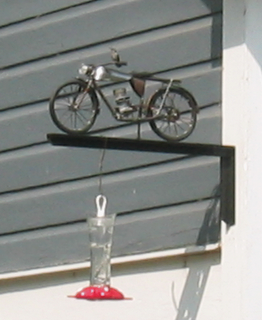
I took this photo in our back yard this morning.
I thought it would be cool if I could get one of the birds
(we counted 6)
sitting on the copper motorcycle
Pete created to look like his Triumph.
(He's a stunt driver! The bird not Pete!)
I caught two in this next photo
and check out the shadow in the lower right corner.

Thursday, September 14, 2006

Comp I (class notes)

I eagerly grabbed All Over but the Shoutin’ by Rick Bragg for my class assignment. This book has always been at the bottom of my reading pile since its publication. I love Southern authors and non-fiction is my favorite genre, yet I never set aside time for this memoir. After reading the prologue tonight, I am sorry I did not start sooner.

From his first paragraph involving fighting redbirds, I see that most of humanity fights with its image. For every bird that strikes at a mirror, millions of human beings strike their imaginary mirrors, eventually destructing their image through self-loathing.

In my case, the mirror reflects my parents, and my struggle to be very different from the sameness I recognized in them. I am afraid, as in Bragg’s last sentence in the redbird paragraph, “it was just in their nature.” Think of all the wasted time resulting from this natural right-of-passage.

Wednesday, September 13, 2006

Another Day in the Frontal Lobe (copy)

“When I walked into the infant’s hospital room for the first time the lights were off and the shades down, in the middle of the day.

The pediatric neurology team was crowded around the crib. The senior neurologist was holding a flashlight up against the baby’s head, and all the residents and medical students stared at the resulting spectacle: a round, pinkish, glowing orb.

Because most of the skull was filled with fluid and not brain, and a baby’s scalp and skull are normally relatively thin, the light was able to pass right through, lighting up the head in an eerie display.”

This is just one of the many stories Katrina Firlik relates in her new book, Another Day in the Frontal Lobe: A Brain Surgeon Exposes Life on the Inside. Firlik was the first woman to be accepted into the University of Pittsburgh Medical Center’s neurosurgery residency program. This book tells of her training and eventual mastery of the mind.

She is very humble throughout the book, explaining that her job isn’t rocket science. She sees her roll as more of a mechanic, using her hands to relieve pressure on the brain, as a grease monkey might loosen a bolt. She states, “If you have an expanding blood clot in your brain, you want a skilled brain mechanic, and preferably a swift one. You don’t care if your surgeon published a paper in Science or Nature.”

One could say her mantra throughout the book is “this is not rocket science,” but, hello, it is brain surgery. She reminds me of a certain person who can’t accept compliments without devaluing herself. Hum?

The book can be graphic at times; for instance, she tells about the removal of a flush, two-inch, carpentry nail. If you get a little woozy reading about maggots and pus, please reach for something else. If not, you will find Firlik humorous at times. She may even settle a bet about the movie Hannibal for you.

The title, and the fact that Firlik is one of only five percent of women serving in the neurosurgery field, might lead a reader to think the book encompasses male incompetent situations, but this is not the case. She never dishes the dirt of others, but rather tells of her own mistakes, which makes for a refreshing take that will win male and female readers alike.

Saturday, September 09, 2006

R.I.P. (Readers Imbibing Peril)


I’ve joined a motley crew of devilish readers on a journey to the dark side of books. We will explore the skeletons in the attics and underground batty abodes of eerie fiction or stranger-than-fiction non-fiction. If you dare, join us at R.I.P. Headquarters, where there is always room for one more body. *maniacal laughter *

My Challenge:
1.) Everyman by Philip Roth
2.) The Brief History of the Dead
by Kevin Brockmeier
3.) The Shadow of the Wind by Carlos Ruiz Zafon and Lucia Graves
4.) Spook by Mary Roach
5.) Thunderstruck by Erik Larson

Extra Credit or if Thunderstruck doesn’t get to my home in time…
A.) Frankenstein by Mary Shelley

Wednesday, September 06, 2006

Everyman (copy)

How can this book be so heavy? It lies innocently enough in my lap, weighing less than a pound, yet feels more like a cold brick or slab of marble. Philip Roth’s Everyman has me perplexed.

This little novella wishes to convey a single simple notion—we live to die. Everyman’s fate, or every man, woman, and child’s fate, is to one day cease being. As Roth stated in an interview, “We all live to die.” This uncomfortable thought translates into a very uncomfortable read.

I read this book over two weeks ago. Struggling with its soberness, I then read the medieval play from whence the title Everyman derives. Can you believe reading the play just made matters worse? I was left with more questions than answers.

Here’s my problem. The play “Everyman” and the book Everyman share only two things: the title and a main character facing death. In the play, our Everyman tries to bargain with Death for more time on earth. In the book, the nameless main character, or Everyman, shuns religion and faces death alone. He doesn’t take comfort in pearly gates and angels.

I can identify with the play whereas the book leaves me anxious. The main character is really a jerk, and I worry about his soul. He faces death so utterly alone. This is silly, but I want to hold his hand. I want to give him human comfort.

Roth believes we all face death alone and his Everyman is utterly alone. At 71-years, Everyman has two ex-wives, three children, two of which do not speak to him, and a loving brother he has excommunicated because he is jealous of his health. He also displays a passion for younger women, who laugh at his advances.

The opening of the book begins with Everyman’s funeral. Here the reader meets all those associated with Everyman’s life. Yes, it is a small gathering, but not without a few weepers. Then Roth reverses the storyline and we meet Everyman before his death.

Roth tells Everyman’s story, from the first operation as a boy to his last operation as an adult. The timeline is based on his health rather than the traditional coming-of-age. This might be why I didn’t bond with the character.

After much soul searching and researching, I admit I like the book. Author Roth scrutinizes mankind’s acceptance of death and I am better for taking this journey. I’ll leave you a quote from the play, “O Death, thou comest when I had thee least in mind.”

Sunday, September 03, 2006

Web 2.0 is so fun!

Part of Learning 2.0!

Libri Grant 2006

Originally uploaded by maggiereads.
This is Martha Rayburn.

She is the banch manager at Sam Lapidus Memorial Library in Creshaw, Mississippi. She recently received over 60 books from the Libri Foundation. Just one of the grants I wrote in November.

Pete and I donated a few, too!

Wednesday, August 30, 2006

Breach of Faith (copy)

This past summer I attended the American Libraries Association’s conference in New Orleans. We were the first international conference to meet in the city after Katrina. One could tell, too. The citizens were thrilled to see 17,000 extra people mulling through their shops and streets. They treated us as royalty. They were grateful we chose to visit them and spend much needed money. Not necessarily a huge amount, we are librarians after all.

One of the meetings I attended was titled “Southern Voices.” It was an opportunity for southern authors to discuss their latest books. The panel and their books included: Mark Childress and his new release One Mississippi, Tom Piazza’s Why New Orleans Matters, and Jed Horne’s Breach of Faith: Hurricane Katrina and the Near Death of a Great American City.

They were all engaging, with distinctly different voices and writing styles. One may know Mr. Childress from his book-made-into-movie, Crazy in Alabama. He read an excerpt that had us all in stitches. Mr. Piazza discussed the unique culture of New Orleans by framing the people who call it home.

The room became silent as Jed Horne took the podium. Mr. Horne’s introduction included an awe-inspiring Pulitzer Prize Award for his recent work at New Orleans Times-Picayune newspaper during Katrina. The two authors, prior to his presentation, were as rapt as the audience awaiting his speech.

Mr. Horne explained that while reporting in the field he was repeatedly stopped and told harrowing stories—stories that needed to be told, but just too abundant for the newspaper’s space. He took names and numbers and when the city became relatively normal he pursued the storytellers.

What I truly like about the book is Horne’s ability to let his subjects tell-all. He doesn’t hold back their political views and theories, which creates a sense of frustration for the reader—the same frustration one may have felt while sitting in a cozy home and watching the events unfold through the television.

Another asset Horne brings to the book is a clear understanding of local politics. As metro editor his job is to know the city’s political history. His style will thrill the reader, as he starts a story, and then slows in the middle to explain perspectives. One eagerly reads the vignettes as cliff hangers.

Sunday, August 27, 2006

Avatar for Library 2.0 Class

Yahoo! Avatars

This is so fun!
Another Library 2.0 Assignment

Isaac's Storm (op-ed) OR Katrina revisited

The levees broke one year ago today in the grand city of New Orleans after Katrina swept through. Is it the levee system’s fault? After all, their construction ended in the early part of the 20th century. Is it the city leaders' fault for ignoring Hurricane Betsy's levee breach in 1965?

Is it a mistake to blame Katrina for the New Orleans devastation? Doesn't the fault live within the levee system and a government that ignores its degeneration?

The weather service did an excellent job informing the gulf areas prior to Katrina’s landfall. Katrina actually pushed through New Orleans and was heading north when the heavy winds triggered levees to collapse. Many residents still wonder what produced the loud bang before the flooding began.

Imagine the loss of life if the weather service had not warned residents. The weather service follows strict procedures when faced with potentially devastating storms. Unlike the early years when eerie calm surfs and lack of birds signaled trouble.

In 1900 the US Weather Service was a small group of observation stations around the country. Most of these stations were run by hobbyists; say a cotton farmer or sailor with a penchant for atmospheric changes. In this, loose network of amateurish professionals, observation reports sent to headquarters in Washington DC took time. The telegraph office, usually located in town, could be miles away from the observer.

The Signal Corp trained an early observer, Isaac Cline, famous for his river weather predictions in 1882. From there he advanced in the professional ranks to man the observation station on Galveston Island, Texas in 1889.

By 1900, Galveston had become the third largest port in the US. It was the first city in Texas to have electricity, a post office, a law office, a private bank and a railroad system to the mainland. It was richer and grander than Houston with a population of around 35,000.

On the morning of September 8, 1900, Buford T. Morris woke to an unusual site. “The sky seemed to be made of mother of pearl; gloriously pink, yet containing a fish-scale effect which reflected all the colors of the rainbow. Never had I seen such a beautiful sky.”

Overnight 6,000 residents of Galveston died in the “deadliest weather disaster in American history”. The category four hurricane, predicted by Isaac Cline, was also downplayed in the same breath. He believed the storm would pass north of the city and residents would be safe in their homes. A decision he would regret for the rest of his life.

The unbelievably forgotten Galveston tragedy as told in Erik Larson’ book, Isaac’s Storm: A Man, a Time and the Deadliest Hurricane in History, is eerily similar to Katrina. The storm surge on Mississippi’s gulf shores happened almost exactly as described in Galveston. The foibles of man’s risk, unchanged.

Note: Husband disagrees with said wife's opinion--Katrina is all to blame.

Saturday, August 26, 2006

What's that buzzing noise?

“A story with a moral appended
is like the bill of a mosquito.
It bores you,
and then injects a stinging drop
to irritate your conscience.”

O. Henry
from
Strictly Business

Wednesday, August 23, 2006

Freckles (copy)

In the world of literature, freakish freckles, curiosity and stubbornness make for memorable characters. Pippi Longstocking, Laura Ingalls, Caddie Woodlawn and Anne Shirley are just a handful of fictional characters that spring to mind.

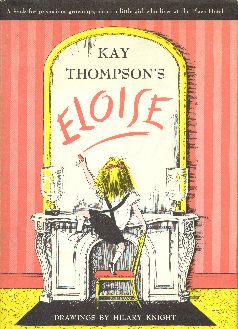
As an early reader, one tends to gravitate towards characters that mirror friends or one’s self. My first encounter with the be-speckled sort, arriving in book form, was Eloise. My mother and I spent hours reading this picture book front to back. Maybe because she mentioned I was very much like Eloise.

At the time, I didn’t think she meant precocious; instead, I focused on her physical traits. Miss Eloise wasn’t a cutesy character, but an ugly, pencil-legged, big-bellied mess. Remember her freckles? Well, she only sported a few, but after Mom’s comment, my Eloise had hundreds. I knew better than mark a book; however, in my mind, she became as splotched as a speckled egg.

Imagine my surprise when reading Anne of Green Gables by Lucy Maud Montgomery. The character Anne Shirley is an 11-year-old, red-headed and enormously freckled, opinionated orphan girl. She could have been my hero, had I known she existed.

I became familiar with Anne on a recent trip to Prince Edwards Island in Canada. As a librarian, I knew the Green Gables series, but my childhood revolved around another entertaining one, Little House on the Prairie. The kindred spirit I felt with Anne, even as an adult, was a little unexpected.

As a teacher, librarian or parent facing a reluctant reader or struggling to get a book in a child’s hand, remember this little secret—it is all in the character. This small tip is the key to creating a life-long reader. If the child identifies with a character, they tend to become the character. For example, I was crawling all over the Plaza, not Eloise.

Search out books filled with characters that mirror the young reader’s world. Take a trip to the library and check out a stack. Sit back and watch as their eyes light up when they recognize themselves. One might catch them role-playing with their imaginary, new friends.

This universal trait applies to adults, too. Adult characters may not have as many freckles, but somehow I can always tell if they did as children.

Sunday, August 20, 2006

Mm I S S
I
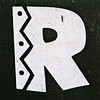
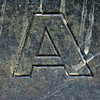
S - Former bookstore on Lankershim S I P One Letter / P
I

R E A D Graffiti exclamation
As part of my Learning 2.0 class...

Saturday, August 19, 2006

Celebrity Look-a-Like


Can't say I really look like any of these
"better looking" women,
but I do have Sally Field's nose.
Thanks Norge Thingy!

Unique as Snowflakes

Take the book,
my friend,
and read your eyes out;
you will never find there what I find.
~ Ralph Waldo Emerson

View of Emerson's study 1877 by Florence Todd

found at Concord Museum

Wednesday, August 16, 2006

The Weather Makers (copy)

We read about it in newspapers and magazines; we hear about it from our neighbors and colleagues; we watch nature shows that include it and a former vice president lent his time to a recent movie about it. What is IT?

It is global warming and it is becoming one hot topic. A topic so hot it literally smacks you in the face when you first step outside. That is, if you believe.

While brushing my teeth before bed, I overheard David Letterman say, "This day in 1909, Antarctica was a negative 38 degrees; today it is 82 and sunny." He had just finished his monolog and was sitting at his desk when this casual comment popped out. I laughed, but then I stopped. Is this really a joke or is he telling the truth?

The South has always experienced hot, sweltering summers. This summer’s drought, the same two summers ago as 30 years ago, is normal. Heck, every mid-south farmer remembers the summers of 1988 and 1993 when we were either bone-dry or sopping wet. Heat waves, like sweet tea and watermelon, are essential elements of summer. So, if we are a little skeptical about global warming, it is understandable.

Author and scientist, Tim Flannery, claims to be a skeptic by nature about nature. He believes, “skepticism has a particularly important role to play in science, for a theory is only valid for as long as it has not been disproved.”

This is the premise of his new book, The Weather Makers. In this intense, dense book, Flannery assembles all the latest and most respected works on the subject. He then breaks the theories into three parts: reasons for the phenomenon, current effects of the phenomenon and earth’s future.

As the jacket blurb would like you to believe, we are to read the chapters through cynic eyes and make our own decisions. Unfortunately, Flannery falls short of the skeptic role, and we, as readers, lack his questioning voice. We are spoon-fed these theories as fact and expected to agree with his conclusions.

Flannery breaks his promise, but this doesn’t diminish the book’s value. He may not go about breaking myths like Myth Busters, but he does provide important information to laymen. For example, one will gain an understanding of the different methods of gauging temperatures through time. I highly recommend this book to anyone straddling the fence on this issue. Flannery successfully knocked me off.

Saturday, August 12, 2006


Dog Days of Summer

Friday, August 11, 2006

Not Picking this Battle

I’m putting The Weather Makers down and moving on. I was planning to write favorable copy, but general opinion discourages me. Apparently, my Southern neighbors believe global warming bogus.

I see their point. The South has always experienced hot, sweltering summers. This summer’s drought, the same 2 summers ago as thirty years ago, is normal. If we are truly experiencing a warming effect, it should be even hotter.

They do admit to the milder winters. It has been a good thirty years since ponds have frozen over. To Southerners, skating in your tennis shoes on the farm’s pond indicates an extra chilly winter.

I shouldn’t type cast all Southerners as non-believers. I give credit to author Tim Flannery for knocking me off the fence, having approached the issue as a skeptic. It is only through his vast research my stubborn views changed.

The book can change other Southern minds, too. I commit eagerly to book talking this honorable title, one-on-one. Using visual cues to judge my effectiveness, (like a seer) I adhere to rule number three, “Every book his reader.”

The Weather Makers (notes)

“The best evidence indicates that we need to reduce our CO2 emissions by 70% by 2050.” p6

“70 percent of all people alive today will still be alive in 2050, so climate change affects almost every family on this planet.” p7

“The CO2 from breath last week may now be feeding a plant on a distant continent, or plankton in a frozen sea. In a matter of months, all of the CO2 you just exhaled will have dispersed around the planet. Because of it dynamism, the atmosphere is on intimate terms with every aspect of our earth, from the mantle upward. No volcano belches, no ocean churns—indeed, no creature breathes—without the great aerial ocean registering it.” p22

Wednesday, August 09, 2006

French Women Don't Get Fat (copy)

What is it about diet books that make you hungry? Is it the impending deprivation between the lines? For example, my mother’s Sunday school class all gained weight when trying the Christian based diet book, Weigh Down by Gwen Shamblin. Why? Mom claims they all had a tendency to snack while reading.

Usher in a new book that puts a cultural spin on weight loss. French Women Don’t Get Fat by Mireille Guiliano is your typical diet book; nothing new or earth shaking here. The common sense tips like drink plenty of water and eat smaller portions reduce weight. No mystery really, although, we secretly feel those Frenchies hoard a skinny gene from Gallic ancestors.

The book's strong point is an eye-opening glimpse into French culture. French women shop daily for fresh in-season produce and meats. French women endure many courses in one sitting by only tasting the selections and chewing slowly. Then there is the magical (natural diuretic) leek soup recipe found on page 26.

Author Giliano begins the book with her own story. At 19 she spent one year in America as a French student participating in a high school exchange program. Upon her return to France, her own father greets her with, “Tu ressembles a un sac de patates.” In English that means you look like a sack of potatoes. Quel horreurs!

Giliano claims she gained weight because of a weakness for pastries. Her solution, when face-to-face with dessert, eat a bite or two for taste and then launch into a funny story. As you deliver the punch line your company will have eaten their last morsel. Then out of politeness pass yours aside and enjoy coffee.

As in real estate, chubbiness is all a matter of, “location, location, location”. Plop a skinny French woman in Dixie and she would be chubby in a month. First, buckle her up in a car, no more walking to the market, and introduce her to fast food. Next, teach her to marinate the Southern way; bread and soak all manner of food in hot grease until golden brown. Lastly, take away her smokes, a sure 10 lb. gain. French women see cigarettes as a classic fashion accessory. The French term “le smoking” actually means dinner-jacket.

To recap, French women don’t get fat because they don’t live in the US and they probably smoke. So, don’t feel so guilty, we have more obstacles to overcome.

The book has an instant appeal for those of us that think France is so romantic. Who wouldn’t want to live like Gigi, dressed in black cigarette pants, white swingy top and black beret toting market fresh French bread, wine and flowers ala Audrey Hepburn in Sabrina through the cobbled streets of Paris.

Listen, save your money on this book and if you must read it, check it out at the library. If you are really serious about losing weight here are the keys. Drink water, exercise regularly and do not eat anything white specifically flour, sugar and salt. When you reach your target weight, eat slowly and in moderation. Vive la difference!

Dictionary Digs

It’s that time of year, when weary parents rejoice at the mere mention of school. The excitement abounds as the household readies for the big event. New clothes, new school supplies, even new shoes are bought for the big occasion. Did you remember the new books?

Whether off to college or to the local kindergarten, we all want our children to do their best. One key to success is a basic understanding of our native English tongue. This is why a dictionary is the single most important book in the house.

“Why, Maggie, the most important book in the house is the Bible.”

Yes, you have a point; the Bible will help all succeed spiritually. A high-quality dictionary on the other hand, will help all succeed intellectually. How many times has a word in the Bible sent you in search of a dictionary? Imagine my surprise when I looked up begot and sired while reading Genesis in sixth grade.

Dictionaries, thesauruses, encyclopedias, and familiar quotations are the cornerstones of any functional library. A good place to begin your child’s education would be with a dictionary. I suggest purchasing hardbacks for younger readers; they are usually substantial enough to withstand the bumps and bruises of play.

Merriam-Webster begins their popular dictionary series as early as preschool with the MW’s Alphabet Book or MW’s Primary Dictionary. All entries have a corresponding picture to enhance the child’s understanding of the word or concept. Another option is Dorling Kindersley’s children’s series; DK My First Dictionary or DK Illustrated Dictionary.

As your children mature, consider replacing their reference books with Merriam-Webster’s Elementary or Intermediary Dictionary. These books exclude explicit words, maintaining a G-rating. To save money, you may wish to purchase a family dictionary. In our house, we have an ancient pre-computer aged Webster, which lacks words like modem, fax and internet.

If your sons and daughters are headed off to college, ensure they have MW’s Collegiate Dictionary. This standard, used as dorm room doorstops all over America, is now in its eleventh edition. If they request a lighter tome, Merriam-Webster offers a dictionary in MP3 format through Franklin Electronics.

At the next tax-free weekend in Memphis, don’t forget the books needed to see your young scholar through preschool to their doctorate degree.

Saturday, August 05, 2006

That That (the sequel)

Seized in place, do I continue to read or gently close the book, take aim, and drive it into my green wall? Of course, I’ll continue reading, being a meek and mild librarian.

Stepping upon the soapbox—I say that that ‘that’ that that author used is wrong. What?

Another author paid to write “that that” in a sentence that needs only one. Which sentence would that be? The Weather Makers author, Tim Flannery writes, “I’m far from certain that that is true, and I’m not sure it is even relevant.” p7

Why is it that that bothers me? Well, it’s a typo that people feel might actually be right. Believe me, one will not change the meaning of the sentence by omitting an extra that.

I see these double words frequently when reading. Lots of “the the” and “and and” have me scratching my head. My Microsoft word catches these with red underscores but ignores double thats. Why is that that way?

I know that this is all irrelevant. Editors are missing the obvious “the the” combos, don’t criticize “that that,” which might be right. Here is my tiff, Flannery is wordy, and his subject at times confusing. An editor needs to weed out extra wordage to aid the reader’s time management. Took me a nanosecond to digest the “that that” but a good 30 minutes to get over it!

Sighing as I step off the soapbox.

Wednesday, August 02, 2006

Is it hot out here?

The Mermaid Chair (copy)

What do you do when your mother does something exceptionally weird? So weird in fact you are thinking of having her committed. I mean, even at her best, she always seems to stand on shifting sand.

My mother, Nelle Dubois, wasn’t always this way. Before she lost her husband, she never missed a picnic or clambake. She would be the first in the water when tide was out and the last to leave the annual Mermaid Festival parade. Now she spends her time in religious ceremonies, constant rosary chants and cooking meals for the island’s Benedictine monastery.

It hasn’t always been easy, being the daughter of one so morose. Before Dad’s tragic accident, I could tell she loved me, although a little removed. It was my father that doted on me. He would sing my name Jessie Jessie Jessie as he barreled through the front door after work. I was so special to him; he even named his boat after me, Jes-Sea.

Maybe this island has driven her to do such a horrible thing. Some crazed island fever, like cabin fever, the same fever which drove her to bury an old tub in the front yard. Just halfway that is, so she could place Mother Mary inside and plant flowers all around—an icky grouted grotto, for all to admire.

Possibly the people themselves have led to Mother’s derangement. Can you believe our little island has a mermaid saint? Something the tourists just eat up. I mean, slap a mermaid on it and its gold. The island is literally littered with hundreds of yellow signs stating, “Mermaid Xing.”

We call her Saint Senara, and every April 30, we carry her throne through the sandy lanes of Egret Island. On the backs of celibate monks, aloft for all to see, breast of mermaids swaying in the island heat. Maybe the whole island nation could use a little time in a padded cell. Might be something the monks could rent out for income.

I mean to say, this is how I left the island 23 years ago. I left golf cart commuters, slave cemetery viewers, and mermaid lovers behind—far behind, until the implausible late night call. My mother, saints preserve us or should I say mermaids preserve us, is less one finger. It seems she voluntarily, without accident, donated a digit to the Lord during her nightly monastery cooking.

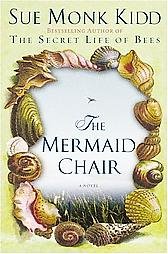
Southern author Sue Monk Kidd of The Secret Life of Bees improves upon her craft with second book The Mermaid Chair, packed with love, mystery, and candid meaning.

Maggie's Note: I'm taking on the persona of main character Jessie Sullivan. These words are my choice and not cited from the book.

Tuesday, August 01, 2006

What are your things?

“These things had been
like hibernating cicadas
that live in the ground
for seventeen years
and then one day,
when the circadian wheel turns,
all come crawling up into the light of day.”

~Sue Monk Kidd
The Mermaid Chair

Monday, July 31, 2006

When the Mississippi Ran Backwards (copy)

(I wrote this copy last year for the Southern Reporter)

Just 3 days after an earthquake hits our region, Jay Feldman appears on C-SPAN2’s Book TV discussing, When the Mississippi Ran Backwards: Empire, Intrigue, Murder, and the New Madrid Earthquakes. The book’s March 2005 debut eerily coincides with three quakes of 4.0 magnitude in our New Madrid seismic zone since February tenth.

Adding to the coincidences, the book also appears on my desk Friday afternoon. The same day, an excited patron relates his reaction to the early Thursday morning tremors of June 2, felt in his vegetable garden. Therefore, I had to read this book; Mother Nature herself created the hype.

By weaving three stories together, author Feldman has managed to keep his book from becoming stagnated like the Coldwater Bottoms.

The first story opens with Creek Indians meeting in the woods. Great Indian Warrior Tecumseh is rallying them to action against the whites with another powerful speech. When the Indians refuse to join his uprising, he prophesizes, upon his arrival at Detroit, he will stomp his feet and the earth will tremble. Later that year, the earth does tremble and a wall of water destroys their village.

Drunken slave owner, Lilburne Lewis and equally drunk brother Isham, nephews of Thomas Jefferson, have gathered their male slaves in the cookhouse. In this second story, Slave George is in trouble. He is spread eagle on the floor, as the other slaves must watch his brutal execution. Once dead, the slaves are instructed to dismember and burn the body in the cook’s fire place. Later that night the earth shakes, toppling the chimney and preserving evidence to the horrendous crime.

Feldman encompasses these stories with the fascinating tale of the first steamboat to travel down the Ohio and Mississippi rivers. Captained by Nicholas Roosevelt, great-grand uncle to Theodore Roosevelt, the newly constructed New Orleans is a joint venture with the famed Roberts, Fulton and Livingston.

Nicholas and Lydia, 24-years younger and very pregnant wife, transverse the dangerous “Falls of the Ohio” which induces Lydia’s birth. The couple, having survived the early perils, feels the rest of the trip will churn smooth like butter. That is until they wake up to discover their beloved New Orleans moving up the river without the aide of steam.

This is a must read for anyone interested in history, the Mississippi River, or the largest earthquake North America has ever recorded. Reel Foot Lake’s formation is also covered and debunks the story I heard as a child. Feldman makes a nice transition into the War of 1812 as he wraps up the aftershocks and their results.

For younger readers, try Judith St. George’s The Amazing Voyage of the New Orleans. Released in 1980, the book still captures the dangers and trails of being the first steamboat to successfully navigate the treacherous, snag laden Mississippi River. Not only did it encounter the surprise earthquake, but survived the “Falls of the Ohio” and a boiler fire. Great for second—fifth graders, especially boys, and the illustrations have hidden humor, kids love pointing out.
.

Blog Eyed!

Blog photo everyone uses to look mysterious…

Professional Photographer Please!

One with the fuzzy lens!

"Mr. Moran, I’m (NOT) ready for my close-up!”
Crop, Crop—Photo-Shop!
"Make-Up!"

Saturday, July 29, 2006

Sandy, Baby!

We brought home a new edition to our family today. Sandy, originally named Julie, is settling in quite well, but we have yet to hear her purr. The helpful staff and volunteers gave us sound advice and she has used her new box without any oops. Now, she is resting at my feet, see pic below…


This is the ad for Sandy, and the nice volunteer told us she just got her picture on the website at noon today. We went in to get Rose, my husband wanted a cat that didn’t like competition, and I didn’t care. (He knows I would take them all!) Julie's story was heart breaking and we drove over an hour to see her and Rose...

Collierville Animal Services
Collierville, TN
901-457-2670

Cat
Domestic Short Hair - buff and white
Size:
Medium
Age: Adult
Sex: Female
Notes: Now here's a story that will break your heart. A car pulls up early one morning, the occupant finds the front door unlocked, the lobby empty, and proceeds to throw a cat inside and speed away just as an employee comes in from the back. This poor baby huddled in a corner, scared half to death, as our employee tried to figure out WHAT had just happened. We have named her Julie; she is declawed and already spayed. Whoever did this doesn't deserve her anyway. She is safe and loved here and we will do whatever we can to find someone who will love her always...

Tuesday, July 25, 2006

The Story of a Shipwrecked Sailor (copy)

Nothing is better than sitting in a cool theatre, watching a summer blockbuster; one gets a break from the heat and entertained at the same time. Well, after viewing Pirates of the Caribbean: Dead Man’s Chest, the second best thing is to read a nautical tale.

This week I chose The Story of a Shipwrecked Sailor by Gabriel Garcia Marquez. This true story first appeared as a series of articles in a Colombian newspaper, El Espectador. Sailor Luis Velasco was tossed overboard the Colombian naval destroyer Caladas, during a routine trip from Mobile, Alabama, to Cartagena, Colombia. He was at sea, devoid of food and water, for ten days.
Once on dry land, Velasco became an instant national hero, “kissed by beauty queens, made rich through publicity,” but unable to tell his real story. After a year of publicity rounds, sporting his unstoppable watch and inedible sneakers, he showed up on the steps of Bogota’s El Espectador.

At the time, the newspaper was in its infancy with a director, editor-in-chief and staff reporter all under the age of thirty. Colombia, ruled by military and social dictator General Gustavo Rojas Pinilla, played down the true events and Velasco’s vastly publicized story had a certain sugary taste.

Author Garcia Marquez was the lone reporter assigned Velasco’s story—a story, which eventually saw the demise of El Espectador, not because of Marquez’s writing ability (he became a Nobel winner in 1982) but rather Velasco’s proof, as in photographs, to damage Pinilla’s government.

Apparently, there was some contraband loaded on the destroyer’s deck, which added instability to the craft. Were they transporting atomic weapons? Not really, they loaded on the regime’s refrigerators, washers and dryers, televisions and air conditioners. So much so, the weight and balance was out of kilter, and the ship began to list.

After midnight, an order came from the loudspeaker, “All personnel to the port side.” At 11:30 the following day, the order again reissued. This time Velasco and shipmates were on watch, not safe in their bunks. At 11:50, one of the many forceful waves knocked some crates loose, and as they began to slide into the sea, eight sailors seeking shelter from the waves went with them.

On February 28, 1955, seven crewmembers lost their lives because, “ill-secured moral and political cargo,” repressed the large destroyer from maneuvering to save them.

This is the story of one man surviving ten grueling days at sea. These few paragraphs are just the beginning; it is up to you to read a budding master at his craft.

“Aye, ‘tis good reading to be sure.”

Sunday, July 23, 2006

The Mermaid Chair (notes)

“Submerged, I would always go off into a dreamy state. I had always loved Chagall’s Lovers in the Red Sky, his painting of an entwined couple soaring above rooftops, above the moon. The image would come to me each time I sank into the wave, the couple sometimes flying through a red sky but more often swimming in searing blue water.

Other times I would think of the mermaid Chagall had painted, suspended above the water, above the trees, a flying mermaid, but without wings, and I would think of Thomas saying he envied mermaids who belonged to the sea and to the sky” p129 ~ Sue Monk Kidd

How effective is art in visualizing a mood if the reader is unfamiliar with the piece?

Friday, July 21, 2006

July 7, 2006

Pete and I toured the streets of Charlottetown, PEI today. Without order, we explored the marinas and discussed the architecture, when a small sign caught my attention. Located at the corner of two streets, the sign claimed, “local books ahead.” I hastily took hold of Pete and swung us ‘round the corner, my appetite whetted by imagined stories of local folklore and ghosts.

Upon entering, I cried out, “Where are your local books!” The jovial bookseller pointed me in the right direction and added his recommendations on the latest. As I shopped, he put on a fresh pot of coffee and the little book nook took on a heady scent.

My host, a cheeky old salt, with rousing beard and salaciously witty manners, had a Gordon’s Fisherman appearance. It is with professional curiosity I asked him which genre he preferred to read. He likes a good mystery or thriller, quick to point out the new Evanovich, but in truth, he leans less towards the genres and more towards the books of substance.

My question, “Would that be the substance of learning in non-fiction or the substance of literary fiction?”

My short Hemingwayish peddler said he enjoyed the writings of modern literary greats like Nobel Prize winner, Gabriel Garcia Marquez. As he named his favorites among Senor Marquez’s works, I thought it about time to tackle “Love in the Time of Cholera.” I mean RA is more effective when one actually reads the recommended books.

To this Papa I owe a gift. What recommendation can I possibly make as equal?

PEI's best bookstore is called The Reading Well.

Sunday, July 02, 2006

Mississippi Roads Less Traveled - Books

^
^
"The World is a book,
and those
who do not travel,
read only a page."
^
~ St. Augustine