In the world of literature, freakish freckles, curiosity and stubbornness make for memorable characters. Pippi Longstocking, Laura Ingalls, Caddie Woodlawn and Anne Shirley are just a handful of fictional characters that spring to mind.
As an early reader, one tends to gravitate towards characters that mirror friends or one’s self. My first encounter with the be-speckled sort, arriving in book form, was Eloise. My mother and I spent hours reading this picture book front to back. Maybe because she mentioned I was very much like Eloise. 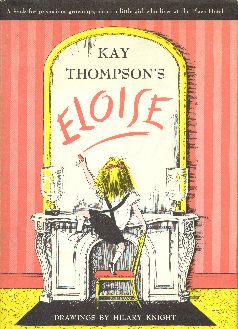
At the time, I didn’t think she meant precocious; instead, I focused on her physical traits. Miss Eloise wasn’t a cutesy character, but an ugly, pencil-legged, big-bellied mess. Remember her freckles? Well, she only sported a few, but after Mom’s comment, my Eloise had hundreds. I knew better than mark a book; however, in my mind, she became as splotched as a speckled egg. Imagine my surprise when reading Anne of Green Gables by Lucy Maud Montgomery. The character Anne Shirley is an 11-year-old, red-headed and enormously freckled, opinionated orphan girl. She could have been my hero, had I known she existed.
I became familiar with Anne on a recent trip to Prince Edwards Island in Canada. As a librarian, I knew the Green Gables series, but my childhood revolved around another entertaining one, Little House on the Prairie. The kindred spirit I felt with Anne, even as an adult, was a little unexpected.
As a teacher, librarian or parent facing a reluctant reader or struggling to get a book in a child’s hand, remember this little secret—it is all in the character. This small tip is the key to creating a life-long reader. If the child identifies with a character, they tend to become the character. For example, I was crawling all over the Plaza, not Eloise.
Search out books filled with characters that mirror the young reader’s world. Take a trip to the library and check out a stack. Sit back and watch as their eyes light up when they recognize themselves. One might catch them role-playing with their imaginary, new friends.
This universal trait applies to adults, too. Adult characters may not have as many freckles, but somehow I can always tell if they did as children.
Wednesday, August 23, 2006
Freckles (copy)

Sunday, August 20, 2006




Saturday, August 19, 2006
Celebrity Look-a-Like

Can't say I really look like any of these
Unique as Snowflakes
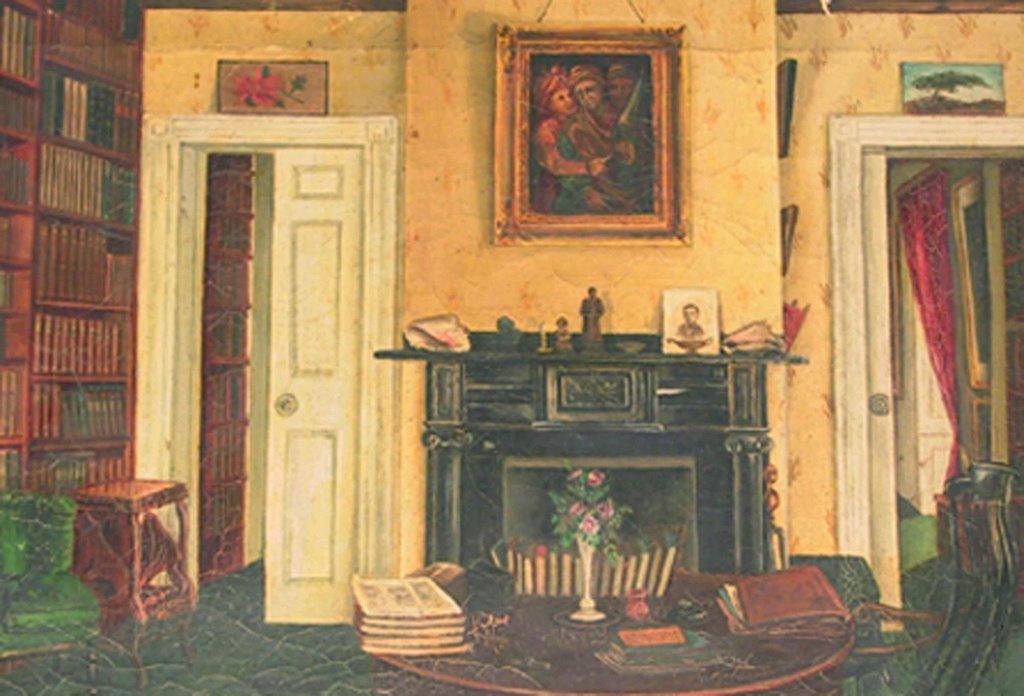 View of Emerson's study 1877 by Florence Todd
found at Concord Museum
Wednesday, August 16, 2006
The Weather Makers (copy)
We read about it in newspapers and magazines; we hear about it from our neighbors and colleagues; we watch nature shows that include it and a former vice president lent his time to a recent movie about it. What is IT?
It is global warming and it is becoming one hot topic. A topic so hot it literally smacks you in the face when you first step outside. That is, if you believe.
While brushing my teeth before bed, I overheard David Letterman say, "This day in 1909, Antarctica was a negative 38 degrees; today it is 82 and sunny." He had just finished his monolog and was sitting at his desk when this casual comment popped out. I laughed, but then I stopped. Is this really a joke or is he telling the truth?
The South has always experienced hot, sweltering summers. This summer’s drought, the same two summers ago as 30 years ago, is normal. Heck, every mid-south farmer remembers the summers of 1988 and 1993 when we were either bone-dry or sopping wet. Heat waves, like sweet tea and watermelon, are essential elements of summer. So, if we are a little skeptical about global warming, it is understandable.
Author and scientist, Tim Flannery, claims to be a skeptic by nature about nature. He believes, “skepticism has a particularly important role to play in science, for a theory is only valid for as long as it has not been disproved.”
This is the premise of his new book, The Weather Makers. In this intense, dense book, Flannery assembles all the latest and most respected works on the subject. He then breaks the theories into three parts: reasons for the phenomenon, current effects of the phenomenon and earth’s future.
As the jacket blurb would like you to believe, we are to read the chapters through cynic eyes and make our own decisions. Unfortunately, Flannery falls short of the skeptic role, and we, as readers, lack his questioning voice. We are spoon-fed these theories as fact and expected to agree with his conclusions.
Flannery breaks his promise, but this doesn’t diminish the book’s value. He may not go about breaking myths like Myth Busters, but he does provide important information to laymen. For example, one will gain an understanding of the different methods of gauging temperatures through time. I highly recommend this book to anyone straddling the fence on this issue. Flannery successfully knocked me off.
Saturday, August 12, 2006

Friday, August 11, 2006
Not Picking this Battle
 I’m putting The Weather Makers down and moving on. I was planning to write favorable copy, but general opinion discourages me. Apparently, my Southern neighbors believe global warming bogus.
I see their point. The South has always experienced hot, sweltering summers. This summer’s drought, the same 2 summers ago as thirty years ago, is normal. If we are truly experiencing a warming effect, it should be even hotter.
They do admit to the milder winters. It has been a good thirty years since ponds have frozen over. To Southerners, skating in your tennis shoes on the farm’s pond indicates an extra chilly winter.
I shouldn’t type cast all Southerners as non-believers. I give credit to author Tim Flannery for knocking me off the fence, having approached the issue as a skeptic. It is only through his vast research my stubborn views changed.
The book can change other Southern minds, too. I commit eagerly to book talking this honorable title, one-on-one. Using visual cues to judge my effectiveness, (like a seer) I adhere to rule number three, “Every book his reader.”
The Weather Makers (notes)
“The best evidence indicates that we need to reduce our CO2 emissions by 70% by 2050.” p6
“70 percent of all people alive today will still be alive in 2050, so climate change affects almost every family on this planet.” p7
“The CO2 from breath last week may now be feeding a plant on a distant continent, or plankton in a frozen sea. In a matter of months, all of the CO2 you just exhaled will have dispersed around the planet. Because of it dynamism, the atmosphere is on intimate terms with every aspect of our earth, from the mantle upward. No volcano belches, no ocean churns—indeed, no creature breathes—without the great aerial ocean registering it.” p22
Wednesday, August 09, 2006
French Women Don't Get Fat (copy)
What is it about diet books that make you hungry? Is it the impending deprivation between the lines? For example, my mother’s Sunday school class all gained weight when trying the Christian based diet book, Weigh Down by Gwen Shamblin. Why? Mom claims they all had a tendency to snack while reading. Usher in a new book that puts a cultural spin on weight loss. French Women Don’t Get Fat by Mireille Guiliano is your typical diet book; nothing new or earth shaking here. The common sense tips like drink plenty of water and eat smaller portions reduce weight. No mystery really, although, we secretly feel those Frenchies hoard a skinny gene from Gallic ancestors.
The book's strong point is an eye-opening glimpse into French culture. French women shop daily for fresh in-season produce and meats. French women endure many courses in one sitting by only tasting the selections and chewing slowly. Then there is the magical (natural diuretic) leek soup recipe found on page 26.
Author Giliano begins the book with her own story. At 19 she spent one year in America as a French student participating in a high school exchange program. Upon her return to France, her own father greets her with, “Tu ressembles a un sac de patates.” In English that means you look like a sack of potatoes. Quel horreurs!
Giliano claims she gained weight because of a weakness for pastries. Her solution, when face-to-face with dessert, eat a bite or two for taste and then launch into a funny story. As you deliver the punch line your company will have eaten their last morsel. Then out of politeness pass yours aside and enjoy coffee.
As in real estate, chubbiness is all a matter of, “location, location, location”. Plop a skinny French woman in Dixie and she would be chubby in a month. First, buckle her up in a car, no more walking to the market, and introduce her to fast food. Next, teach her to marinate the Southern way; bread and soak all manner of food in hot grease until golden brown. Lastly, take away her smokes, a sure 10 lb. gain. French women see cigarettes as a classic fashion accessory. The French term “le smoking” actually means dinner-jacket.
To recap, French women don’t get fat because they don’t live in the US and they probably smoke. So, don’t feel so guilty, we have more obstacles to overcome.
The book has an instant appeal for those of us that think France is so romantic. Who wouldn’t want to live like Gigi, dressed in black cigarette pants, white swingy top and black beret toting market fresh French bread, wine and flowers ala Audrey Hepburn in Sabrina through the cobbled streets of Paris.
Listen, save your money on this book and if you must read it, check it out at the library. If you are really serious about losing weight here are the keys. Drink water, exercise regularly and do not eat anything white specifically flour, sugar and salt. When you reach your target weight, eat slowly and in moderation. Vive la difference!
Dictionary Digs
It’s that time of year, when weary parents rejoice at the mere mention of school. The excitement abounds as the household readies for the big event. New clothes, new school supplies, even new shoes are bought for the big occasion. Did you remember the new books?
Whether off to college or to the local kindergarten, we all want our children to do their best. One key to success is a basic understanding of our native English tongue. This is why a dictionary is the single most important book in the house.
“Why, Maggie, the most important book in the house is the Bible.”
Yes, you have a point; the Bible will help all succeed spiritually. A high-quality dictionary on the other hand, will help all succeed intellectually. How many times has a word in the Bible sent you in search of a dictionary? Imagine my surprise when I looked up begot and sired while reading Genesis in sixth grade.
Dictionaries, thesauruses, encyclopedias, and familiar quotations are the cornerstones of any functional library. A good place to begin your child’s education would be with a dictionary. I suggest purchasing hardbacks for younger readers; they are usually substantial enough to withstand the bumps and bruises of play.
Merriam-Webster begins their popular dictionary series as early as preschool with the MW’s Alphabet Book or MW’s Primary Dictionary. All entries have a corresponding picture to enhance the child’s understanding of the word or concept. Another option is Dorling Kindersley’s children’s series; DK My First Dictionary or DK Illustrated Dictionary.
As your children mature, consider replacing their reference books with Merriam-Webster’s Elementary or Intermediary Dictionary. These books exclude explicit words, maintaining a G-rating. To save money, you may wish to purchase a family dictionary. In our house, we have an ancient pre-computer aged Webster, which lacks words like modem, fax and internet.
If your sons and daughters are headed off to college, 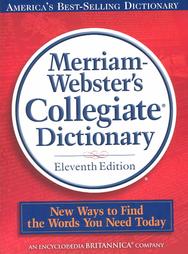 ensure they have MW’s Collegiate Dictionary. This standard, used as dorm room doorstops all over America, is now in its eleventh edition. If they request a lighter tome, Merriam-Webster offers a dictionary in MP3 format through Franklin Electronics.
At the next tax-free weekend in Memphis, don’t forget the books needed to see your young scholar through preschool to their doctorate degree.
Saturday, August 05, 2006
That That (the sequel)
Seized in place, do I continue to read or gently close the book, take aim, and drive it into my green wall? Of course, I’ll continue reading, being a meek and mild librarian.
Stepping upon the soapbox—I say that that ‘that’ that that author used is wrong. What?
Another author paid to write “that that” in a sentence that needs only one. Which sentence would that be? The Weather Makers author, Tim Flannery writes, “I’m far from certain that that is true, and I’m not sure it is even relevant.” p7
Why is it that that bothers me? Well, it’s a typo that people feel might actually be right. Believe me, one will not change the meaning of the sentence by omitting an extra that.
I see these double words frequently when reading. Lots of “the the” and “and and” have me scratching my head. My Microsoft word catches these with red underscores but ignores double thats. Why is that that way?
I know that this is all irrelevant. Editors are missing the obvious “the the” combos, don’t criticize “that that,” which might be right. Here is my tiff, Flannery is wordy, and his subject at times confusing. An editor needs to weed out extra wordage to aid the reader’s time management. Took me a nanosecond to digest the “that that” but a good 30 minutes to get over it!
Sighing as I step off the soapbox.
Wednesday, August 02, 2006
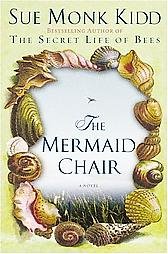
The Mermaid Chair (copy)
 What do you do when your mother does something exceptionally weird? So weird in fact you are thinking of having her committed. I mean, even at her best, she always seems to stand on shifting sand.
My mother, Nelle Dubois, wasn’t always this way. Before she lost her husband, she never missed a picnic or clambake. She would be the first in the water when tide was out and the last to leave the annual Mermaid Festival parade. Now she spends her time in religious ceremonies, constant rosary chants and cooking meals for the island’s Benedictine monastery.
It hasn’t always been easy, being the daughter of one so morose. Before Dad’s tragic accident, I could tell she loved me, although a little removed. It was my father that doted on me. He would sing my name Jessie Jessie Jessie as he barreled through the front door after work. I was so special to him; he even named his boat after me, Jes-Sea.
Maybe this island has driven her to do such a horrible thing. Some crazed island fever, like cabin fever, the same fever which drove her to bury an old tub in the front yard. Just halfway that is, so she could place Mother Mary inside and plant flowers all around—an icky grouted grotto, for all to admire.
Possibly the people themselves have led to Mother’s derangement. Can you believe our little island has a mermaid saint? Something the tourists just eat up. I mean, slap a mermaid on it and its gold. The island is literally littered with hundreds of yellow signs stating, “Mermaid Xing.”
We call her Saint Senara, and every April 30, we carry her throne through the sandy lanes of Egret Island. On the backs of celibate monks, aloft for all to see, breast of mermaids swaying in the island heat. Maybe the whole island nation could use a little time in a padded cell. Might be something the monks could rent out for income.
I mean to say, this is how I left the island 23 years ago. I left golf cart commuters, slave cemetery viewers, and mermaid lovers behind—far behind, until the implausible late night call. My mother, saints preserve us or should I say mermaids preserve us, is less one finger. It seems she voluntarily, without accident, donated a digit to the Lord during her nightly monastery cooking.
Southern author Sue Monk Kidd of The Secret Life of Bees improves upon her craft with second book The Mermaid Chair, packed with love, mystery, and candid meaning.
Maggie's Note: I'm taking on the persona of main character Jessie Sullivan. These words are my choice and not cited from the book.
Tuesday, August 01, 2006
What are your things?
 “These things had been
~Sue Monk Kidd
The Mermaid Chair
Monday, July 31, 2006
When the Mississippi Ran Backwards (copy)
(I wrote this copy last year for the Southern Reporter)
Just 3 days after an earthquake hits our region, Jay Feldman appears on C-SPAN2’s Book TV discussing, When the Mississippi Ran Backwards: Empire, Intrigue, Murder, and the New Madrid Earthquakes. The book’s March 2005 debut eerily coincides with three quakes of 4.0 magnitude in our New Madrid seismic zone since February tenth. Adding to the coincidences, the book also appears on my desk Friday afternoon. The same day, an excited patron relates his reaction to the early Thursday morning tremors of June 2, felt in his vegetable garden. Therefore, I had to read this book; Mother Nature herself created the hype.
By weaving three stories together, author Feldman has managed to keep his book from becoming stagnated like the Coldwater Bottoms.
The first story opens with Creek Indians meeting in the woods. Great Indian Warrior Tecumseh is rallying them to action against the whites with another powerful speech. When the Indians refuse to join his uprising, he prophesizes, upon his arrival at Detroit, he will stomp his feet and the earth will tremble. Later that year, the earth does tremble and a wall of water destroys their village.
Drunken slave owner, Lilburne Lewis and equally drunk brother Isham, nephews of Thomas Jefferson, have gathered their male slaves in the cookhouse. In this second story, Slave George is in trouble. He is spread eagle on the floor, as the other slaves must watch his brutal execution. Once dead, the slaves are instructed to dismember and burn the body in the cook’s fire place. Later that night the earth shakes, toppling the chimney and preserving evidence to the horrendous crime.
Feldman encompasses these stories with the fascinating tale of the first steamboat to travel down the Ohio and Mississippi rivers. Captained by Nicholas Roosevelt, great-grand uncle to Theodore Roosevelt, the newly constructed New Orleans is a joint venture with the famed Roberts, Fulton and Livingston.
Nicholas and Lydia, 24-years younger and very pregnant wife, transverse the dangerous “Falls of the Ohio” which induces Lydia’s birth. The couple, having survived the early perils, feels the rest of the trip will churn smooth like butter. That is until they wake up to discover their beloved New Orleans moving up the river without the aide of steam.
This is a must read for anyone interested in history, the Mississippi River, or the largest earthquake North America has ever recorded. Reel Foot Lake’s formation is also covered and debunks the story I heard as a child. Feldman makes a nice transition into the War of 1812 as he wraps up the aftershocks and their results.
For younger readers, try Judith St. George’s The Amazing Voyage of the New Orleans. Released in 1980, the book still captures the dangers and trails of being the first steamboat to successfully navigate the treacherous, snag laden Mississippi River. Not only did it encounter the surprise earthquake, but survived the “Falls of the Ohio” and a boiler fire. Great for second—fifth graders, especially boys, and the illustrations have hidden humor, kids love pointing out.
.
Blog Eyed!
 Blog photo everyone uses to look mysterious…
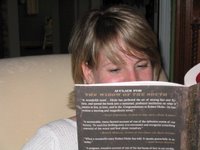
Professional Photographer Please!
One with the fuzzy lens!


Saturday, July 29, 2006
Sandy, Baby!
We brought home a new edition to our family today. Sandy, originally named Julie, is settling in quite well, but we have yet to hear her purr. The helpful staff and volunteers gave us sound advice and she has used her new box without any oops. Now, she is resting at my feet, see pic below…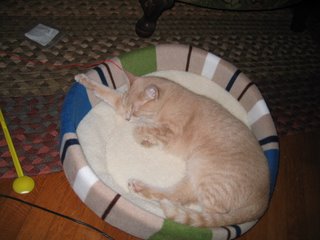
This is the ad for Sandy, and the nice volunteer told us she just got her picture on the website at noon today. We went in to get Rose, my husband wanted a cat that didn’t like competition, and I didn’t care. (He knows I would take them all!) Julie's story was heart breaking and we drove over an hour to see her and Rose...
Collierville Animal Services
Collierville, TN
901-457-2670
Cat
Domestic Short Hair - buff and white
Size: Medium
Age: Adult
Sex: Female
Notes: Now here's a story that will break your heart. A car pulls up early one morning, the occupant finds the front door unlocked, the lobby empty, and proceeds to throw a cat inside and speed away just as an employee comes in from the back. This poor baby huddled in a corner, scared half to death, as our employee tried to figure out WHAT had just happened. We have named her Julie; she is declawed and already spayed. Whoever did this doesn't deserve her anyway. She is safe and loved here and we will do whatever we can to find someone who will love her always...
Tuesday, July 25, 2006
The Story of a Shipwrecked Sailor (copy)
Nothing is better than sitting in a cool theatre, watching a summer blockbuster; one gets a break from the heat and entertained at the same time. Well, after viewing Pirates of the Caribbean: Dead Man’s Chest, the second best thing is to read a nautical tale. This week I chose The Story of a Shipwrecked Sailor by Gabriel Garcia Marquez. This true story first appeared as a series of articles in a Colombian newspaper, El Espectador. Sailor Luis Velasco was tossed overboard the Colombian naval destroyer Caladas, during a routine trip from Mobile, Alabama, to Cartagena, Colombia. He was at sea, devoid of food and water, for ten days.
Once on dry land, Velasco became an instant national hero, “kissed by beauty queens, made rich through publicity,” but unable to tell his real story. After a year of publicity rounds, sporting his unstoppable watch and inedible sneakers, he showed up on the steps of Bogota’s El Espectador.
At the time, the newspaper was in its infancy with a director, editor-in-chief and staff reporter all under the age of thirty. Colombia, ruled by military and social dictator General Gustavo Rojas Pinilla, played down the true events and Velasco’s vastly publicized story had a certain sugary taste.
Author Garcia Marquez was the lone reporter assigned Velasco’s story—a story, which eventually saw the demise of El Espectador, not because of Marquez’s writing ability (he became a Nobel winner in 1982) but rather Velasco’s proof, as in photographs, to damage Pinilla’s government.
Apparently, there was some contraband loaded on the destroyer’s deck, which added instability to the craft. Were they transporting atomic weapons? Not really, they loaded on the regime’s refrigerators, washers and dryers, televisions and air conditioners. So much so, the weight and balance was out of kilter, and the ship began to list.
After midnight, an order came from the loudspeaker, “All personnel to the port side.” At 11:30 the following day, the order again reissued. This time Velasco and shipmates were on watch, not safe in their bunks. At 11:50, one of the many forceful waves knocked some crates loose, and as they began to slide into the sea, eight sailors seeking shelter from the waves went with them.
On February 28, 1955, seven crewmembers lost their lives because, “ill-secured moral and political cargo,” repressed the large destroyer from maneuvering to save them.
This is the story of one man surviving ten grueling days at sea. These few paragraphs are just the beginning; it is up to you to read a budding master at his craft.
“Aye, ‘tis good reading to be sure.”
Sunday, July 23, 2006
The Mermaid Chair (notes)
 “Submerged, I would always go off into a dreamy state. I had always loved Chagall’s Lovers in the Red Sky, his painting of an entwined couple soaring above rooftops, above the moon. The image would come to me each time I sank into the wave, the couple sometimes flying through a red sky but more often swimming in searing blue water.Other times I would think of the mermaid Chagall had painted, suspended above the water, above the trees, a flying mermaid, but without wings, and I would think of Thomas saying he envied mermaids who belonged to the sea and to the sky” p129 ~ Sue Monk Kidd
How effective is art in visualizing a mood if the reader is unfamiliar with the piece?
Friday, July 21, 2006
July 7, 2006
Pete and I toured the streets of Charlottetown, PEI today. Without order, we explored the marinas and discussed the architecture, when a small sign caught my attention. Located at the corner of two streets, the sign claimed, “local books ahead.” I hastily took hold of Pete and swung us ‘round the corner, my appetite whetted by imagined stories of local folklore and ghosts.
Upon entering, I cried out, “Where are your local books!” The jovial bookseller pointed me in the right direction and added his recommendations on the latest. As I shopped, he put on a fresh pot of coffee and the little book nook took on a heady scent.
My host, a cheeky old salt, with rousing beard and salaciously witty manners, had a Gordon’s Fisherman appearance. It is with professional curiosity I asked him which genre he preferred to read. He likes a good mystery or thriller, quick to point out the new Evanovich, but in truth, he leans less towards the genres and more towards the books of substance.
My question, “Would that be the substance of learning in non-fiction or the substance of literary fiction?”
My short Hemingwayish peddler said he enjoyed the writings of modern literary greats like Nobel Prize winner, Gabriel Garcia Marquez. As he named his favorites among Senor Marquez’s works, I thought it about time to tackle “Love in the Time of Cholera.” I mean RA is more effective when one actually reads the recommended books.
To this Papa I owe a gift. What recommendation can I possibly make as equal?
PEI's best bookstore is called The Reading Well.
Sunday, July 02, 2006

Wednesday, June 28, 2006
Flirt Alert:
What Southern Women Know about Flirting (copy)
 Ah, the art of flirting, all respectable Southern woman use this secret weapon every once in a while. It is one of the basic tools in our psyche, allowing us to obtain wants and needs in a fun, game-like manner. Flirting allows us to meet new people, charm the curmudgeons, and climb the business ladder. We know exactly when to use it and when to turn it off.
Margaret Mitchell got it right in Gone with the Wind, when Bonnie Blue hugs and kisses a delighted Daddy Rhett, and then asks for a pony. We, as Southern girls, are always Daddy’s little girl and carry this special gene for the flirting ability.
Our fathers activate this gene without consciously being aware. From the beginning, they melt when asked for something, if given the proper XXOOs lead-in. When they realize they may be spoiling us, they slow down rewards. We still get what we want, but we may wait a couple of months or years for satisfaction. This slow down is an opportunity to hone our skills for the hard sell, we know her as mother.
Ronda Rich fills her book, What Southern Women Know about Flirting, with wonderful Southern stories to demonstrate our God-given ability. One of my favorites involves the marital argument, which always occurs if one spouse thinks the other is “laying it on too thick” at a social event.
“…an Alabama-trained diva, and her husband left a Christmas party and immediately entered into an argument over her allure and charm, which had held most of the men at the party captivated. He thought she had taken too far her vow to always uphold social flirting as a critical attribute of Southern womanhood. As they argued, he swerved the car and looked up moments later to see a blue light flashing behind him.
He pulled over and a trooper approached the car. Since [the] husband, an attorney, had partaken of a couple of glasses of wine over the course of the evening, he was a bit nervous. After checking his license, the trooper said, ‘Sir, can you recite the alphabet for me?’
[The wife] leaned across her husband and said sweetly with a flutter of her eyelashes, ‘Now, officer, he couldn’t recite the alphabet when he was a senior at Ole Miss. Why would you expect that of him now?’ She finished the question with a delicious, flirtatious smile, and the officer laughed so hard that he dropped the whole matter.
As her chastised husband pulled the car back onto the road, she asked mischievously, ‘Now, what do you think of my charm?’”
Tuesday, June 27, 2006
Just for fun...Thanks Orange Blossom
| You are Betty Grable |
 The ulitmate girl next door You're the perfect girl for most guys Pretty yet approachable. Beautiful yet real. |
Monday, June 26, 2006

Wednesday, June 21, 2006
We are All Welcome Here (Copy)
Author Elizabeth Berg received a letter in 2003 requesting she write the story of polio survivor, Pat Raming. The letter, written by Pat’s youngest daughter, Marianne Raming Burke, began, “I have no idea if you get this type of request often, however what is life without risks?”
Fiction writer Berg was ready to pass on the request, believing a non-fiction author would better suit Mrs. Burke’s needs. In the Author’s Note, Berg states, “I don’t like to take ideas from anyone—it goes best when I work alone.”
Yet, she could not stop looking at the photograph enclosed in the letter. The picture depicts a wheelchair-bound, young mother and sweet, curly-blonde daughter in front of their ranch home in California. “I was so taken with the lack of pity and the strength and joy I believed I saw on her face," Berg wrote in an e-mail.
Four days before Marianne’s birth in 1952, her mother contracted polio that placed her in an iron lung. Marianne, the youngest of three, believes she is the only baby to survive an iron lung birth. Marianne added, "They had her funeral ready and mine."
To make matters worse, Mr. Raming suggested they put their children up for adoption. The cause of their immediate divorce, Pat vehemently denied this insensitive request. It was now Pat’s responsibility to raise three children, all under the age of six, within her wheelchair-toting, portable lung. Although the book, We are All Welcome Here, is based on this true story, it is purely fictional. Berg, who likes to explore mother-daughter relationships in her novels, has chosen polio-stricken mother, Paige Dunn, and only child, Diana Dunn, as her main characters.
In the summer of 1964, 14-year-old Diana is the primary night caregiver to Paige. It’s another grueling summer in Tupelo, Mississippi, not only for the heat but also the simmering discourse between the races. There are three individuals in the Dunn household struggling with freedom issues: Paige, Diana, and the house cleaner, Peacie.
This is unlike any book Elizabeth Berg has written. She seems to rush through this story, as if she has a train to catch. The plot is predictable, yet, I can’t taint a woman who adds Elvis to her mix of characters. If anything, pick it up for the local flavor, it only takes a day to read.
Monday, June 19, 2006
My Fantasy Quest
In my quest to Make Mississippi Read, I wanted to explore a genre of the unfamiliar. I’ve read the Harry Potters and have tried to promote read-a-likes, but you can’t fool children. They know when you haven’t read a book. So, on special assignment and because this is a genre bookstores carry, I listened to fantasy on CD including Eragon by Christopher Paolini
A Series of Unfortunate Events: The Grim Grotto by Lemony Snicket and a book by Dave Barry and Ridley Pearson titled Peter and the Starcatchers. I also read The Thief Lord by Funke and the new book Buried Fire by Jonathan Stroud.
This genre is not only fun but also addictive. I find it utterly amazing how writers dream up these new worlds. Along with new lands, they create outrageous names and unheard of creatures. They truly force their reader to take on the whole package that is their story or put it down. They present us with their own vocabulary which you must learn or face further chapters of confusion. This could be the reason many begin in a reality setting then fall through the infamous rabbit hole to a new world below.
These books pack excitement that keeps the pages turning. Many are full of end-of-the-chapter cliff hangers that yell at you to hold it; bathroom break later. The plot driven device is “good versus evil” and the hero is usually a child. Reader’s can really relate to the hero: a kid about their age, without all the answers, and willing to try stupidly brave acts. By sheer grit and determination this hero saves the fantasy world or conquers the evil that controls it. These books empower the child reader to take the steps necessary to become the hero.
Wherever there are children reading good fantasy, there will be controversy. One doesn’t occur without the other. I once had a whole family (5 kids ages 4-12) refuse to participate in our Summer Reading Program because the theme was “Fantasy Quest.” It is with heavy heart you listen to their reasons, present yours, and know that compromise is highly unlikely. Funny, they want their children to believe in an invisible force called God, but are afraid they will also believe in a fantasy world filled with witches and dragons. Let’s try trusting the kids to know the difference and act accordingly.
Wednesday, June 14, 2006
The Dead Beat (copy)
As we age, some things just naturally occur: we lose a little hair, we wrinkle a little around the eyes and we begin to hold the newspaper further away, as we read the obituary page. Yes, the aging process gently leads us to the daily reading of obituaries.
In our 20s and 30s, we just glance over the names of the newly departed. If we know the person, we skip to the last sentence to address the donation check or make visitation plans. In our late 30’s through early 50s, we start reading deeper into the announcement, looking to aid survivors by phone calls or food. When is it we start to focus on the age of the deceased as less a curiosity and more a barometer to our own longevity?
As you read obituaries, you start to wish they conveyed more of the person’s past spirit. The articles contain the basics, yet they miss the essences that made a life essential on earth. As Marilyn Johnson says in her new book, The Dead Beat, “A little life well lived is worth talking about.”
Author Johnson claims this is a good time to die. “Historians tell us we are living in the Golden Age of the Obituary.” Three of the biggest papers in America have reporters who report only on the departed—an assignment known fondly in the business as the “dead beat.”
The obituary section, usually assigned to insubordinate reporters as punishment, became an opportunity to weld ink pens filled with bittersweet sentiments. Banished to the basement, reporters figured no one would be reading their work so why not jazz it up. They even took to mock announcements, giving overly flourished eulogies, punctured with an atmosphere of hush, to saintly ghost that were never born.
Famous people require a reporter to research their lives and have the obituary written months in advance. These two-to-three, column-long missives called “canned obituaries” are ready when it is time for the second act.
Violet-eyed, Elizabeth Taylor’s obituary has been written and rewritten as the actress struggles with continuing health issues—multiple broken backs, life threatening pneumonias, hip replacements and now congestive heart failure. One eager reporter, in the early 90s, leaked her canned obit to the presses. After reading them she said, “The best reviews I ever had.”
Tuesday, June 13, 2006
Beep! Beep! I need Sheep in a Jeep!
 The Accelerated Reader (AR) program has an admirable mission and all public libraries want to help. As public institutions, we purchase materials for the public, but out of necessity, we have added extra AR paperbacks to the collection. Why? The demand is great and the elementary schools libraries do not allow children to check out.
Picture little Betty coming home and telling mom she needs to read Sheep in a Jeep by Nancy Shaw for school. Time always of the essence, big Betty fires up the car and heads to the public library. They greet the happy librarian who takes little Betty by the hand and shows her Sheep in a Jeep and others in the sheep series. Meanwhile big Betty pulls out the AR list and begins the search for four more.
So, what is the big deal? Well, as the Betties leave with their five AR books, no time for any extra books, they pass Joe and Joe Jr. Yep, Joe has the same list and Sheep in a Jeep just departed with the Betties. Joe Jr. is in little Betty's class and eventually all these easy reading mates will visit the library before the week ends. The holds list for Sheep in a Jeep just jumped to fifteen.
It is a difficult situation to force a public library to buy multiple books because of school assignments. Really, with shelf space concerns, one hardback or two paperback copies of Sheep in a Jeep is enough. It might not be so bad if you are working with just one school. In our area there are three different elementary schools, which have bought, and brought different AR lists.
As a public library we have a special mission to supplement the school curriculum as much as feasibly possible. We just look unprofessional come the third, fourth, and so on kids we cannot serve because of demand. You can see why the schools prefer their books sit on their shelves.
My answer is to give these kids more time with AR books while in school. Provide 20 minutes in the morning and possibly take the test after lunch. We as librarians can also be sure to add silly, just for the heck of it, books to their AR pile.
"Miss Betty, have you read Don't Let the Pigeon Drive the Bus?"
Saturday, June 10, 2006
Paid to write that that
Now, stand back, I’m about to step upon my soapbox.
Where is Marilyn Johnson’s editor? I love this book for many reasons, mostly the humor, the inside information, and the unusual subject. That said, how do I write a positive review when the author makes (elementary school) English mistakes?
Throughout her surprise chat with Billy Collins she misrepresents the possessive apostrophe with an extra “s.” On pages 45 & 46 she writes, “Collins’s anthology” and “Collins’s father.” Just how many Billy Collins(es) is she yapping to. She doesn’t capitalize titles like on page 44, “former poet laureate of the United States, Billy Collins.” This very sentence begins with “and” as follows. “And that was when I saw that that great stillness next to the window was the former,” add above ending.
Yes, I know what you are thinking, calling a spade a spade, aren’t I.
I just finished looking up the rule for apostrophes and am clearly in the wrong. Author Johnson has correctly placed the divet for which I became riled. Please excuse my ignorance. The rule I found gave the "Jones's bakery" as an example. If it was more than one it would be "Joneses' bakery."
I still stand by my other observations. I believe she should erase and rewrite the whole sentence on page 44. For example, "It was then, I noticed the great stillness to be no other than the former Poet Laureate of the United States, Billy Collins."
Stay tune for further updates...
Stepping down from soapbox to write more notes…
“The Independent, in an effort to dodge the desperate chronology, appends to its obituaries a little shaded box with the particulars of the subject’s birth, death, marriages, and positions, and a few other papers have followed.” Colin Haskin of Canada’s Globe and Mail, “calls it the Black Box, which is apt, even if the box it’s in isn’t black.”p37
The story of Opal Petty, on page 38, was institutionalized by her parents for three decades for wanting to dance.
Former Poet Laureate, Billy Collins, shares a subway car with the author by happenstance. She explains her trip and discovers Collins is also a fan of the obit. He tells her, his father used to call the New York Times obits, “the Irish sports page.”
The Dead Beat (notes)
“Historians tell us we are living in the Golden Age of the Obituaries.”p10
“It’s the best time ever to read obituaries, and I’m here to tell you, it’s a great time to die.”p12
“Obit writers are invisible, writing about people who have ceased to exist. If they wrote advance obituaries for some publication’s files, and they die before their subjects, they become people who no longer exist writing about people who no longer exist.”p14
Have to say that puts a whole new meaning into the term ghost writer.
“What is the correct collective noun for obituarists? A plague of obituarists? A wake of obituarists?”p16
I personally like, an exasperation of expiration writers, or headlines like, “The Obituarists Raise Money at the Death Benefit.” What about “Local Obit Writer’s hold 3-Day Death Camp”? Please excuse my bad taste.
Richard Pearson, Post obituary editor said, “God is my assignment editor.”p20
Friday, June 09, 2006
Smells like Sweet Lemons...
 Last night I caught our bees cooling outside of the hive.


Wednesday, June 07, 2006
Angry Housewives Eating Bon Bons (Copy)
Picture a 1960s suburban cul-de-sac in Minnesota, teeming with young upwardly mobile families. This is the setting where Faith, mother of twin toddlers, feels lonely and unhappy. She is new to the neighborhood; she is even newer to Minnesota, having left her warm Texas life just three months earlier.
This has been a miserable wintry spring for Faith. Tied, no, chained to a house by fussy kids, icy roads, and ceaseless snow, the days are as exciting as watching ice melt. It doesn’t help that her pilot-husband is gone for days. If only she had family or even a friend in this frozen north, maybe things would be easier.
On this particular night, the twins are in bed and Faith is enjoying a book when the lights flicker then go out. Was it a real power outage or a prowler? To rule out the prowler, she opens the curtains to find a moonlit, wintry wonderland. Relief is short lived, as she catches stirring on the street. Swift movement, something launched, and then her window fills with a sloppy wet snowball.
Determined not to let these hoodlums get away with the blatant vandalism, Faith heads out the door; this time she takes a snowball in the shoulder and the night air fills with joyous laughter. This is how Faith meets the members of the Angry Housewives Eating Bon Bons Book Club—a close-knit group of four women who spend one day a month discussing books. Audrey is the audacious member always wearing, “necklines that plunge inches past propriety.” The tomboy honors go to the shortest member, Slip, who can walk on her hands like a circus acrobat. Merit is the shy, quiet one with a face like a china doll. Kari is the member that holds them all together with her wisdom and love.
So why do these five women harbor so much anger? Well, the name is not an indication of their true feelings. One drunken husband at a party says, “They’re just a bunch of angry housewives sitting around, eating bon bons.” The group gets together and decides it sounds like “the code name of a subversive group Gloria Stein and Sara Lee had put together.”
Angry Housewives Eating Bon Bons by Lorna Landvik is a delightful read. The book focuses less on the club’s reading material and more on their lives through three decades of meetings. It reminds me of the game Bunko, where most people come for the conversation not necessarily the game.
Monday, June 05, 2006
Good News!
Hot-diggity-dog!
Como Elementary school has been awarded the 2006 Laura Bush Foundation Grant Award. I wrote this, while between jobs, during the month of November. This grant provides $5,000 dollars for books, and only children’s books, which we will not have to match.
This has been one of the most satisfying grants in my grant writing 10 years, not because it is the biggest, got one for $10,000 in 1998, but because I never thought I would get it. We are a huge Democrat county in an even larger Democratic State.
Part of the grant calls for more reading time, like the DEAR (Drop Everything And Read) program. Just another one of my sneaky plans to Make Mississippi Read! *evil laugh*
Thursday, June 01, 2006
Summer Reading Challenge
 Below is my Summer Reading List! I’m participating in Amanda's Weekly Zen book challenge. Her blog is…
http://ttbookjunkie.blogspot.com/
I may or may not read all of these since I read based on current mood. Right now, I’m in the mood for The Big Oyster, it being past 5:00pm and my stomach growling.
Non-Fiction Reads
1421: The Year China Discovered America by Gavin Menzies
A Fine Place to Daydream by Bill Barich
Affluenza by DeGraaf Wann Naylor
A Girl Named Zippy by Haven Kimmel
Guitar by Tim Brookes
Rats: History & Habitat of the City’s Most Unwanted Inhabitants by Robert Sullivan
She Got Up Off the Couch by Haven Kimmel
Silicon Snake Oil by Clifford Stoll
The Big Oyster: History on the Half Shell by Mark Kurlansky
The Dead Beat by Marilyn Johnson
The Glass Castle by Jeannette Walls
The Lost Painting by Jonathan Harr
The Tender Bar by JR Moehringer
What Southern Women Know about Flirting by Ronda Rich
You’re Wearing That? by Deborah Tannen
Professional Reads
Every Book Its Reader by Nicholas A. Basbanes
Growing a Reader from Birth by Diane McGuiness
Who Let the Blogs Out? By Biz Stone
Self Improvement Reads
Grammar Snobs are Great Big Meanies by June Casagrande
The Gremlins of Grammar by Toni Boyle and KD Sullivan
How to Knit Afghan Book by Barbara G. Walker
Miss Thistlebottom’s Hobgoblins by Theodore M. Bernstein
Stitch ‘N Bitch by Debbie Stoller
Fiction Reads
Angry Housewives Eating Bon Bons by Lorna Landvik
Arthur and George by Julian Barnes
Brilliant by Marne Davis Kellogg
Brookland by Emily Barton
Gilead by Marilynne Robinson
In This House of Brede by Rumer Godden
The Mermaid Chair by Sue Monk Kidd
Middlesex by Jeffrey Eugenides
Perfect by Marne Davis Kellogg
Priceless by Marne Davis Kellogg
Saturday by Ian McEwan
The Kitchen Madonna by Rumer Godden
We are All Welcome Here by Elizabeth Berg


